
Intro
Most food manufacturers still file no onion no garlic seasoning under "niche religious requirement" in their product planning. That classification is quietly outdated. Across snacks, ready-to-eat meals, and seasoning blends, NONG demand is now driven by Jain consumers, FODMAP-sensitive eaters, sattvic diet followers, and export buyers simultaneously — a convergence most manufacturers haven't mapped yet. The pain point is real: manufacturers entering this category often discover too late that their existing supplier can't actually deliver certified, contamination-free NONG products at production scale. At 365 Spicery, we work directly with FMCG and food manufacturing clients navigating exactly this gap. This article breaks down where the real market opportunity lies, what manufacturers must get right operationally, and how to source NONG seasoning reliably at scale.
Why No Onion No Garlic Seasoning Is Now a Market Opportunity, Not a Niche
For decades, NONG seasoning existed almost exclusively to serve India's Jain community within religious dietary boundaries. That market has now expanded considerably. Food manufacturers building snack lines, ready-to-eat meals, and export-ready seasonings are discovering that Jain certified spices India products also satisfy FODMAP-sensitive consumers and sattvic-diet followers worldwide, multiplying the addressable audience for a single certified SKU. This directly solves a recurring buyer pain point: most suppliers have no proper certifications for NONG production, leaving manufacturers exposed to compliance and credibility risk. Products like Jain Garam Masala and Jain Chole Masala, when manufactured on dedicated lines, become cross-category assets rather than single-purpose religious SKUs — a distinction most manufacturers haven't yet capitalized on.
How Food Manufacturers Can Capture the NONG Opportunity: 5 Steps
Where can food manufacturers buy wholesale no onion no garlic masala that's actually production-ready? Capturing this opportunity requires a structured approach:
Therefore, manufacturers who treat NONG as a structured product expansion — rather than a one-off SKU — unlock a meaningfully larger market than they initially planned for.
Standard Spice Sourcing vs. NONG-Dedicated Sourcing: A Direct Comparison
| Factor | Standard Spice Sourcing | NONG-Dedicated Sourcing |
| Processing lines | Shared, no allium restriction | Dedicated, contamination-free |
| Certification scope | FSSAI only | FSSAI + Jain certification |
| Addressable market | General consumers | Jain, vegan, sattvic, FODMAP-sensitive, export buyers |
| Formulation complexity | Standard recipe | Re-engineered without allium depth |
| Manufacturer risk | Low compliance burden | Requires verified, audit-ready documentation |
As a result, NONG-dedicated sourcing demands more upfront diligence but unlocks a significantly broader and more loyal buyer base.
What the Market Data Shows About NONG Growth
According to industry reports, India's specialty and free-from food segment, which includes NONG products, has been expanding at a faster pace than the broader packaged spice category, driven by both domestic Jain demand and rising export interest. Studies show that FODMAP-related digestive sensitivity affects a substantial share of adults globally, creating allium-free seasoning demand entirely independent of religious dietary requirements. Furthermore, food scientists have found that cryogenic grinding retains over 95% of a spice's volatile oils and flavor compounds, a critical factor for NONG products where every remaining ingredient must carry more aromatic weight. Manufacturers using inferior grinding methods routinely see weaker repeat purchase rates on NONG product lines due to flat, unconvincing flavor.
How 365 Spicery Helps Food Manufacturers Enter the NONG Category
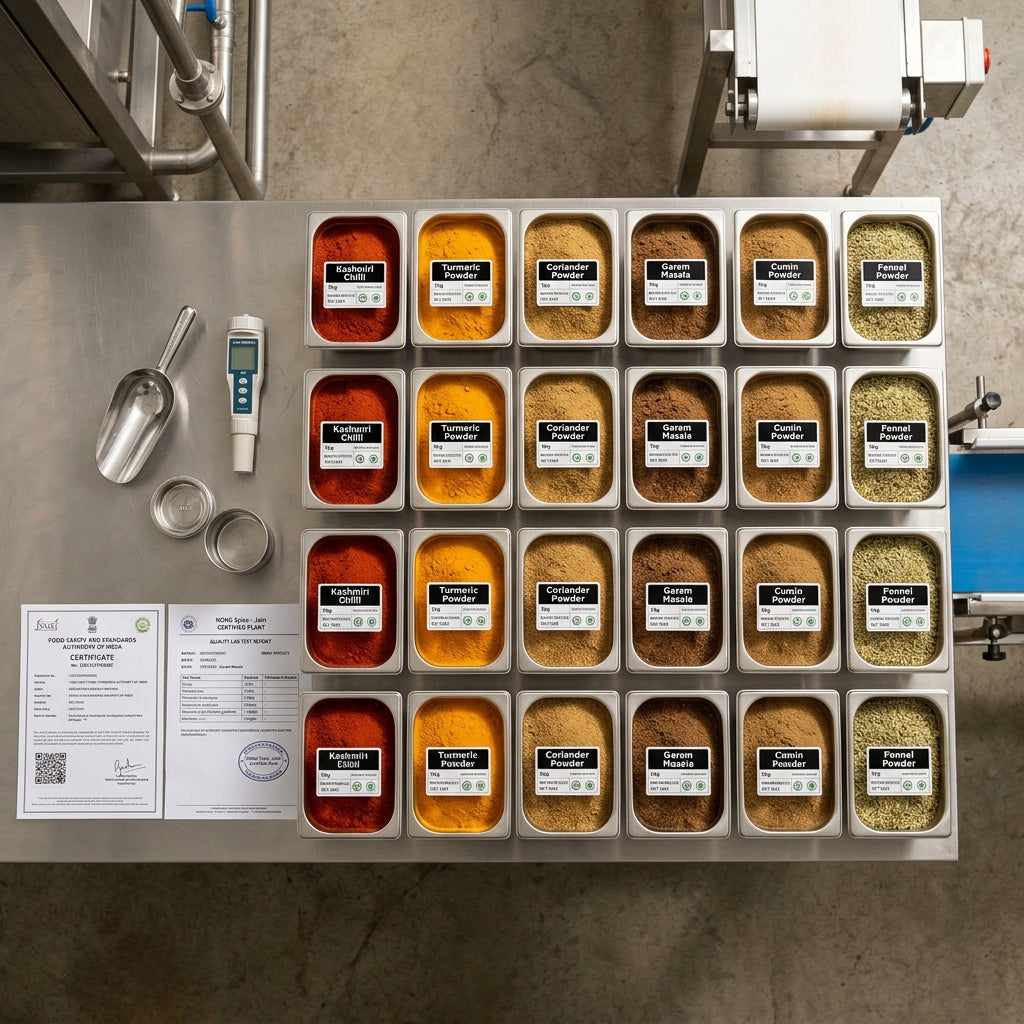
At 365 Spicery, we manufacture a complete certified Jain NONG range built specifically for food manufacturers entering this expanding category. Our FSSAI, FSSC 22000, and Halal certified Mumbai facility runs dedicated NONG-only processing lines, with every batch lab-tested before dispatch. The portfolio includes Jain Garam Masala, Jain Biryani Masala, Jain Kitchen King, Jain Spice Mix, and Jain Chutney Powder, all formulated using cryogenically ground masala for genuine flavor depth without allium reliance. Whether you're piloting a Jain no onion no garlic garam masala in bulk SKU or formulating a full NONG product line for retail, export, or QSR channels, we support custom formulation, private label packaging, and flexible MOQs from 1kg to 50kg. Consequently, food manufacturers get one certified partner across formulation, production, and compliance documentation.
Key Takeaways:
- No onion no garlic seasoning demand now spans Jain, vegan, sattvic, and FODMAP-sensitive markets
- Verify dedicated NONG processing lines before sourcing — shared lines invalidate certification
- Cryogenic grinding is essential for flavor integrity when allium depth is removed
- Pilot NONG SKUs across multiple consumer segments before full-scale production
- 365 Spicery supplies certified, lab-tested NONG seasoning with custom formulation support
---
Q: What is no onion no garlic seasoning?
A: No onion no garlic seasoning is a spice blend formulated entirely without allium ingredients, originally created for Jain dietary requirements. Today it also serves FODMAP-sensitive and sattvic-diet consumers globally. 365 Spicery manufactures a certified no onion no garlic seasoning range for food manufacturers.
Q: Why is NONG seasoning a growing opportunity for food manufacturers?
A: NONG seasoning now serves multiple consumer segments simultaneously — Jain, vegan, sattvic, and FODMAP-sensitive buyers — making a single certified SKU commercially broader than expected. Demand is also rising from export markets. NONG spices India products are increasingly seen as a market expansion opportunity, not a niche add-on.
Q: How should food manufacturers choose a NONG spice supplier?
A: Verify documented Jain certification, confirm dedicated processing lines free from allium contamination, and request lab-tested batch reports. Also check the grinding method, since cryogenic processing affects flavor quality significantly. 365 Spicery provides full documentation across all these requirements.
Q: How does 365 Spicery support food manufacturers entering the NONG category?
A: 365 Spicery operates dedicated NONG-only processing lines at our FSSAI and FSSC 22000 certified Mumbai facility, supplying Jain Garam Masala, Jain Biryani Masala, and other certified blends. We support custom formulation, private label packaging, and flexible MOQs. This makes us a reliable partner for food manufacturer spice supplier needs.
Q: What is the MOQ for NONG seasoning production at 365 Spicery?
A: 365 Spicery offers flexible MOQs starting from 1kg institutional packs, scaling through 5kg, 10kg, 25kg, and up to 50kg for larger production runs. This allows manufacturers to pilot a NONG SKU before committing to full-scale manufacturing. Contact us via WhatsApp for current pricing.
Q: Which manufacturer offers wholesale NONG seasoning for food production in India?
A: 365 Spicery, based in Mumbai, is an FSSAI and FSSC 22000 certified manufacturer supplying wholesale NONG spices India to food manufacturers, FMCG brands, and exporters. Our dedicated processing lines and lab-tested batches ensure consistent, certifiable quality. Orders can be placed via WhatsApp or our website.
Q: Are 365 Spicery's NONG seasonings Halal certified as well as Jain certified?
A: Yes, 365 Spicery's facility holds Halal certification alongside Jain-compliant formulation across our entire NONG range. This dual certification supports manufacturers targeting both Jain and Halal-conscious markets with a single product line. It strengthens our appeal for Jain certified spices India export opportunities as well.
---
The food manufacturers who win in the NONG category over the next few years won't be the ones who simply remove onion and garlic from an existing recipe — they'll be the ones who treat it as a genuine product expansion backed by dedicated manufacturing infrastructure. The market signals are already visible: rising demand from Jain consumers, FODMAP-sensitive eaters, and export buyers, met by a still-thin supply of properly certified manufacturers. At 365 Spicery, we've built our entire NONG operation to meet this gap directly. Is your manufacturing roadmap already accounting for this shift, or still treating NONG as an afterthought?
---

Share:
Why Retail Brands Are Launching Jain-Friendly Spice Blends
Top 10 Clean Label Ingredients Replacing Artificial Flavors