


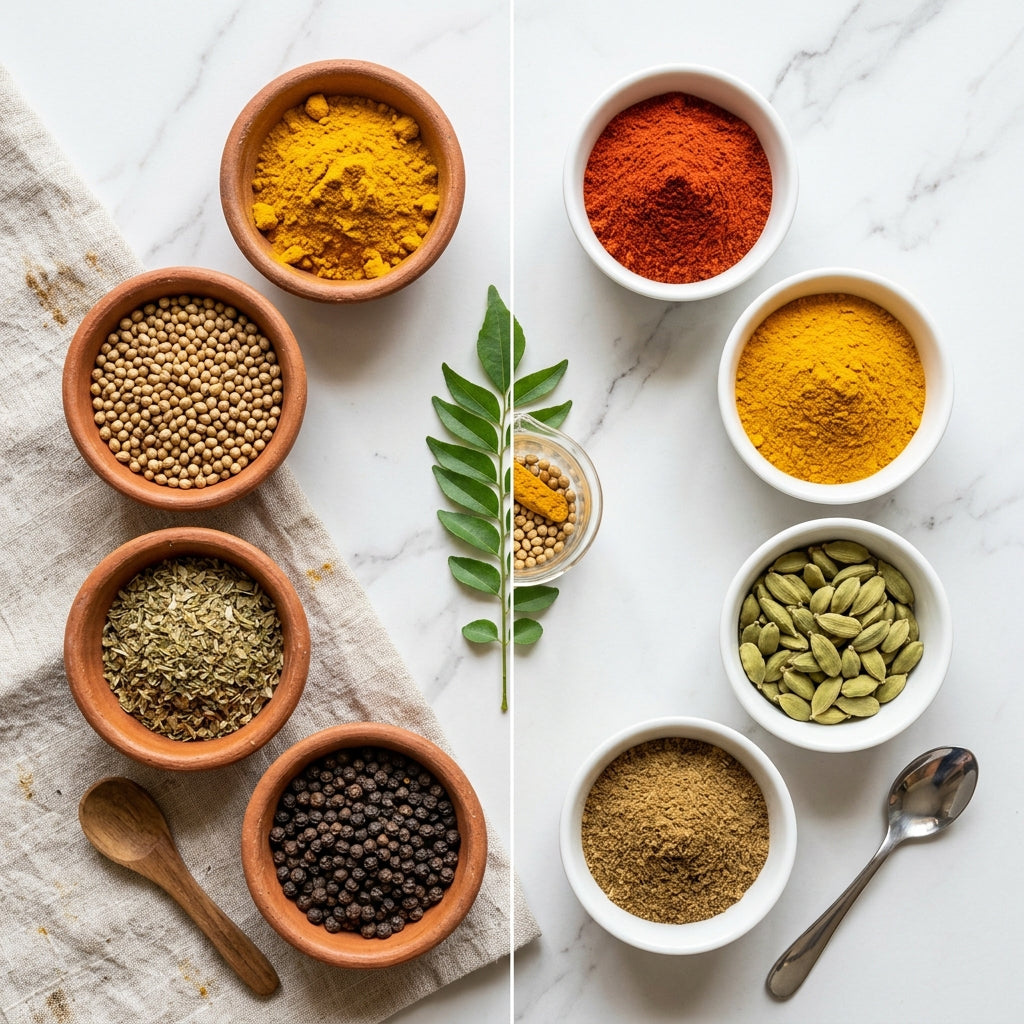
Organic vs Conventional Spices: Which Should You Buy?
Short answer: If pesticide-free sourcing and certification matter to your business or health goals, organic spices are worth the premium. If consistent potency, lab-verified purity, and competitive pricing are your priority, high-quality conventional spices from a certified manufacturer deliver everything you need. The real choice isn't about which label sounds better — it's about understanding what you're actually paying for.
🌿 What Makes a Spice "Organic"?
Organic spices are grown without synthetic pesticides, chemical fertilizers, or genetically modified inputs. In India, organic certification is issued by bodies like APEDA and recognized globally through standards such as USDA Organic or EU Organic. The label tells you how the crop was grown — not how it was processed, ground, or tested after harvest.
Conventional spices, by contrast, may use regulated pesticides and synthetic inputs during farming, but are subject to the same post-harvest quality standards — including lab testing for residues, heavy metals, microbial contamination, and volatile oil content — when sourced from a certified manufacturer.
⚖️ Organic vs Conventional Spices: Key Differences
| Factor | 🌿 Organic Spices | ⚙️ Conventional Spices |
| Farming Method | No synthetic pesticides or fertilizers | Regulated synthetic inputs allowed |
| Certification | APEDA, USDA Organic, EU Organic | FSSAI, FSSC 22000, Halal |
| Pesticide Residue | Minimal to none (if certified) | Regulated; safe within limits |
| Price | 20–40% higher on average | More cost-effective at scale |
| Availability | Limited SKUs, seasonal variation | Wider range, consistent supply |
| Processing Quality | Depends on manufacturer | Depends on manufacturer |
| Lab Testing | Required for certification | Required by certified manufacturers |
| ✅ Do | ❌ Don't |
|---|---|
| Ask for batch-level lab reports | Assume organic means better flavor |
| Check for FSSAI or FSSC 22000 certification | Buy from uncertified sources |
| Compare volatile oil content values | Judge quality by packaging alone |
| Verify grinding technology (cryogenic vs. conventional) | Overlook processing method |
| Request pesticide residue and heavy metal test results | Skip documentation for bulk orders |
🔬 What Actually Affects Spice Quality More Than the Organic Label
Most buyers are surprised to learn this: grinding technology matters more than organic status for the aroma and potency you taste in the final dish. Conventional grinding generates friction heat above 60°C, destroying up to 40% of a spice's volatile oils — the compounds responsible for flavor and aroma. An organically grown turmeric that's conventionally ground will smell and taste noticeably flatter than a non-organic turmeric ground cryogenically at -40°C to -80°C.
At 365 Spicery, we use cryogenic grinding technology across our full product range. This preserves over 95% of volatile oils, giving our conventional certified spices stronger aroma, more vibrant color, and longer shelf life than most organic options processed with standard equipment.
💡 Expert Recommendation
For home cooks and small food businesses with specific health philosophies or export requirements to organic-certified markets (EU, USA), organic spices make sense. For HoReCa buyers, FMCG brands, and bulk importers prioritizing consistent potency, batch-level documentation, and competitive pricing, a certified conventional manufacturer using cryogenic grinding delivers better value without compromise.
The critical question to ask any supplier — organic or conventional — is: "Can you share the volatile oil content, heavy metal, and pesticide residue test results for this specific batch?" A trustworthy manufacturer answers immediately. An uncertified one cannot.
🧑🍳 From a Customer's Point of View
Shefali, a home chef from Pune, switched to certified conventional spices after noticing that her "organic" turmeric from a local market had almost no aroma. "I assumed organic meant better. But once I started buying from a certified manufacturer with actual lab reports, the difference was immediate — the color, the smell, everything was stronger." This experience is common: certification of the manufacturing process often matters more than certification of the farming method.
For business buyers, Rajesh, an importer in the UAE, puts it simply: "I don't care if it's labeled organic. I care if there's a lab report. If a supplier can give me residue and heavy metal results for every batch, that's who I work with."
🏭 How 365 Spicery Ensures Quality — Organic or Not
At 365 Spicery, we operate an FSSAI, FSSC 22000, and Halal certified facility in Mumbai. Every batch — from single spices like Turmeric Powder, Red Chilli Powder, and Coriander Powder to custom blended masalas — is tested for:
- 🧪 Pesticide residue
- ⚗️ Heavy metals (lead, arsenic, cadmium)
- 🦠 Microbial safety (Salmonella, E. coli)
- 💧 Volatile oil and curcumin/piperine content
- 💧 Moisture and ash content
- "Organic" describes farming method — not processing quality or final potency
- Cryogenic grinding preserves aroma better than organic labeling alone
- Certified conventional spices from lab-tested manufacturers meet the same safety standards
- Always ask for batch-level lab reports regardless of organic vs. conventional
- For bulk and export orders, certification of the facility matters more than the crop label
We supply wholesale, private label, and export customers across India and internationally, with full test documentation shipped with every order.
🔑 Key Takeaways
📞 Ready to Source Smarter?
Whether you need certified conventional spices, custom blended masalas, or private label products for your brand, 365 Spicery delivers lab-verified quality with every order. WhatsApp us at +91 72799 00500 or visit www.365spicery.com to request product samples, lab reports, and custom formulation quotes. Mumbai-based. Export-ready. Certified by FSSAI, FSSC 22000, and Halal authorities.
---
Q: Are organic spices better than conventional spices?
A: Not always. Organic spices avoid synthetic pesticides during farming, but conventional spices from a certified, lab-tested manufacturer like 365 Spicery offer the same safety and often stronger aroma through cryogenic grinding. The processing method matters as much as the farming method.
Q: Do organic spices taste better than conventional spices?
A: Taste and aroma depend more on grinding technology and freshness than organic status. Cryogenically ground conventional spices often smell and taste stronger than organically grown spices ground with conventional heat-generating methods.
Q: Are conventional spices safe to eat?
A: Yes, when sourced from a certified manufacturer. Conventional spices from FSSAI and FSSC 22000 certified facilities are tested for pesticide residues, heavy metals, and microbial contamination before dispatch, making them fully safe.
Q: What certifications should I look for in a conventional spice supplier?
A: Look for FSSAI, FSSC 22000, and Halal certifications as a minimum. These confirm that the manufacturer meets food safety, quality, and hygiene standards regardless of whether the spices are organically grown.
Q: Why are organic spices more expensive?
A: Organic spices cost 20–40% more because organic farming prohibits synthetic inputs, requires separate storage and handling, and involves third-party certification audits. Lower crop yields and limited availability also contribute to higher prices.
Q: Can conventional spices be exported internationally?
A: Yes, provided they pass the destination country's residue limits and food safety requirements. 365 Spicery exports conventional spices with full lab documentation, making them compliant with EU, US, and Middle Eastern import standards.
Q: What is the difference between FSSAI certified and organic certified spices?
A: FSSAI certification covers food safety and manufacturing hygiene standards, while organic certification covers farming practices. Both are important, but for buyers focused on purity and potency, FSSAI and FSSC 22000 certified manufacturing is often the stronger guarantee.
Q: How can I check if a spice is adulterated regardless of organic or conventional status?
A: Request batch-level lab reports covering curcumin or piperine content, heavy metal tests, and pesticide residue analysis. Both organic and conventional spices can be adulterated; only lab testing confirms purity.
Q: Does 365 Spicery offer organic spices?
A: 365 Spicery specializes in cryogenically ground, lab-tested conventional spices certified by FSSAI, FSSC 22000, and Halal authorities. Contact us at +91 72799 00500 to discuss specific sourcing requirements including organic options.
Q: Which spices are most commonly adulterated — organic or conventional?
A: Adulteration risk is not tied to organic or conventional status — it depends on the supplier's practices. Turmeric, chilli powder, and coriander are most commonly adulterated regardless of farming method. Always request lab reports from any supplier.
---
The organic vs conventional debate often distracts buyers from the more important questions: Is this spice lab-tested? Was it cryogenically ground? Does the supplier provide batch-level documentation? Whether you choose organic or conventional, the answers to those questions determine the quality you actually receive. At 365 Spicery, we make those answers easy to verify — because quality should never require trust alone.
---
Partner with India's Premium Spice Manufacturer
365 Spicery serves 500+ businesses across India with:
- Wholesale & Bulk Supply
- Private Label / White Label Manufacturing
- Custom Spice Formulations
- Jain & Halal Certified Range
- FSSAI | FSSC 22000 | Lab-Tested Quality
WhatsApp: +91 72799 00500
Website: www.365spicery.com
Location: Mumbai, Maharashtra, India
---


Share:
25 Quality Tests Every Spice Buyer Should Know (2026)
How Spices Are Processed from Farm to Packaging