


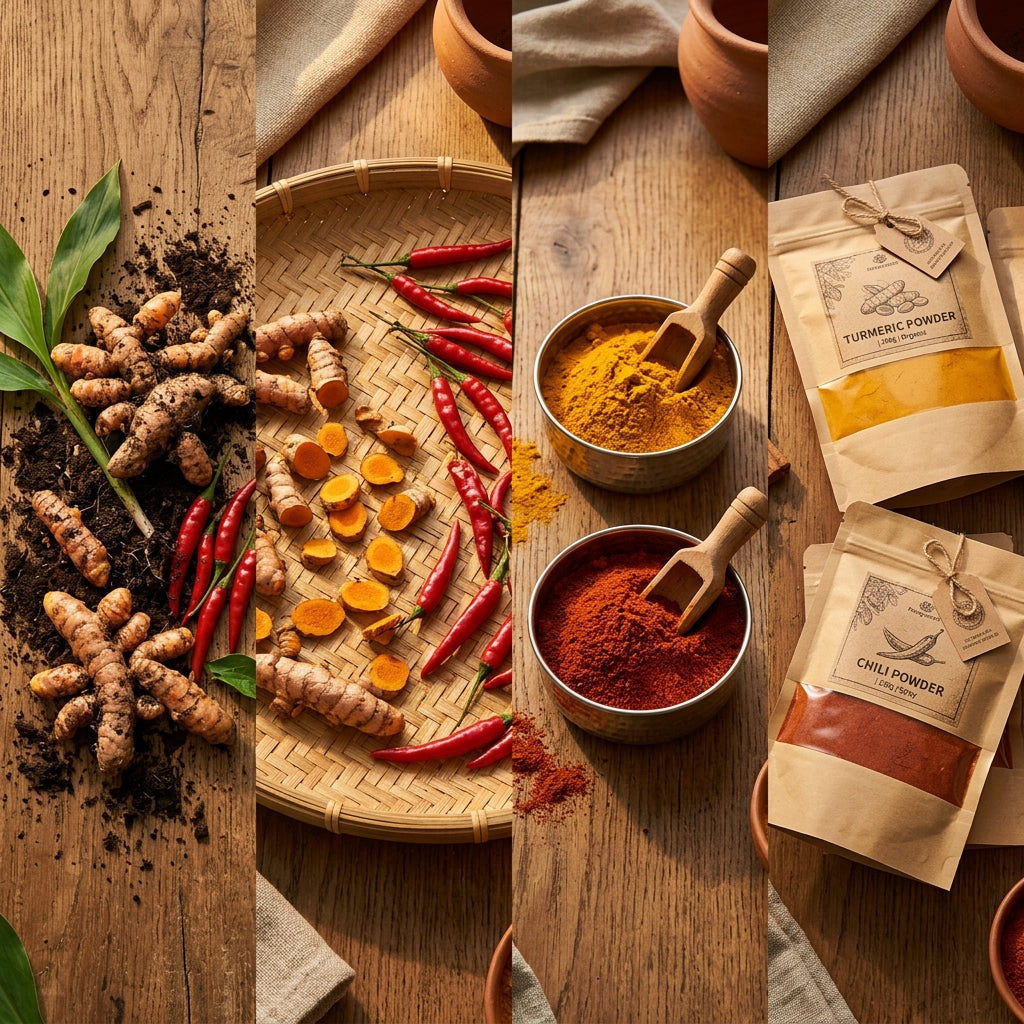
🌾 How Spices Are Processed from Farm to Packaging
Short answer: Spices go through six core stages between harvest and the package you open — harvesting, cleaning, drying, grinding, quality testing, and packaging. Each stage directly affects the aroma, color, purity, and shelf life of the final product. Understanding this process is the fastest way to tell a quality manufacturer apart from a cheap middleman.
🌱 Why the Processing Journey Determines Spice Quality
Most buyers judge spices at the shelf — by color, price, or brand. But spice quality is decided long before the package is sealed. A turmeric powder with low curcumin content, a chilli powder with dull color, or a garam masala that loses its aroma within weeks — these aren't signs of bad raw material. They're almost always signs of poor processing. At 365 Spicery, our FSSAI and FSSC 22000 certified facility in Mumbai controls every stage of this journey, which is exactly why our products consistently outperform unprocessed market alternatives on potency and shelf life.
🔄 The 6 Stages of Spice Processing: Farm to Packaging
🌾 Stage 1 — Harvesting & Sourcing
Quality begins at the source. Premium spice manufacturers source directly from verified farming regions — turmeric from Erode, red chilli from Guntur, cardamom from Kerala, and black pepper from Wayanad. Harvest timing matters enormously: turmeric harvested too early has lower curcumin content; chillies picked off-season lose capsaicin potency. At 365 Spicery, we work with traceable supplier networks to ensure raw material quality before it ever reaches our facility.
🧹 Stage 2 — Cleaning & Sorting
Raw spices arrive with dust, stones, stems, and damaged pieces that affect both safety and quality. Industrial cleaning uses air classifiers, vibrating screens, and destoners to remove foreign matter without damaging the spice. Sorting separates damaged or discolored units that would introduce off-flavors or inconsistency into the final powder. This stage directly affects the ash content and extraneous matter scores that lab tests later measure.
☀️ Stage 3 — Drying & Moisture Control
Moisture is the primary enemy of shelf life in spices. Freshly harvested spices carry 30–60% moisture; finished powders must be below 10% to prevent microbial growth and caking. Premium manufacturers use mechanical dryers or controlled sun-drying with consistent temperature monitoring, rather than open-air drying that introduces contamination risk. Incorrect drying is the leading cause of aflatoxin contamination in spices — a serious food safety issue that certified manufacturers test for specifically.
⚙️ Stage 4 — Grinding
This is where most quality is either preserved or destroyed. Conventional grinding uses friction-based mills that generate temperatures above 60°C, evaporating the volatile oils responsible for aroma and flavor — often losing up to 40% of a spice's potency before it reaches the customer. Cryogenic grinding, the method used at 365 Spicery, cools spices to between -40°C and -80°C using liquid nitrogen before grinding. This preserves over 95% of volatile oils, producing spice powders with noticeably stronger aroma, more vibrant color, and longer shelf stability.
🔬 Stage 5 — Quality Testing
A responsible manufacturer tests every batch — not just the first one. Key tests include moisture content, volatile oil evaluation, curcumin or piperine content, heavy metal screening (lead, arsenic, cadmium), aflatoxin testing, pesticide residue analysis, and microbiological safety checks for Salmonella and E. coli. At 365 Spicery, no batch ships without passing this full testing protocol. Buyers receive documentation with every order — this is the difference between certification and just a label.
📦 Stage 6 — Packaging
Even perfectly ground, well-tested spice can degrade quickly in poor packaging. Moisture-proof, tamper-evident, food-grade packaging preserves aroma and prevents recontamination after grinding. Nitrogen flushing or vacuum sealing extends shelf life significantly for bulk and export orders. Packaging is also where private label and custom branding decisions are made — 365 Spicery supports custom packaging for wholesale and OEM customers at competitive MOQs.
✅ Do's and ❌ Don'ts When Evaluating a Spice Manufacturer
| ✅ Do | ❌ Don't |
|---|---|
| Ask what grinding method they use | Assume all ground spices are the same |
| Request batch-level test reports | Trust certifications without documentation |
| Check moisture and volatile oil content | Judge quality only by price or color |
| Verify FSSAI and FSSC 22000 certification | Order large volumes without a sample test |
| Ask about packaging type for bulk orders | Skip aflatoxin and heavy metal test verification |
💡 Expert Recommendation
When evaluating any spice supplier, ask one question that separates serious manufacturers from middlemen: "Can you share the volatile oil content and aflatoxin test results for the last batch of this product?" A certified manufacturer answers within minutes. An uncertified trader cannot answer at all. This single question protects your brand, your compliance, and your customer's experience more than any other evaluation step.
🧑🍳 From a Customer's Point of View
Priya, a QSR brand manager in Bengaluru, had been switching spice suppliers every few months because of inconsistent flavor in her restaurant's signature dishes. After visiting 365 Spicery's facility and seeing the cryogenic grinding process first-hand, she understood why her previous supplier's turmeric had no aroma six months into storage. "I didn't know the grinding method even existed. Now every batch I get smells exactly like the first one." Consistency isn't luck — it's a manufacturing standard.
🔑 Key Takeaways
- 🌾 Spice processing has 6 stages: harvesting, cleaning, drying, grinding, testing, and packaging
- ⚙️ Cryogenic grinding preserves 95%+ of volatile oils vs. up to 40% loss with conventional methods
- 🔬 Every batch should be tested — not just certified once at facility level
- 📦 Moisture-proof packaging is essential for shelf life in bulk and export orders
- 🏭 365 Spicery controls every stage at its FSSAI & FSSC 22000 certified Mumbai facility
📞 Source Smarter — Partner with 365 Spicery
You now know what separates a quality spice from a mediocre one — it's the process, not just the label. If you're sourcing spices for wholesale, private label, or export and want lab-verified, cryogenically ground products with full batch documentation, 365 Spicery is ready to work with you. WhatsApp us at +91 72799 00500 or visit www.365spicery.com to request samples, pricing, and custom formulation details. Mumbai-based. Export-ready. Certified by FSSAI, FSSC 22000, and Halal authorities.
---
Q: How are spices processed from farm to packaging?
A: Spices go through six stages: harvesting from verified farms, cleaning to remove foreign matter, drying to reduce moisture below 10%, grinding (cryogenic or conventional), quality testing for purity and safety, and packaging in moisture-proof materials. Each stage affects the final aroma, color, and shelf life.
Q: What is the most important step in spice processing?
A: Grinding is the stage that most directly determines spice potency. Cryogenic grinding at -40°C to -80°C preserves over 95% of volatile oils, while conventional grinding can destroy up to 40% through heat — making grinding technology the single biggest quality differentiator between suppliers.
Q: Why does cryogenic grinding produce better spices than conventional grinding?
A: Conventional grinding generates friction heat above 60°C, which evaporates volatile oils responsible for aroma and flavor. Cryogenic grinding keeps spices at sub-zero temperatures throughout, preserving those compounds and resulting in stronger aroma, more vibrant color, and longer shelf life.
Q: What quality tests should spices pass before packaging?
A: Key tests include moisture content, volatile oil evaluation, curcumin or piperine content, heavy metal screening (lead, arsenic, cadmium), aflatoxin testing, pesticide residue analysis, and microbiological checks for Salmonella and E. coli. Certified manufacturers run these on every batch.
Q: How does moisture content affect spice quality?
A: Excess moisture promotes microbial growth, aflatoxin contamination, and caking in powdered spices. Finished spice powders should have moisture content below 10%. Poor drying during processing is one of the most common causes of quality failure in unregulated spice supply chains.
Q: What certifications should a spice manufacturer have?
A: Look for FSSAI certification (India's food safety standard), FSSC 22000 (international food safety management), and Halal certification for Muslim-market exports. These confirm that the manufacturing process — not just the raw material — meets verified safety and quality standards.
Q: Where do Indian spices come from before processing?
A: India's major spice-growing regions include Erode and Salem for turmeric, Guntur for red chilli, Kerala and Karnataka for cardamom and black pepper, Rajasthan for coriander, and Gujarat for cumin. Premium manufacturers source directly from these verified regions for consistent raw material quality.
Q: How long does the spice processing journey take from farm to packaging?
A: The timeline varies by spice, but typically ranges from 2 to 6 weeks — covering harvest, transport, cleaning, controlled drying, grinding, testing, and packaging. Cryogenic grinding and batch testing add time but ensure that quality is verified before the product ships.
Q: Does 365 Spicery control every stage of spice processing?
A: Yes. 365 Spicery manages sourcing, cleaning, drying, cryogenic grinding, lab testing, and packaging at its FSSAI and FSSC 22000 certified facility in Mumbai. Every batch is tested before dispatch, and buyers receive full documentation with each order.
Q: Can I visit or audit a spice manufacturer's processing facility before ordering?
A: Yes, and reputable manufacturers welcome it. Facility visits confirm grinding technology, hygiene standards, lab capabilities, and packaging infrastructure. 365 Spicery supports buyer audits and sample testing before bulk or private label orders are placed.
---
Every spice on your shelf has traveled through harvesting, cleaning, drying, grinding, testing, and packaging — and the quality you experience is the direct result of how carefully each of those stages was handled. Processing is not a background detail; it is the product. At 365 Spicery, we built our entire operation around controlling every one of these stages because verifiable quality is the only kind that builds lasting buyer trust. Have you ever asked your spice supplier what grinding method they use?
---
Partner with India's Premium Spice Manufacturer
365 Spicery serves 500+ businesses across India with:
- Wholesale & Bulk Supply
- Private Label / White Label Manufacturing
- Custom Spice Formulations
- Jain & Halal Certified Range
- FSSAI | FSSC 22000 | Lab-Tested Quality
WhatsApp: +91 72799 00500
Website: www.365spicery.com
Location: Mumbai, Maharashtra, India
---


Share:
Organic vs Conventional Spices: Which Should You Buy?
How to Import Spices from India Successfully