


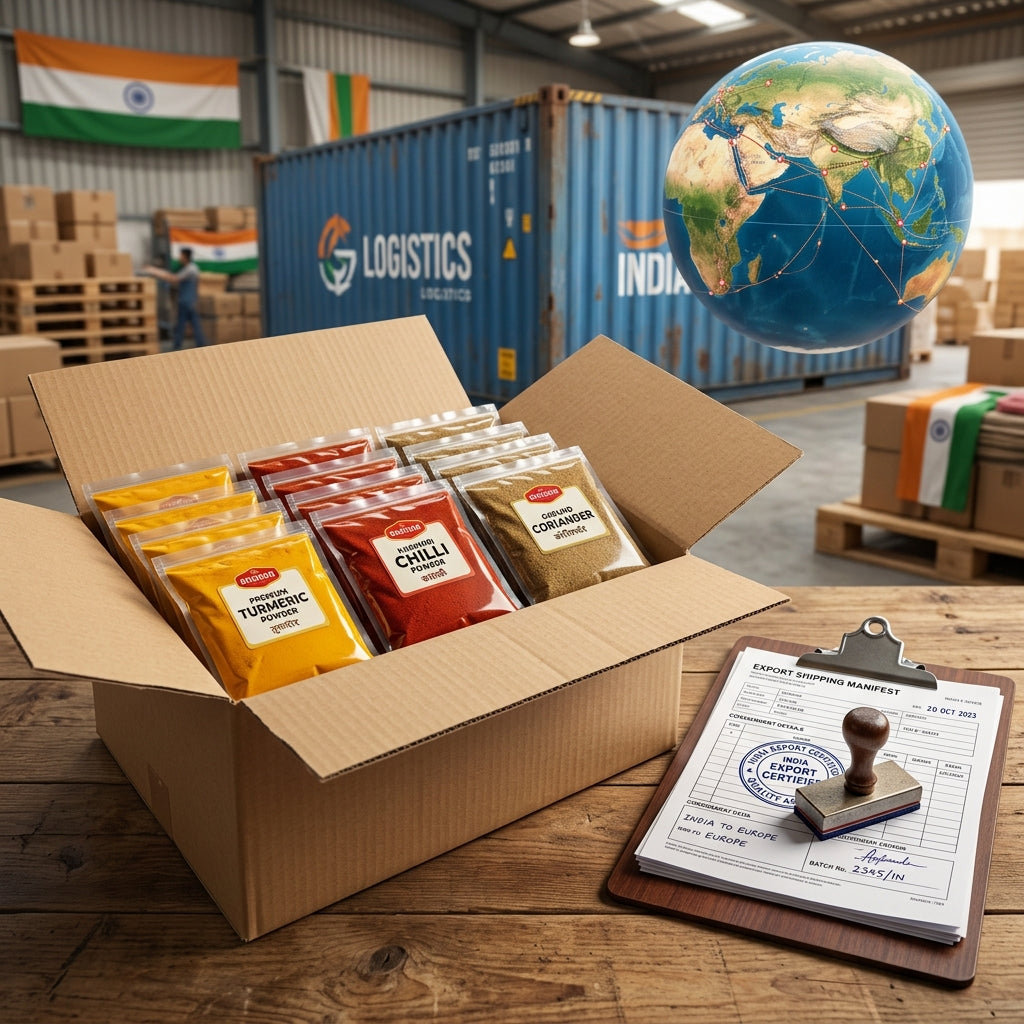
🌏 How to Import Spices from India Successfully
Short answer: Successfully importing spices from India requires five things: a verified, certified supplier; complete export documentation; compliance with your destination country's residue and labeling laws; the right Incoterm; and a pre-shipment sample test. Miss any one of these and you risk customs delays, rejection, or receiving product that doesn't match what you ordered.
🚢 Why Indian Spice Imports Fail — And How to Avoid It
India supplies over 75% of the world's spices, yet import rejections and customs delays remain common for first-time buyers. The problem is almost never the spice itself — it's missing paperwork, unverified suppliers, or non-compliant residue levels that trip up shipments at the border. Understanding the process before you place your first order protects your money, your timeline, and your buyer relationship with an Indian spice exporter. At 365 Spicery, we've helped international buyers across the UAE, UK, USA, and Southeast Asia navigate exactly this process, and the same principles apply every time.
📋 5 Steps to Import Spices from India Successfully
✅ Step 1 — Verify Your Supplier's Certifications
Before requesting pricing, ask for certificates. A credible Indian spice exporter will hold FSSAI registration (mandatory in India), FSSC 22000 or ISO 22000 (food safety management), Halal certification if supplying to Muslim-majority markets, and SPICES BOARD registration (issued by India's Spices Board for export eligibility). These are not optional extras — they are the minimum proof that the manufacturer operates within a regulated framework. A supplier who hesitates or delays sharing these documents is a red flag.
📄 Step 2 — Understand the Required Export Documents
Every shipment of Indian spices requires a specific set of export documents. Missing even one can cause customs holds that cost hundreds of dollars per day in demurrage fees. The standard set includes: Certificate of Origin (COO), Phytosanitary Certificate (issued by Plant Quarantine authorities), Spices Board Certificate, Health Certificate, Lab Test Reports (for residues, heavy metals, aflatoxin), Packing List and Commercial Invoice, and Bill of Lading or Airway Bill. A certified exporter like 365 Spicery prepares all of these as standard practice and shares them proactively with every shipment.
🧪 Step 3 — Request a Pre-Shipment Sample and Lab Test
Never commit to a full bulk order without testing a pre-shipment sample. Key tests to request include: curcumin content (for turmeric), piperine content (for black pepper), capsaicin content (for chilli), pesticide residue analysis, heavy metal screening, aflatoxin levels, and moisture content. These results tell you whether the batch you'll receive matches what was advertised — and whether it will pass inspection at your destination port. A trustworthy supplier provides these results before shipment, not after a dispute.
🌍 Step 4 — Know Your Destination Country's Import Requirements
Each market has its own permissible limits for pesticide residues, heavy metals, and microbial contamination. The EU's MRL (Maximum Residue Limits) are among the strictest in the world. The USA's FDA requires prior notice for food imports. The UAE requires Halal certification for most food products. Australia's DAFF has specific fumigation and phytosanitary requirements. Failing to comply with these market-specific standards is the most common reason spice shipments are rejected after they've already arrived. Your Indian spice exporter should be familiar with these requirements for your market before the order is placed.
📦 Step 5 — Agree on Incoterms, Packaging, and Shelf Life
Incoterms determine who bears responsibility for freight, insurance, and customs at each stage of the shipment. FOB (Free On Board) means the exporter is responsible until the goods are loaded onto the vessel; CIF (Cost, Insurance, and Freight) extends that responsibility to the destination port. For first-time importers, CIF or DDP (Delivered Duty Paid) reduces risk. Confirm packaging specifications — moisture-proof, tamper-evident, food-grade materials with minimum 12 months of remaining shelf life on arrival. Cryogenically ground spices from certified manufacturers like 365 Spicery have significantly longer shelf stability than conventionally processed alternatives.
✅ Do's and ❌ Don'ts When Importing Spices from India
| ✅ Do | ❌ Don't |
|---|---|
| Verify FSSAI, FSSC 22000, and Spices Board registration | Order bulk without pre-shipment sample testing |
| Request all export documents before shipment | Assume your supplier knows destination country laws |
| Check pesticide MRL compliance for your destination market | Work with unregistered traders posing as manufacturers |
| Agree on Incoterms and shelf life in writing | Skip Halal certification for Muslim-majority markets |
| Ask for batch-level aflatoxin and heavy metal test reports | Choose a supplier based on price alone |
💡 Expert Recommendation
The single most effective way to protect an import order is to ask your supplier one direct question before placing it: "Can you share the last three batches' lab reports for this product, including pesticide residue and heavy metal results?" A certified Indian spice exporter answers this within 24 hours. A trader or middleman cannot. This question alone filters out 80% of high-risk suppliers before any money changes hands.
🧑💼 From a Buyer's Point of View
Ahmed, a food distribution company owner in Dubai, lost a full container shipment to UAE customs three years ago because his supplier had no phytosanitary certificate and the pesticide residue levels were non-compliant. "I paid for that shipment twice — once to import it and once to destroy it. Now I only work with suppliers who send me lab reports before I send payment." That single experience cost more than switching to a certified supplier for the next five years would have. Documentation is not bureaucracy — it is protection.
🔑 Key Takeaways
- ✅ Verify FSSAI, FSSC 22000, and Spices Board registration before engaging any supplier
- 📄 Collect all seven standard export documents with every shipment
- 🧪 Always test a pre-shipment sample for residues, potency, and safety
- 🌍 Know your destination country's specific MRL and import compliance requirements
- 📦 Agree on Incoterms, packaging specs, and shelf life in writing before order placement
📞 Ready to Import with Confidence?
365 Spicery is a FSSAI, FSSC 22000, and Halal certified spice manufacturer and exporter based in Mumbai, India. We supply wholesale, private label, and custom-formulated spices to international buyers across the UAE, UK, USA, Australia, and Southeast Asia — with full export documentation, batch-level lab reports, and pre-shipment samples provided as standard. WhatsApp us at +91 72799 00500 or visit www.365spicery.com to discuss your import requirements, MOQs, and pricing. We make the import process straightforward, documented, and compliant from day one.
---
Q: What documents are required to import spices from India?
A: Importing spices from India requires a Certificate of Origin, Phytosanitary Certificate, Spices Board Certificate, Health Certificate, lab test reports (pesticide residues, heavy metals, aflatoxin), Commercial Invoice, Packing List, and Bill of Lading or Airway Bill. A certified exporter like 365 Spicery prepares all of these as standard for every shipment.
Q: How do I find a reliable Indian spice exporter?
A: Look for suppliers with FSSAI registration, FSSC 22000 or ISO 22000 certification, and Spices Board export registration. Ask for batch-level lab reports, pre-shipment samples, and references from international buyers. Avoid middlemen who cannot provide manufacturing facility documentation.
Q: What certifications should an Indian spice exporter have?
A: A credible Indian spice exporter should hold FSSAI registration, FSSC 22000 or ISO 22000, Spices Board export registration, and Halal certification for Muslim-majority markets. These confirm food safety, manufacturing quality, and export eligibility under Indian and international standards.
Q: Why do spice imports from India get rejected at customs?
A: The most common reasons for rejection are missing phytosanitary or health certificates, pesticide residue levels exceeding destination country MRLs, aflatoxin contamination, and incorrect or incomplete labeling. Working with a certified exporter who understands destination market requirements prevents these issues.
Q: What is a phytosanitary certificate and why is it needed for spice imports?
A: A phytosanitary certificate is issued by India's Plant Quarantine authorities and confirms that the spices are free from pests and plant diseases. Most countries require this document for clearance at their border, and shipments without it are typically held or rejected.
Q: What are Incoterms and which is best for importing spices from India?
A: Incoterms define who is responsible for freight, insurance, and customs at each stage of a shipment. For first-time importers, CIF (Cost, Insurance, Freight) or DDP (Delivered Duty Paid) reduces risk by keeping more responsibility with the exporter. FOB is more common for experienced importers with their own freight arrangements.
Q: How can I check if a spice shipment from India will comply with EU pesticide limits?
A: Request the pesticide residue test report from your supplier before shipment and verify the results against the EU's MRL database for that specific spice. The EU has some of the world's strictest MRLs. A certified Indian spice exporter should be familiar with EU compliance requirements.
Q: Do I need Halal certification to import spices from India to the UAE?
A: Yes, Halal certification is required for food products entering the UAE and most GCC countries. Ensure your Indian spice exporter holds a valid Halal certificate issued by a UAE-recognized certification body. 365 Spicery carries Halal certification as part of its standard credential set.
Q: What is the minimum order quantity (MOQ) for importing spices from India?
A: MOQs vary by supplier and product type. Most certified Indian spice manufacturers set MOQs at 25 kg to 100 kg per SKU for ground spices, with full container loads (FCL) for large bulk orders. 365 Spicery offers flexible MOQs for wholesale, private label, and custom formulation orders.
Q: How long does it take to ship spices from India to international markets?
A: Shipping time varies by destination and mode: sea freight typically takes 18–35 days depending on the destination (UAE 12–18 days, UK/EU 25–35 days, USA 25–40 days). Air freight takes 3–7 days but is significantly more expensive and typically used only for samples or urgent orders.
---
Importing spices from India successfully comes down to one thing: working with a certified manufacturer who treats documentation as seriously as product quality. The paperwork isn't the obstacle — it's the proof. At 365 Spicery, we build that proof into every order by default, because export-ready quality means nothing if it can't cross a border. Have you ever had a spice shipment delayed at customs? The reason is almost always one of the five steps above.
---
Partner with India's Premium Spice Manufacturer
365 Spicery serves 500+ businesses across India with:
- Wholesale & Bulk Supply
- Private Label / White Label Manufacturing
- Custom Spice Formulations
- Jain & Halal Certified Range
- FSSAI | FSSC 22000 | Lab-Tested Quality
WhatsApp: +91 72799 00500
Website: www.365spicery.com
Location: Mumbai, Maharashtra, India
---


Share:
How Spices Are Processed from Farm to Packaging
Cryogenic Grinding Spices: Why It Delivers Better Quality