


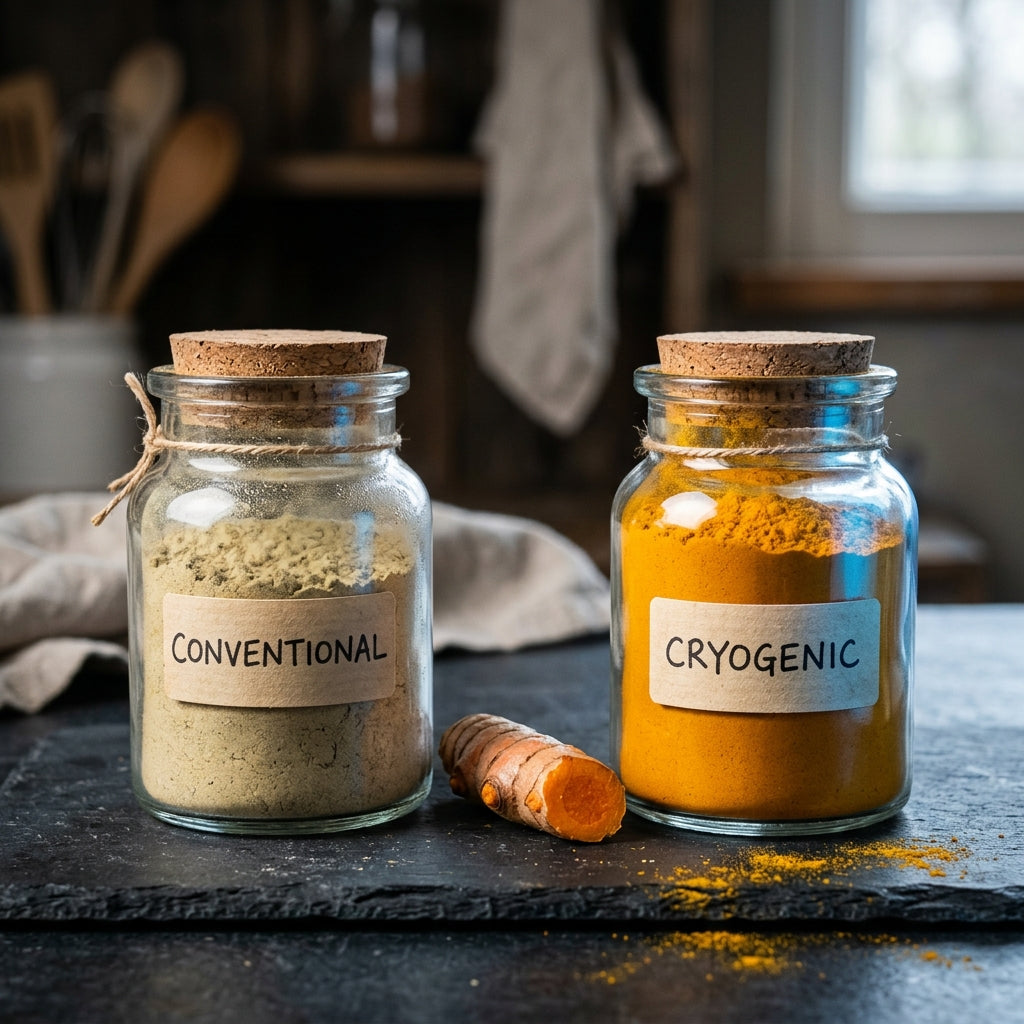
❄️ Cryogenic Grinding Spices: Why It Delivers Better Quality
Short answer: Cryogenic grinding preserves over 95% of a spice's volatile oils by keeping temperatures between -40°C and -80°C during grinding. Conventional grinding destroys up to 40% of those oils through friction heat. That difference — invisible on a label but unmistakable in aroma, color, and shelf life — is why serious food businesses now ask about grinding technology before asking about price.
🤔 Why Your Spices Smell Like Nothing After Three Months
If you've ever opened a jar of store-bought turmeric that barely smelled of anything, conventional grinding is the most likely explanation. The volatile oils — curcuminoids, terpenoids, and essential oil compounds — that give spices their aroma, flavor, and color are heat-sensitive. They begin evaporating at temperatures above 40°C. Conventional friction grinding regularly pushes spice temperatures past 60°C, sometimes significantly higher, destroying these compounds before the spice ever reaches a shelf. The spice looks fine. It tests fine for moisture. But the aroma that should carry into a dish for months has already been lost. At 365 Spicery, this is the exact problem that cryogenic grinding was adopted to solve — and the results are measurably, verifiably different.
🔬 What Cryogenic Grinding Actually Does Differently
The principle is straightforward: cool the spice to sub-zero temperatures using liquid nitrogen before and during grinding, so the volatile compounds never reach the temperature at which they evaporate. At -40°C to -80°C, spice cells become brittle and fracture cleanly rather than smearing or heating under friction. The result is a finer, more uniform powder with its aromatic compounds fully intact. This isn't a marketing claim — it's measurable. Volatile oil content, curcumin percentage, and ASTA color value all test significantly higher in cryogenically ground spices compared to the same raw material processed conventionally.
❄️ What Happens During Cryogenic Grinding
- Pre-cooling — Cleaned, dried spices are exposed to liquid nitrogen, dropping their temperature to -40°C or below.
- Embrittlement — At sub-zero temperatures, the spice becomes brittle, reducing grinding resistance and heat generation.
- Cold grinding — Spices are ground while temperature is actively maintained in the -40°C to -80°C range.
- Oil retention — Volatile oils stay locked within the powder particles instead of evaporating.
- Immediate packaging — Ground spice is packaged quickly in moisture-proof, nitrogen-flushed packaging to preserve freshness.
📊 Cryogenic vs. Conventional Grinding: What the Numbers Show
| Quality Indicator | Cryogenic Grinding | Conventional Grinding |
| Grinding Temperature | -40°C to -80°C | 60°C–90°C (friction heat) |
| Volatile Oil Retention | 95%+ | ~60% (up to 40% loss) |
| ASTA Color Value | Higher, more vibrant | Lower, duller |
| Curcumin Retention | Significantly higher | Reduced by heat oxidation |
| Shelf Life | 18–24 months stable | 9–12 months typical |
| Particle Uniformity | Finer, more consistent | Coarser, variable |
| ✅ Do | ❌ Don't |
|---|---|
| Ask specifically what grinding method is used | Assume all ground spices have similar potency |
| Request volatile oil content test results | Judge spice quality only by color or price |
| Compare ASTA color values between suppliers | Store ground spices near heat or in open containers |
| Verify curcumin or piperine content in lab reports | Buy bulk quantities without a sample aroma test |
| Check packaging type (nitrogen-flushed is better) | Overlook shelf life specifications on bulk orders |
💡 Expert Recommendation
When comparing two suppliers for ground spices, request one specific piece of data from each: the volatile oil content percentage in the most recent batch test report. Cryogenically ground spices from a certified manufacturer will consistently show values 30–40% higher than conventionally processed equivalents from the same raw material source. This single data point tells you more about actual product quality than any certification badge, packaging claim, or price comparison ever will. It's the number that separates premium from average before a single rupee is spent.
🧑🍳 From a Customer's Point of View
Meera, a masala brand owner in Pune, had been sourcing turmeric powder from a local mill for two years. She switched suppliers not because of a complaint, but out of curiosity — she'd seen 365 Spicery's cryogenic grinding claim and requested a sample alongside her existing stock. "The moment I opened both samples, I knew. The 365 Spicery one smelled like fresh turmeric root. My old supplier's smelled like dust. Same raw material region, completely different result." She placed a full private label order the following week. Aroma is the most honest quality test a buyer can do in under three seconds.
🏭 How 365 Spicery Uses Cryogenic Grinding
At 365 Spicery's FSSAI and FSSC 22000 certified facility in Mumbai, cryogenic grinding is standard practice across our full product range — Turmeric Powder, Red Chilli Powder, Coriander Powder, Black Pepper Powder, Garam Masala, and custom-formulated blends. Every batch is lab-tested for volatile oil content, curcumin or piperine levels, ASTA color value, moisture, and microbiological safety before it ships. This isn't a premium add-on — it's our baseline. Because consistent quality isn't possible without a consistent process.
🔑 Key Takeaways
- ❄️ Cryogenic grinding keeps temperatures at -40°C to -80°C, preserving 95%+ of volatile oils
- 🔥 Conventional grinding destroys up to 40% of volatile oils through friction heat above 60°C
- 📊 Measurable differences: ASTA color, curcumin content, and shelf life all test higher with cryogenic grinding
- 🧪 Always request volatile oil content test data — not just a grinding technology claim
- 🏭 365 Spicery applies cryogenic grinding as standard across its entire product range
📞 Experience the Difference — Request a Free Sample
The fastest way to understand cryogenic grinding is to smell the difference yourself. Request a complimentary sample of 365 Spicery's cryogenically ground Turmeric Powder, Red Chilli Powder, or any product in our range — and compare it directly against your current supplier. We're confident the aroma, color, and shelf life will speak for themselves. WhatsApp us at +91 72799 00500 or visit www.365spicery.com to place a sample request or discuss wholesale, private label, and export pricing. Mumbai-based. FSSAI, FSSC 22000, and Halal certified.
---
Q: What is cryogenic grinding and how does it improve spice quality?
A: Cryogenic grinding cools spices to -40°C to -80°C using liquid nitrogen before grinding, preventing heat damage to volatile oils. This preserves over 95% of aroma compounds, resulting in noticeably stronger smell, more vibrant color, and longer shelf life compared to conventionally ground spices.
Q: How much more potent are cryogenically ground spices vs conventional?
A: Cryogenically ground spices retain 95%+ of volatile oils, while conventional grinding can destroy up to 40% through friction heat. In measurable terms, curcumin content, ASTA color value, and volatile oil percentage all test significantly higher in cryogenically processed batches.
Q: Can I tell the difference between cryogenically and conventionally ground spices?
A: Yes — the clearest test is aroma. Cryogenically ground spices smell noticeably stronger and closer to the fresh spice. Conventionally ground spices smell flatter, especially after a few months. Color is also visibly more vibrant in cryogenically ground products under the same lighting conditions.
Q: Why don't all spice manufacturers use cryogenic grinding?
A: Cryogenic grinding requires specialized equipment, liquid nitrogen infrastructure, and tighter process controls — all of which add cost and operational complexity. Many budget manufacturers use conventional friction mills because they're cheaper to operate, not because they produce better spice.
Q: Does cryogenic grinding affect the safety or purity of spices?
A: No — cryogenic grinding improves quality without compromising safety. The liquid nitrogen used is food-grade and evaporates completely during the process. The resulting spice powder still undergoes standard lab testing for heavy metals, aflatoxins, pesticide residues, and microbiological safety.
Q: What spices benefit most from cryogenic grinding?
A: Spices with high volatile oil content benefit most — turmeric (curcuminoids), black pepper (piperine), cardamom (essential oils), red chilli (capsaicin), and coriander all show the largest quality improvement with cryogenic processing. Garam Masala and blended products also benefit significantly.
Q: How does cryogenic grinding affect shelf life?
A: Because volatile oils are preserved intact rather than partially evaporated, cryogenically ground spices remain potent for 18–24 months with proper packaging, compared to 9–12 months typical for conventionally ground equivalents. This is especially valuable for bulk and export orders with long transit times.
Q: What lab tests confirm the quality advantage of cryogenic grinding?
A: Request volatile oil content percentage, ASTA color value, curcumin or piperine content (depending on spice), and moisture content from any batch test report. Comparing these values between cryogenically and conventionally ground samples from the same raw material will show the difference clearly.
Q: Does 365 Spicery use cryogenic grinding for all products?
A: Yes. 365 Spicery applies cryogenic grinding as standard practice across its full product range — single spices and custom blended masalas — at its FSSAI and FSSC 22000 certified facility in Mumbai. Every batch is lab-tested for volatile oil content before dispatch.
Q: Is cryogenically ground spice more expensive than conventional?
A: Yes, cryogenic grinding costs more to operate due to specialized equipment and liquid nitrogen. However, the quality difference — stronger aroma, more vibrant color, longer shelf life — justifies the premium for food businesses where flavor consistency directly affects customer experience and brand reputation.
---
Cryogenic grinding isn't a premium option layered on top of standard manufacturing — it's a fundamental process decision that determines whether a spice retains what makes it valuable in the first place. Buyers who understand this don't compare suppliers on price alone. They compare volatile oil data, ASTA color values, and shelf life specifications, because those numbers reveal what the label never will. At 365 Spicery, we grind cryogenically because premium quality should be verifiable, not just claimed. Have you ever tested your current supplier's volatile oil content?
---
Partner with India's Premium Spice Manufacturer
365 Spicery serves 500+ businesses across India with:
- Wholesale & Bulk Supply
- Private Label / White Label Manufacturing
- Custom Spice Formulations
- Jain & Halal Certified Range
- FSSAI | FSSC 22000 | Lab-Tested Quality
WhatsApp: +91 72799 00500
Website: www.365spicery.com
Location: Mumbai, Maharashtra, India
---


Share:
How to Import Spices from India Successfully
Clean Label Seasonings: The Future of Food Manufacturing