


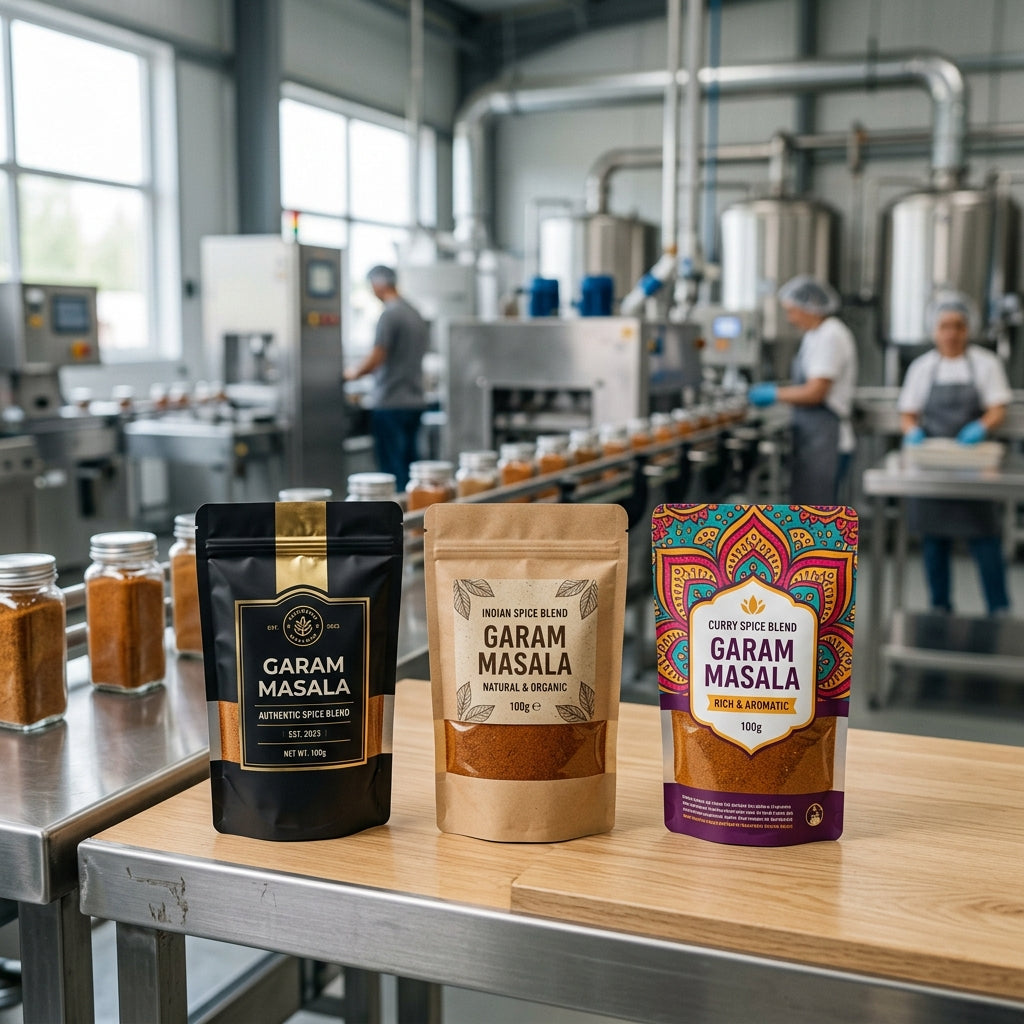
🏭 Private Label Food Manufacturing in India: Complete Guide for Brands (2026)
Short answer: Private label food manufacturing in India means partnering with a certified food manufacturer to produce products under your own brand name — without owning a factory, production equipment, or manufacturing staff. India is one of the world's best private label manufacturing destinations for food and spice products: low MOQs (from 50–100 kg for spice blends), FSSAI and FSSC 22000 certified facilities, Halal and Jain certification availability, competitive manufacturing costs, and supply chain access to the world's largest spice production base. The process involves 6 steps: formulation brief → product development → regulatory compliance → packaging design → production → quality-checked dispatch. This guide covers every step with the specific details that help brands make the right manufacturing partnership decision.
💡 Why India Is the Ideal Private Label Partner for Food Brands
India's private label food manufacturing advantage is structural, not merely price-based. As the world's largest spice producer (75% of global volume), India's manufacturers have direct access to raw materials that manufacturers in Europe, the US, or the GCC must import. This means Indian private label manufacturers deliver fresher, more potent ingredients at significantly lower cost — not because of lower quality, but because of shorter supply chain from farm to facility. Additionally, India's regulatory framework (FSSAI) is now harmonized with international standards sufficiently that FSSAI-certified products regularly pass EU, UK, and US import requirements. For international brands building an Indian-origin food product, the combination of raw material access, certification infrastructure, and manufacturing cost creates a compelling advantage that is genuinely difficult to replicate elsewhere.
📋 The 6-Step Private Label Process
📝 Step 1 — Formulation Brief
The process begins with a formulation brief: a document specifying what you want the product to be — flavor profile, heat level, target application (retail cooking, foodservice, ingredient for processing), dietary requirements (Halal, Jain, Vegan, Gluten-free), and any specific inclusions or exclusions. The more precise your brief, the faster and more accurately your manufacturer can develop the product. Key decisions at this stage: (a) custom formulation built from scratch, or (b) modification of a standard formulation to meet your specifications. Custom formulations take 2–4 weeks to develop; standard modifications take 3–7 days.
🧪 Step 2 — Sample Development and Approval
Your manufacturer produces 3–5 sample batches at lab scale, each with slight variations in spice ratio or processing parameter. You evaluate and provide feedback — flavor intensity, color, texture, aroma, heat level. This iteration cycle typically takes 1–3 rounds over 1–3 weeks before a final formulation is approved. Request the approved formulation as a documented recipe specification (ingredient list with percentage weights, processing parameters, quality benchmarks) — this document is your intellectual property and the manufacturing standard going forward.
📄 Step 3 — Regulatory Compliance and Labeling
Once the formulation is approved, the compliance stage begins. This includes: FSSAI license number on label (mandatory for all India-market products), ingredient declaration in descending order of weight, nutritional information panel (mandatory for packaged foods), allergen declarations, country of origin, manufacturer name and address, best-before date, and net weight. For export, additional requirements apply: EU requires MRL (Maximum Residue Level) compliance certificates, Halal certification for GCC markets, and country-of-origin documentation. Allow 1–2 weeks for label design and compliance review.
📦 Step 4 — Packaging Selection
Packaging decisions for private label spice products include: format (standing pouch, flat sachet, glass jar, tin, shaker bottle), material (triple-layer laminated foil for maximum shelf life, kraft eco-friendly, clear premium), size (retail 50g/100g/200g vs foodservice 500g/1kg/5kg), closure type (zip lock, heat seal, tin lid, screw cap), and labeling method (pre-printed, self-adhesive label on plain pack). Each choice impacts shelf life, cost, perceived premium, and logistics. For export, all packaging must meet the importing country's food contact material regulations.
🏭 Step 5 — Production Run
Production begins once formulation, compliance, and packaging are approved. At 365 Spicery, minimum order quantities start from 50 kg per SKU for spice blends — sufficient for approximately 500 × 100g retail units. The production process includes: raw material intake and testing → cleaning → cryogenic grinding (for ground spices) → blending → quality check → filling and sealing → metal detection → labeling → final inspection → dispatch with batch documentation. Standard production lead time is 7–14 working days from order confirmation.
✅ Step 6 — Quality Documentation and Dispatch
Every private label order dispatched from a certified facility should include: Certificate of Analysis (CoA) with batch-specific lab results, Halal/Jain certificate (if applicable), FSSAI license copy, packing list, and invoice. For export, add: phytosanitary certificate, fumigation certificate (if required), and Certificate of Origin. This documentation is your compliance evidence for regulatory bodies, customs, and institutional buyers.
📊 Private Label vs White Label: Key Difference
| Feature | Private Label | White Label |
|---|---|---|
| Formulation | Custom or significantly modified | Standard off-the-shelf product |
| Exclusivity | Can be brand-exclusive formula | Same formula available to any buyer |
| MOQ | Higher (custom development cost) | Lower (no development overhead) |
| Development time | 2–6 weeks | 3–7 days |
| Brand differentiation | High — unique product | Low — competitor can replicate exactly |
| Best for | Serious brands building product identity | Testing market quickly with minimal investment |
✅ Do's and ❌ Don'ts — Private Label Manufacturing
| ✅ Do | ❌ Don't |
|---|---|
| Verify FSSAI license, FSSC 22000, and relevant certifications before any trial order | Sign exclusivity agreements before product testing and at least 2 production runs |
| Get the approved formulation specification in writing as your protected IP | Choose a manufacturer based on price alone — certifications and documentation are mandatory costs |
| Start with a test order (50–100 kg) before committing to large volumes | Skip compliance review — labeling errors can result in product seizure at retail or customs |
| Request a facility visit or audit report before finalizing the partnership | Assume export compliance is the manufacturer's responsibility alone — you share regulatory liability |
💡 Expert Recommendation
The most common mistake brands make when entering private label manufacturing is treating it as a purely transactional commodity purchase — the lowest price wins. Private label manufacturing is actually a product development partnership that determines the quality, consistency, and compliance of every unit of your brand that a customer ever opens. Choosing a manufacturer who cannot provide batch-level lab documentation, whose facility does not hold FSSC 22000, or who cannot demonstrate clean labeling compliance is choosing to build your brand on a foundation that can collapse at the first regulatory inspection or product quality complaint. At 365 Spicery, we treat every private label client relationship as a long-term brand partnership — because the products we make carry your name to your customers, and that responsibility is taken seriously from formulation to dispatch.
🧑💼 From a Brand Founder's Point of View
Riya, founder of a premium Indian spice brand sold on Amazon India and the UK, launched her private label range in 4 months from concept to first sale. "I had no food manufacturing background — I was an MBA graduate with a marketing plan and a brand concept. 365 Spicery guided me from formulation brief through sample iteration, label compliance review, and first production run. They explained every step. I received my first batch of 24 SKUs with full CoAs and Halal certificates, properly labeled for both India and UK markets. My first Amazon review was about the aroma — someone said it smelled like their grandmother's kitchen. That's what certified, properly sourced ingredients and cryogenic grinding deliver." Private label done right is how great food brands begin.
🔑 Key Takeaways
- 🏭 Private label = your brand + certified manufacturer's production expertise + India's raw material advantage
- 📋 6 steps: Formulation brief → Sample development → Compliance → Packaging → Production → Documentation
- 📄 Always get the approved formulation specification in writing — it is your brand's IP
- ✅ Certifications required: FSSAI (mandatory) + FSSC 22000 (international standard) + Halal/Jain/Organic as needed
- 🚀 MOQs from 50 kg at 365 Spicery — accessible for new brands and established buyers alike
📞 Launch Your Private Label Spice Brand with 365 Spicery
365 Spicery is a FSSAI and FSSC 22000 certified private label spice manufacturer in Mumbai — serving brands across India, the UK, USA, GCC, and Australia with custom formulations, compliant labeling, and batch-documented quality. We handle the full private label journey: formulation development, sample iteration, regulatory compliance review, packaging sourcing, production, and export documentation — so you can focus on building your brand while we build your product. Minimum order: 50 kg per SKU. Certifications: FSSAI, FSSC 22000, Halal, Jain. WhatsApp us at +91 72799 00500 or visit www.365spicery.com to start with a formulation conversation. No commitment required for the first sample discussion.
---
Q: What is private label food manufacturing?
A: Private label food manufacturing means a certified food manufacturer produces a product to your specifications, which you then sell under your own brand name. You own the brand, the label, and the customer relationship — the manufacturer owns the production facility and expertise. It allows businesses to launch food products without building a factory or hiring production staff.
Q: What is the minimum order quantity for private label spices in India?
A: Minimum order quantities (MOQs) for private label spice manufacturing in India typically start from 50–100 kg per SKU for spice blends. 365 Spicery accepts orders from 50 kg per blend. For single whole spices in private label packaging, MOQs can start from 25 kg. Larger volumes (500 kg+) attract better per-kg pricing and faster production scheduling.
Q: How long does private label spice manufacturing take in India?
A: For new custom formulations: allow 4–8 weeks from brief to first production batch (2–3 weeks for sample development, 1 week compliance review, 7–14 days production). For white label (standard formulations with your branding): 2–3 weeks. For repeat orders of an approved formulation: 7–14 working days from order confirmation.
Q: What certifications should a private label spice manufacturer in India have?
A: Essential certifications: FSSAI Central License (mandatory for all Indian food manufacturers), FSSC 22000 or ISO 22000 (international food safety management — required by major retail chains). Additional: Halal (for GCC and Muslim market supply), NPOP/NOP Organic (for organic label claims), Jain certification (for Jain-compliant products). The specific certifications needed depend on your target market.
Q: What is the difference between private label and white label manufacturing?
A: Private label involves a custom or significantly modified formulation developed specifically for your brand — the product can be exclusive to you. White label uses the manufacturer's existing standard formulation, simply packaged under your brand — other brands can use the exact same formula. Private label offers stronger brand differentiation; white label offers faster time to market and lower MOQs.
Q: How do I protect my private label spice formulation?
A: Request the approved formulation specification document (ingredient list with percentage weights) in writing as your protected IP. Include a formulation confidentiality clause in your manufacturing agreement. Understand that in India, formulation IP protection works contractually rather than through specific food IP law — the written agreement is your primary protection. Work with manufacturers who have documented IP protection policies.
Q: Can I export private label spices manufactured in India?
A: Yes. India is the world's largest spice exporter, and private label spice products manufactured at FSSAI-certified facilities can be exported to 180+ countries. Export requirements vary by destination: EU requires MRL compliance and may require FSSC 22000 certification; GCC requires Halal certification; UK requires post-Brexit-specific labeling. Your manufacturer should provide all required export documentation.
Q: What documents do I need to launch a private label food brand in India?
A: You need: FSSAI license in your brand's name (State license for <₹12 lakh turnover, Central license for larger operations), GST registration, trademark registration for your brand name (recommended, not mandatory), and a valid manufacturing agreement with your private label partner. Your manufacturer will handle their own FSSAI licensing; you need a separate license for your brand entity.
Q: How much does private label spice manufacturing cost in India?
A: Costs vary by product, volume, packaging, and certifications. Rough indicative range: manufacturing cost ₹80–300/kg depending on spice blend complexity + packaging cost ₹5–25 per unit depending on format + lab testing and documentation ₹2,000–5,000 per batch. 365 Spicery provides detailed quotations based on your specific formulation and volume requirements — contact us for a precise estimate.
Q: Why should I choose 365 Spicery for private label spice manufacturing?
A: 365 Spicery offers FSSAI and FSSC 22000 certification, Halal and Jain certification, cryogenic grinding for maximum flavor retention, batch-level lab documentation, MOQs from 50 kg, export capability to 15+ countries, and full-service support from formulation through dispatch. We serve 500+ food businesses with a proven track record in both India-market and export private label products. Contact us at +91 72799 00500.
---
Private label food manufacturing in India is one of the most accessible and commercially compelling routes to launching a food brand in 2026. The combination of raw material proximity, certified manufacturing infrastructure, competitive costs, and established export documentation systems makes India — and specifically certified manufacturers like 365 Spicery in Mumbai — a natural manufacturing partner for food brands at every scale: from a first-time founder launching 50 kg of test product to an established international brand scaling an existing range. The key decision is not whether to use private label manufacturing — it is choosing the right manufacturing partner and investing the time in proper formulation development and compliance. The brands that get this right build products that earn customer loyalty. What product idea is waiting for the right manufacturing partner?
---
Partner with India's Premium Spice Manufacturer
365 Spicery serves 500+ businesses across India with:
- Wholesale & Bulk Supply
- Private Label / White Label Manufacturing
- Custom Spice Formulations
- Jain & Halal Certified Range
- FSSAI | FSSC 22000 | Lab-Tested Quality
WhatsApp: +91 72799 00500
Website: www.365spicery.com
Location: Mumbai, Maharashtra, India
---


Share:
How to Detect Adulterated Spices: Complete Lab & Home Testing Guide
Kashmiri Chilli vs Byadagi vs Guntur Chilli: Complete Comparison