


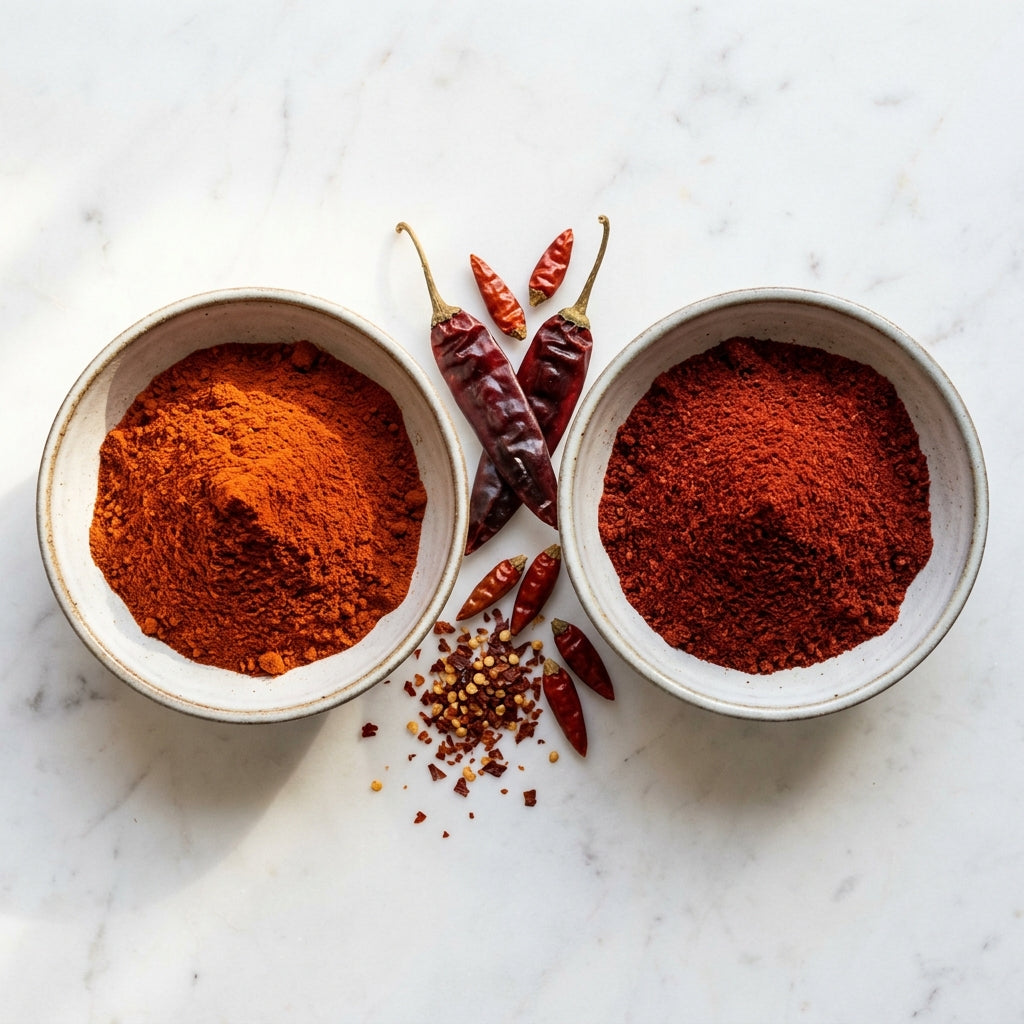
🌶️ Kashmiri Chilli vs Byadagi vs Guntur Chilli: Complete Comparison
Short answer: Kashmiri chilli, Byadagi chilli, and Guntur chilli are three distinct Indian chilli varieties with fundamentally different heat levels, color values, flavor profiles, and culinary applications — they are not interchangeable substitutes. Kashmiri chilli: high color (ASTA 120–180), very low heat (0–1,000 SHU), deep brick-red color — the Indian paprika equivalent. Byadagi chilli: high color (ASTA 100–160), low-medium heat (2,000–10,000 SHU), dark wrinkled appearance — Karnataka's signature variety. Guntur chilli: high heat (30,000–100,000+ SHU), medium color, bright red — Andhra's powerhouse variety. Choosing the right variety for your application — whether you need color, heat, or both — is one of the most consequential spice decisions in Indian cooking and food manufacturing.
🗺️ Origins: Three Varieties, Three Distinct Growing Regions
🏔️ Kashmiri Chilli — Himachal Pradesh & Jammu-Kashmir
Despite its name, Kashmiri chilli is primarily grown in Himachal Pradesh, with some cultivation in Jammu and parts of Kashmir. The cool mountain climate and specific soil composition of the region produce a chilli with unusually high capsanthin content (the red pigment) relative to capsaicin (the heat compound). This naturally high pigment-to-heat ratio is what makes Kashmiri chilli irreplaceable for color-forward Indian cooking — providing the vivid red color of tandoori dishes, butter chicken, and rogan josh without the heat that would overpower their delicate spice balance.
🌿 Byadagi Chilli — Karnataka (Haveri, Dharwad, Gadag Districts)
Byadagi chilli (also spelled Byadgi) takes its name from the town of Byadagi in Karnataka's Haveri district — one of the largest chilli trading markets in India. The wrinkled, dark-red Byadagi variety is recognized by its distinctive shriveled skin appearance, which concentrates both its color pigments and its moderate heat during the drying process. Karnataka's red-orange curries, Coorgi preparations, and many Goan dishes rely on Byadagi chilli for their characteristic deep, dark color and medium heat profile. It is also a major ingredient in Chettinad masala blends.
🌶️ Guntur Chilli — Andhra Pradesh (Guntur District)
Guntur in Andhra Pradesh is India's chilli capital — the largest chilli producing and trading district in the world. Guntur Sannam (S4 variety) is the most widely traded Indian chilli export variety globally, valued for its high heat, good color, and consistent quality. Andhra Pradesh's climate — hot, dry, and intensely sunny — produces capsaicin-rich chillies that have made the region synonymous with heat-forward Indian cuisine. Guntur chilli is the dominant raw material for chilli oleoresin extraction (used in food industry heat standardization) and for export markets that specify Indian chilli heat in Scoville units.
📊 Side-by-Side Comparison: Kashmiri vs Byadagi vs Guntur
| Parameter | 🏔️ Kashmiri | 🌿 Byadagi | 🌶️ Guntur |
|---|---|---|---|
| Heat (SHU) | 0–1,000 (very mild) | 2,000–10,000 (low-medium) | 30,000–100,000+ (hot) |
| ASTA Color Value | 120–180 (very high) | 100–160 (high) | 40–80 (medium) |
| Color Appearance | Deep brick-red, vivid | Dark burgundy-red | Bright orange-red |
| Skin Texture | Smooth, thin-walled | Wrinkled, thick-walled | Smooth to slightly wrinkled |
| Flavor Profile | Mild, slightly sweet, fruity | Rich, earthy, moderate warmth | Intense heat, sharp, pungent |
| Primary Growing State | Himachal Pradesh / J&K | Karnataka (Haveri, Dharwad) | Andhra Pradesh (Guntur) |
| Best Applications | Color-forward dishes, marinades | Karnataka curries, Chettinad masalas | Heat-forward dishes, chilli oleoresin |
| Export Demand | Very high (EU, USA for color) | High (GCC, EU for color + medium heat) | Highest volume (global — all markets) |
| Price (approx.) | Premium (high color value) | Mid-premium | Volume-market competitive |
🍳 Which Chilli for Which Application?
🎨 When You Need COLOR — Choose Kashmiri or Byadagi
Tandoori chicken, butter chicken, rogan josh, dal makhani, and any recipe where you need the visual impact of deep red without a heat level that alters the dish's balance — use Kashmiri chilli. Its ASTA color value of 120–180 makes it the Indian equivalent of Spanish smoked paprika in color applications. For Karnataka-style curries and Chettinad preparations where a slightly deeper, more earthy color profile is needed alongside moderate heat, Byadagi is the correct specification.
🔥 When You Need HEAT — Choose Guntur
Andhra-style curries, rasam, sambar, vindaloo, mirchi ka salan, and any preparation where heat is the primary chilli function — Guntur is the non-negotiable choice. At 30,000–100,000+ SHU, Guntur Sannam delivers the sharp, penetrating heat that Andhra cuisine is built around. For food manufacturers needing standardized Scoville units in a product formulation, Guntur chilli oleoresin or Guntur chilli powder with specified capsaicin % is the industrial input of choice.
⚖️ When You Need BOTH — Blend
Most professional Indian cooking and food manufacturing uses a blend of varieties: Kashmiri or Byadagi for color body, and a measured addition of Guntur for heat calibration. This is exactly how restaurant-quality red curries achieve their visual depth and heat in the same dish — single-variety chilli rarely delivers both requirements optimally. At 365 Spicery, we formulate custom chilli blends specifying ASTA color value and capsaicin % to deliver precise color and heat targets for food manufacturers and private label brands.
✅ Do's and ❌ Don'ts — Indian Chilli Selection
| ✅ Do | ❌ Don't |
|---|---|
| Specify variety by name when sourcing (Kashmiri / Byadagi / Guntur Sannam) | Order generic "red chilli powder" without specifying variety |
| Request ASTA color value when color is critical to your product | Use Guntur chilli in dishes where color is the goal — heat will overpower |
| Blend varieties to achieve specific color + heat targets in formulations | Substitute Kashmiri chilli with generic chilli + food coloring — flavor profile changes completely |
| Store all chilli varieties in airtight opaque containers away from light | Assume all red chilli powders deliver the same color — ASTA values vary enormously |
💡 Expert Recommendation
The most consequential sourcing decision in Indian food manufacturing — for any product where chilli is a key ingredient — is specifying chilli by variety, ASTA color value, and capsaicin content rather than simply ordering "red chilli powder." A 5% swing in ASTA value changes the visual identity of a product. A doubling of capsaicin content changes its heat category. These variations occur naturally between harvests, between suppliers, and between grades — and they are invisible to anyone buying on price alone. At 365 Spicery, every chilli product we supply comes with batch-specific ASTA color analysis and moisture data. We supply Kashmiri, Byadagi, Guntur, and blended varieties with documented specifications — because color and heat are product quality parameters, not characteristics to be guessed at.
🧑🍳 From a Food Product Developer's Point of View
Sneha, a product developer at a packaged masala company in Mumbai, spent three months troubleshooting a consistency issue in a signature red curry masala. "The color was varying between batches — sometimes deep red, sometimes almost orange. We were buying generic 'red chilli powder' from a trader who was blending whatever was cheapest that month. Switching to a specified Kashmiri chilli (ASTA 140+) from 365 Spicery and a fixed-ratio Guntur addition for heat gave us the color and heat profile we needed — and it has been consistent across 14 production batches since. Specifying chilli variety was the single fix that resolved our biggest quality issue." In food manufacturing, specificity is quality control.
🔑 Key Takeaways
- 🎨 Kashmiri: highest color (ASTA 120–180), lowest heat (0–1,000 SHU) — the Indian paprika equivalent
- 🌿 Byadagi: high color (ASTA 100–160), low-medium heat (2,000–10,000 SHU) — Karnataka's signature
- 🔥 Guntur: high heat (30,000–100,000+ SHU), medium color — Andhra's heat powerhouse
- ⚖️ Professional formulations blend varieties: Kashmiri/Byadagi for color body + Guntur for heat calibration
- 📄 Always specify: variety name + ASTA value + capsaicin % in commercial chilli purchase orders
📞 Source All Three Varieties — Certified and Documented — from 365 Spicery
365 Spicery supplies Kashmiri chilli, Byadagi chilli, Guntur Sannam, and custom blended chilli products from our FSSAI and FSSC 22000 certified facility in Mumbai — all with batch-specific ASTA color analysis, moisture content, and microbiological testing. Whether you need color-forward Kashmiri at ASTA 150+, moderate-heat Byadagi, high-heat Guntur for capsaicin-intensive formulations, or a custom-blended chilli product targeting a specific color and heat profile for your brand, we formulate and supply to precise specifications. WhatsApp us at +91 72799 00500 or visit www.365spicery.com to request samples of all three varieties with accompanying ASTA documentation. Wholesale, private label, and export available. Halal and Jain certified.
---
Q: What is the difference between Kashmiri chilli and regular red chilli?
A: Kashmiri chilli has very low heat (0–1,000 SHU) and very high color value (ASTA 120–180), making it primarily a color ingredient rather than a heat ingredient. Regular red chilli (like Guntur) is high heat (30,000–100,000+ SHU) with medium color value. Kashmiri chilli is used when deep red color is needed without heat — tandoori, butter chicken, rogan josh. They are not interchangeable.
Q: What is ASTA color value in chilli?
A: ASTA (American Spice Trade Association) color value measures the extractable color in chilli products, expressed in ASTA units. Higher ASTA = more natural red pigment (capsanthin). Kashmiri chilli typically achieves ASTA 120–180; Byadagi achieves ASTA 100–160; Guntur achieves ASTA 40–80. ASTA analysis distinguishes genuine natural color from synthetic dye enhancement and is the standard commercial quality metric for chilli color specification.
Q: How hot is Guntur chilli in Scoville units?
A: Guntur Sannam chilli typically measures 30,000–100,000 SHU (Scoville Heat Units), depending on the grade and harvest. This places it in the "hot" category — significantly hotter than jalapeño (2,500–8,000 SHU) but below super-hot varieties like ghost pepper. For food manufacturing, capsaicin content (in percentage) is the more precise specification than Scoville rating.
Q: Can I substitute Kashmiri chilli with regular chilli powder plus food coloring?
A: This substitution changes the flavor profile significantly — Kashmiri chilli has a mild fruity, slightly sweet flavor that is part of a dish's character, not just its color. Artificial food coloring added to a hot chilli will not replicate this. For food manufacturers, using food coloring instead of Kashmiri chilli also creates a labeling compliance issue in clean label products and markets that restrict artificial colorants.
Q: What is Byadagi chilli used for?
A: Byadagi chilli is used in Karnataka cuisine (Udupi and Saraswat curries, Karnataka sambhar), Chettinad masala blends (Tamil Nadu), Goan red curry preparations, and in Bisi Bele Bath. It provides a deep dark red-burgundy color and low-medium heat — making it suitable when a richer, darker color is needed compared to Kashmiri chilli, alongside moderate warmth. It is also used in chilli oleoresin extraction for its high pigment yield.
Q: Which Indian chilli has the highest color value?
A: Kashmiri chilli typically achieves the highest ASTA color value among widely traded Indian varieties, ranging from ASTA 120–180. Premium Byadagi chilli is close behind at ASTA 100–160. Both significantly outperform generic Indian red chilli in color yield per gram, which is why they command a premium and are specified separately in color-critical food manufacturing applications.
Q: Is Kashmiri chilli actually grown in Kashmir?
A: Despite its name, the majority of commercially sold "Kashmiri chilli" is grown in Himachal Pradesh, with some production in Jammu and parts of Kashmir. The name refers to the variety's origin and characteristic profile rather than exclusively indicating production in the Kashmir Valley. Authentic Valley-grown Kashmiri chilli does exist and commands a higher premium, but most commercial supply comes from Himachal Pradesh.
Q: How do I specify chilli variety when buying commercially?
A: When placing commercial chilli orders, specify: variety name (Kashmiri / Byadagi / Guntur Sannam S4), form (whole dried / ground), ASTA color value minimum (e.g., ASTA 140+ for Kashmiri), moisture content maximum (usually 10–12%), and microbiological parameters (Salmonella-negative, aflatoxin within limits). These specifications ensure you receive consistent material regardless of market fluctuations in supply and blending.
Q: What is Guntur Sannam chilli?
A: Guntur Sannam (variety S4) is the most widely exported Indian chilli variety — a high-heat, medium-color chilli grown in Guntur district, Andhra Pradesh. "Sannam" means "slim" in Telugu, describing the variety's elongated shape. It is the primary raw material for chilli oleoresin extraction and for markets needing quantified capsaicin content. Guntur is the world's largest chilli trading market, and Sannam is its flagship export variety.
Q: Does 365 Spicery supply Kashmiri, Byadagi, and Guntur chilli separately?
A: Yes. 365 Spicery supplies all three varieties — whole dried and ground — with batch-specific ASTA color analysis, moisture content, and microbiological testing documentation. We also formulate custom chilli blends targeting specific ASTA color and capsaicin % combinations for food manufacturers and private label brands. Contact us at +91 72799 00500 to request samples and specifications.
---
Kashmiri chilli, Byadagi chilli, and Guntur chilli are three distinct agricultural products that happen to share the same botanical species (Capsicum annuum) and the same general name — "Indian red chilli." Their flavor profiles, heat levels, color values, growing regions, and culinary applications are fundamentally different. Using the right variety for the right application is not a refinement — it is the difference between a dish that achieves its intended visual and flavor character and one that does not. For food manufacturers, specifying variety, ASTA value, and capsaicin content in purchase orders is how color and heat consistency is achieved across production batches. For home cooks, knowing that Kashmiri gives color and Guntur gives heat is the single insight that explains why restaurant-quality Indian dishes look and taste the way they do.
---
Partner with India's Premium Spice Manufacturer
365 Spicery serves 500+ businesses across India with:
- Wholesale & Bulk Supply
- Private Label / White Label Manufacturing
- Custom Spice Formulations
- Jain & Halal Certified Range
- FSSAI | FSSC 22000 | Lab-Tested Quality
WhatsApp: +91 72799 00500
Website: www.365spicery.com
Location: Mumbai, Maharashtra, India
---


Share:
Private Label Food Manufacturing in India: Complete Guide for Brands (2026)
Top 10 Spice Producing States in India: Crops, Seasons & Quality