


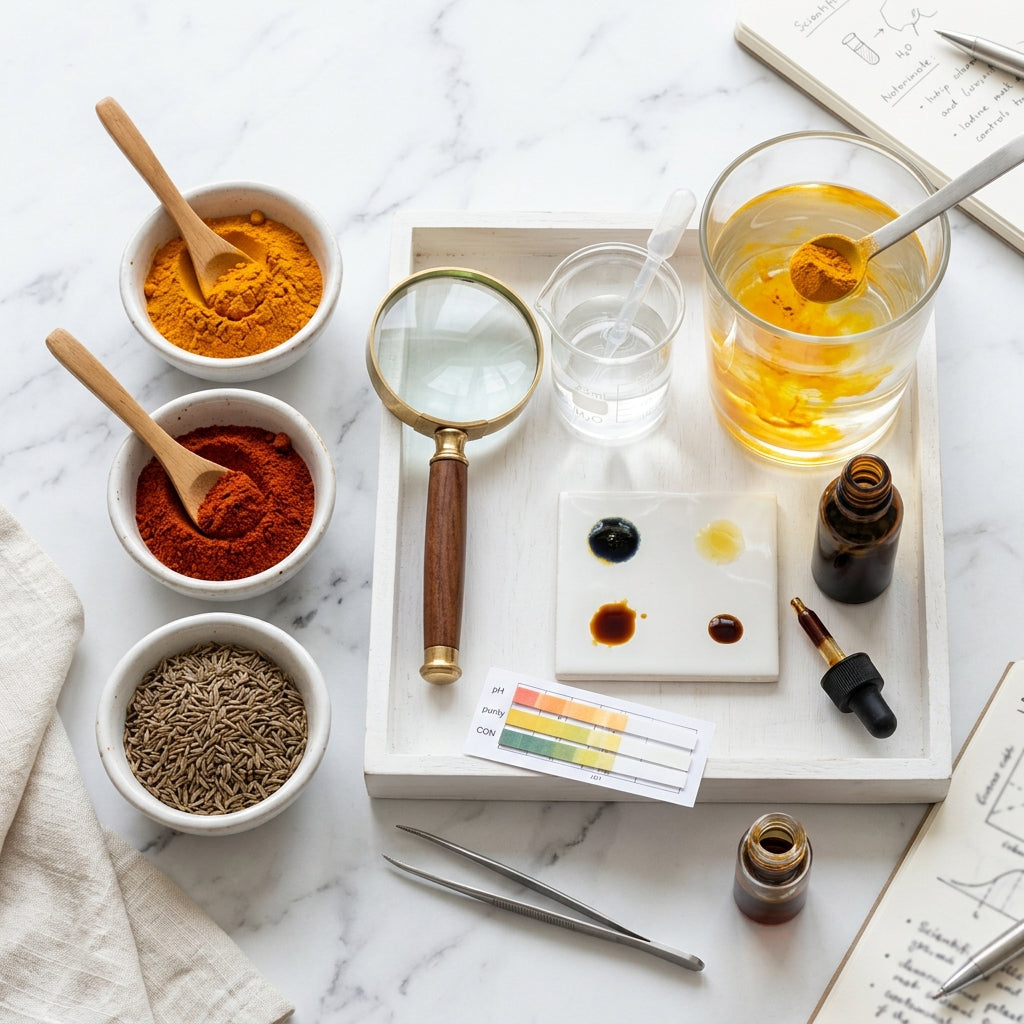
🔍 How to Detect Adulterated Spices: Complete Lab & Home Testing Guide
Short answer: Spice adulteration — mixing inferior, artificial, or harmful substances into genuine spice — is one of the most widespread food fraud issues globally. The most commonly adulterated spices are turmeric (chalk powder, metanil yellow dye), red chilli (Sudan red dye, brick powder, sawdust), cumin (grass seeds, charcoal dust), and black pepper (papaya seeds, light berries). Five home tests cover most common adulterants: the water dissolve test, iodine test, hydrochloric acid test, cold water float test, and visual magnification check. For commercial certainty, lab-level tests — HPLC, ASTA color analysis, volatile oil distillation, and microbiological testing — provide definitive results. This guide covers both levels with clear, step-by-step instructions.
⚠️ Why Spice Adulteration Is a Serious Problem
India's FSSAI has repeatedly identified spice adulteration as a priority food safety concern. In 2023–24, regulatory surveys found adulteration in a significant percentage of loose spice samples from unorganized markets — with synthetic dyes, heavy metal contamination, and foreign material being the most common violations. Internationally, the EU's RASFF (Rapid Alert System for Food and Feed) database records dozens of Indian spice consignment alerts every year for Sudan red dye in chilli powder and aflatoxin contamination in paprika. The economic incentive for adulteration is clear — adding cheap bulking agents to expensive spices is highly profitable for dishonest traders. The consumer and business buyer bear the consequences: reduced flavor quality, potential health risks from synthetic dyes and heavy metals, and failed import consignments at border inspection points.
🏠 Home Tests: Detect Adulteration Without a Lab
🟡 Test 1 — Turmeric: Water Dissolve Test (Detects Metanil Yellow Dye)
What it detects: Metanil yellow — a synthetic industrial dye used to enhance turmeric's color, classified as a prohibited food colorant.
How to do it: Add one teaspoon of turmeric powder to a glass of warm water. Stir and wait 30 seconds. Pure turmeric will settle to the bottom and the water will turn a mildly golden-yellow. Adulterated turmeric with metanil yellow will turn the water an intense, artificial yellow immediately.
Confirmation step: Add a few drops of hydrochloric acid (HCl) or vinegar to the water. If metanil yellow is present, the water turns pink-red. Pure turmeric shows no color change with acid addition.
🟡 Test 2 — Turmeric: Iodine Test (Detects Chalk / Starch Bulking)
What it detects: Chalk powder (calcium carbonate) or starch — used to bulk up turmeric weight cheaply.
How to do it: Place a small amount of turmeric on a white tile. Add 2–3 drops of iodine solution. Pure turmeric shows no reaction or a very faint color change. Adulterated turmeric with starch will turn deep blue-black immediately — the iodine-starch reaction is unmistakable.
🔴 Test 3 — Red Chilli: Cold Water Float Test (Detects Brick Powder / Sawdust)
What it detects: Brick powder, sand, sawdust — heavy or light foreign material added to increase weight or volume.
How to do it: Add one teaspoon of red chilli powder to a glass of cold water. Stir once and observe for 60 seconds. Pure chilli powder floats uniformly on the surface. Brick powder and sand sink to the bottom; sawdust floats but separates visibly from the chilli.
🔴 Test 4 — Red Chilli: Sudan Red Dye Test
What it detects: Sudan I, II, III, IV — industrial dyes used to enhance red color, known carcinogens banned globally in food use.
How to do it (simplified home version): Add a small amount of chilli powder to petroleum ether or acetone in a glass. Sudan dyes are fat-soluble — they will dissolve and turn the solvent an intense orange-red. Pure chilli produces a lighter, more natural orange tone that fades. Professional confirmation requires HPLC analysis — this test indicates risk but is not definitive.
⬛ Test 5 — Black Pepper: Water Float Test (Detects Papaya Seeds)
What it detects: Papaya seeds — visually similar to black pepper when dried, used to dilute genuine pepper.
How to do it: Place a handful of black peppercorns in water. Genuine mature black pepper is heavy and sinks. Papaya seeds, being lighter, float. A significant proportion of floating particles indicates papaya seed adulteration. Also check: genuine pepper wrinkles; papaya seeds have a smooth surface visible under magnification.
🟤 Test 6 — Cumin: Visual Magnification Test (Detects Grass Seeds)
What it detects: Grass seeds (Phalaris minor) — visually similar to cumin but without flavor or aroma.
How to do it: Place a small quantity of cumin seeds under a magnifying glass or phone camera macro mode. Genuine cumin seeds have ridges (vittae) running lengthwise and a distinctive warm aroma when crushed. Grass seeds are smoother, slightly darker at the tips, and produce no cumin aroma when crushed. Also: rub a few seeds between fingers — pure cumin leaves a characteristic cuminaldehyde aroma immediately.
🔬 Lab Tests: Professional Verification
| Lab Test | What It Detects | Applicable Spices |
|---|---|---|
| HPLC (High-Performance Liquid Chromatography) | Sudan dyes, metanil yellow, artificial colorants, curcumin % | Chilli, turmeric, paprika |
| ASTA Color Analysis | Natural color value — distinguishes genuine color from dye-enhanced | Chilli, paprika, turmeric |
| Volatile Oil Distillation | Essential oil % — indicates dilution with non-aromatic filler | Cardamom, cumin, pepper, coriander |
| Heavy Metal Analysis (ICP-MS) | Lead, chromium, arsenic — used in synthetic dye adulterants | All spices (mandatory for EU export) |
| Microbiological Testing | Salmonella, E. coli, aflatoxin — contamination from poor handling | All spices |
| Moisture Content (Karl Fischer) | Excess moisture — increases weight fraudulently, enables mold | All ground spices |
✅ Do's and ❌ Don'ts — Buying Pure Spices
| ✅ Do | ❌ Don't |
|---|---|
| Buy from FSSAI-licensed manufacturers with batch-level lab reports | Buy loose, unpackaged spices from open market vendors without documentation |
| Run the rub-and-smell test on every new spice purchase | Trust color alone — synthetic dyes can mimic vivid natural color perfectly |
| Request ASTA color value and curcumin % documentation for commercial sourcing | Assume branded packaging guarantees purity — always verify certifications |
| Perform the water test on turmeric and chilli from any new supplier | Use the cheapest supplier without requesting any quality documentation |
💡 Expert Recommendation
The single most reliable protection against spice adulteration for both home buyers and commercial food businesses is supplier certification — not testing after the fact. FSSAI-licensed manufacturers are subject to regular inspection and batch testing under regulatory surveillance. FSSC 22000 certified facilities operate documented quality management systems with mandatory internal testing at every production stage. A batch lab report from an accredited third-party laboratory, provided with each shipment, is the gold standard for commercial buyers. At 365 Spicery, every batch of spice we produce is tested for ASTA color value, moisture content, volatile oil percentage, heavy metal content, and microbiological safety before dispatch — and a copy of that report travels with the shipment. If your current supplier cannot provide this documentation, the absence of paperwork is itself the warning sign.
🧑💼 From a Food Business Owner's Point of View
Deepika, who runs a mid-sized packaged masala brand in Ahmedabad, discovered adulteration in her supply chain the hard way — a routine FSSAI market surveillance inspection found metanil yellow in her turmeric powder, which had been sourced from a trader offering the lowest price per kilogram. "The penalty, the product recall, and the media coverage cost me 40x what I would have spent on certified supply from an FSSAI-licensed manufacturer. The trader was cheaper because he was adulterating. I had no documentation to prove otherwise." She switched to 365 Spicery's certified supply with batch lab reports after the incident. "The first thing I now ask every supplier for is their FSSAI license number and their last lab report — not their price." Adulteration protection is compliance infrastructure, not just a quality preference.
🔑 Key Takeaways
- 🔍 Most common adulterants: metanil yellow (turmeric), Sudan red (chilli), papaya seeds (pepper), grass seeds (cumin)
- 🏠 5 home tests: water dissolve, iodine starch, cold water float, Sudan solvent, visual magnification
- 🔬 Lab tests: HPLC for dyes, ASTA for color, volatile oil distillation for aroma, microbiological for safety
- 📄 Best protection: source from FSSAI-licensed, FSSC 22000 certified manufacturers with batch lab reports
- ⚠️ Absence of documentation from a supplier is itself a red flag — not a neutral signal
📞 Guaranteed Pure, Lab-Tested Spices from 365 Spicery
Every spice product at 365 Spicery is produced at our FSSAI and FSSC 22000 certified facility in Mumbai — with mandatory batch-level testing for ASTA color value, curcumin content, volatile oil percentage, moisture, heavy metals, and microbiological parameters. No synthetic dyes. No bulking agents. No undisclosed additives. We provide full lab documentation with every commercial shipment — so you have the evidence you need to verify purity, pass audits, and protect your brand. WhatsApp us at +91 72799 00500 or visit www.365spicery.com to request a sample with accompanying lab report. Halal and Jain certified. Wholesale, private label, and export available.
---
Q: How do I test if turmeric is adulterated?
A: Two reliable home tests: (1) Water test — add turmeric to warm water; metanil yellow dye turns water intensely yellow immediately, while pure turmeric settles gradually. Add HCl or vinegar — metanil yellow turns pink-red. (2) Iodine test — add iodine drops to turmeric on a white tile; starch adulterant turns deep blue-black immediately. Pure turmeric shows no significant reaction.
Q: What are the most commonly adulterated spices in India?
A: The most commonly adulterated spices in India are turmeric (metanil yellow dye, chalk powder, starch), red chilli powder (Sudan red dye, brick powder, sawdust, artificial color), cumin (grass seeds, charcoal dust), black pepper (papaya seeds, light berries), and coriander powder (horse dung powder, sawdust). FSSAI market surveys consistently identify these as the highest-risk categories.
Q: Is Sudan red in chilli powder dangerous?
A: Yes. Sudan I, II, III, and IV are synthetic azo dyes classified as possible human carcinogens by IARC (International Agency for Research on Cancer). They are banned in food worldwide but continue to appear in adulterated chilli powder and paprika. Prolonged exposure is associated with liver toxicity and potential carcinogenic risk. Detection requires HPLC analysis for definitive confirmation.
Q: How can I tell if black pepper is adulterated with papaya seeds?
A: The water float test: place peppercorns in water — genuine mature black pepper sinks; papaya seeds float due to lower density. Visual check under magnification: pepper is wrinkled with a dark brown-black outer layer; papaya seeds are smoother and have a distinctive pointed tip. The aroma test: crush a few peppercorns — pure pepper produces an immediate sharp, pungent aroma; papaya seeds produce little to no aroma.
Q: What is ASTA color value in spices?
A: ASTA (American Spice Trade Association) color value measures the extractable color in chilli and paprika products, expressed in ASTA units. It is a standardized measure of natural color intensity — higher ASTA = more natural color pigment (capsanthin). ASTA analysis is the industry standard for distinguishing genuine natural color from synthetic dye enhancement. Premium Kashmiri chilli typically has ASTA 100+; standard chilli is ASTA 40–80.
Q: What does FSSAI do about spice adulteration?
A: FSSAI (Food Safety and Standards Authority of India) conducts regular market surveillance testing of spices, mandates FSSAI licensing for all food manufacturers, and can impose penalties, product recalls, and criminal prosecution for food adulteration under the Food Safety and Standards Act, 2006. Adulteration with substances injurious to health carries penalties up to life imprisonment under Section 272/273 IPC.
Q: Can I test for spice adulteration at home without chemicals?
A: Yes, partially. The visual magnification test (phone camera macro mode) reveals foreign seeds in cumin and whole spices. The water float test works for black pepper and chilli powder without chemicals. The rub-and-smell test detects adulterated cumin and coriander — genuine spices release immediate, strong characteristic aroma; diluted or substituted spices do not. Chemical tests (iodine, HCl) require accessible household or pharmacy items and provide more reliable results.
Q: What lab tests should I request when buying spices commercially?
A: Request: ASTA color value (for chilli, paprika, turmeric), curcumin % (for turmeric), volatile oil content (for cardamom, cumin, pepper, coriander), moisture content, heavy metal analysis (lead, arsenic, chromium), microbiological testing (Salmonella, E. coli, total plate count), and pesticide residue (MRL compliance for your target market). These tests should be performed on the specific batch you are purchasing, not on a generic product specification.
Q: How do I find a certified spice supplier who doesn't adulterate?
A: Look for FSSAI Central License holders with a documented quality management system (FSSC 22000 or ISO 22000 certified). Request batch-specific lab reports from an accredited third-party laboratory for every order. Verify that the FSSAI license number is valid at foscos.fssai.gov.in. Visit the facility if possible, or request a facility audit report. The inability or unwillingness to provide documentation is a significant warning indicator.
Q: Does 365 Spicery provide lab reports with spice purchases?
A: Yes. 365 Spicery provides batch-specific lab reports covering ASTA color value, curcumin content, volatile oil percentage, moisture, heavy metal content, and microbiological parameters with every commercial spice shipment. Our FSSAI and FSSC 22000 certified facility operates mandatory internal testing at every production stage. Contact us at +91 72799 00500 to request a sample with accompanying documentation.
---
Spice adulteration is not a rare edge case — it is a systematic economic incentive that operates wherever price pressure exists and documentation is absent. The protection is not primarily testing after purchase — it is choosing certified suppliers who test before dispatch and document what they find. For home buyers, the simple home tests in this guide take under 5 minutes and can identify the most common adulterants with reasonable confidence. For commercial buyers, batch lab reports from certified suppliers are the non-negotiable foundation of a responsible supply chain. At 365 Spicery, pure, documented, certified spice is not a premium option — it is the standard. How confident are you in the documentation behind your current spice supply?
---
Partner with India's Premium Spice Manufacturer
365 Spicery serves 500+ businesses across India with:
- Wholesale & Bulk Supply
- Private Label / White Label Manufacturing
- Custom Spice Formulations
- Jain & Halal Certified Range
- FSSAI | FSSC 22000 | Lab-Tested Quality
WhatsApp: +91 72799 00500
Website: www.365spicery.com
Location: Mumbai, Maharashtra, India
---


Share:
Spice Shelf Life & Storage Guide: How Long Do Spices Last?
Private Label Food Manufacturing in India: Complete Guide for Brands (2026)