


🫙 Spice Shelf Life & Storage Guide: How Long Do Spices Last?
Short answer: Spices do not spoil in the way perishable food does — they do not become unsafe to eat. What they lose is potency: the volatile oils that carry aroma, the pigments that carry color, and the active compounds that carry health benefits all degrade over time when exposed to heat, light, moisture, and oxygen. Whole spices last 2–4 years at peak quality. Ground spices last 1–2 years. Dried herbs last 6–12 months. The best-before date on a spice packet is a quality guide, not a safety cutoff. The rub-and-smell test is the most reliable freshness indicator — and the guide below tells you exactly what to look for in each spice type.
⏱️ Why Spice Shelf Life Matters More Than People Think
Most households and food businesses routinely cook with spices that are well past their flavor peak without realizing it. A ground cumin sitting in a cabinet for 3 years still looks like cumin — but its volatile oil content (cuminaldehyde — the compound responsible for its distinctive aroma) has degraded to a fraction of its original level. The result is a dish that tastes flat, muted, or simply "missing something" even when the cook has followed a recipe accurately. The spice was the variable that failed. For food businesses, this has commercial consequences: a product formulated with fresh, potent spices that then uses depleted stock in production will not taste the same. Understanding shelf life is not a housekeeping detail — it is a flavor quality management decision.
📊 Spice Shelf Life Reference Chart
| Spice / Herb | Whole | Ground / Dried | Key Quality Indicator |
|---|---|---|---|
| Black Pepper | 3–4 years | 1–2 years | Sharp bite when cracked; pungent aroma |
| Cumin Seeds | 3–4 years | 1–2 years | Strong earthy aroma when rubbed |
| Coriander Seeds | 3–4 years | 1–2 years | Citrusy-warm fragrance when crushed |
| Green Cardamom | 2–3 years | 1 year | Intense floral aroma when pod cracked |
| Turmeric (ground) | N/A | 2–3 years | Deep golden-orange color; earthy smell |
| Cinnamon | 3–4 years | 2–3 years | Sweet warm scent; reddish-brown color |
| Cloves | 4 years | 2–3 years | Sinks in water (fresh); float = oil-depleted |
| Red Chilli (whole) | 2–3 years | 1–2 years | Deep red color; sharp heat on touch |
| Garam Masala (blend) | N/A | 6–12 months | Complex warm aroma; not flat or musty |
| Dried Herbs (basil, oregano) | N/A | 6–12 months | Bright color; immediate aroma when rubbed |
| Star Anise | 3–4 years | 1–2 years | Strong licorice aroma; intact star shape |
| Fenugreek Seeds | 3–4 years | 1–2 years | Bitter maple-like scent when cracked |
| Saffron | 2–3 years | N/A | Deep red-orange color; honey-floral scent |
🔬 The Science: What Degrades Inside a Spice
💨 Volatile Oils — Aroma and Flavor
The primary flavor carriers in most spices are volatile aromatic oils — compounds like cuminaldehyde (cumin), eugenol (cloves), cinnamaldehyde (cinnamon), and cineole (cardamom). These molecules evaporate at room temperature, especially when exposed to air, heat, and light. Ground spices have dramatically more surface area exposed to these degrading conditions than whole spices, which is why ground spices lose potency 3–4 times faster than whole. This is the scientific basis for always buying whole spices and grinding just before use when possible.
🎨 Pigments — Color
Curcumin (turmeric), capsanthin (chilli), and other carotenoid pigments responsible for the vivid colors of Indian spices are photosensitive — they degrade rapidly in UV and visible light. A turmeric stored in a clear glass jar on a sunlit countertop will visibly pale within weeks. Opaque or dark containers, or a dark storage location, are essential for color-sensitive spices. This matters for both cooking (visual appeal of a dish) and commercial applications (ASTA color value specifications).
💧 Moisture — Clumping and Microbial Risk
Moisture is the only storage condition that can create an actual safety risk in spices — not spoilage in the traditional sense, but mold growth if moisture content rises above 12–13%. Ground spices left in humid environments (near a stove, in a bathroom-adjacent cabinet, or in poorly sealed containers) can develop mold colonies. More commonly, moisture causes clumping which degrades texture and makes the spice harder to measure and blend consistently. Always use dry spoons when scooping from spice containers, and never pour directly from a container over steam.
🏠 How to Store Spices Correctly
🫙 Container: Airtight Glass or Metal — Not Plastic
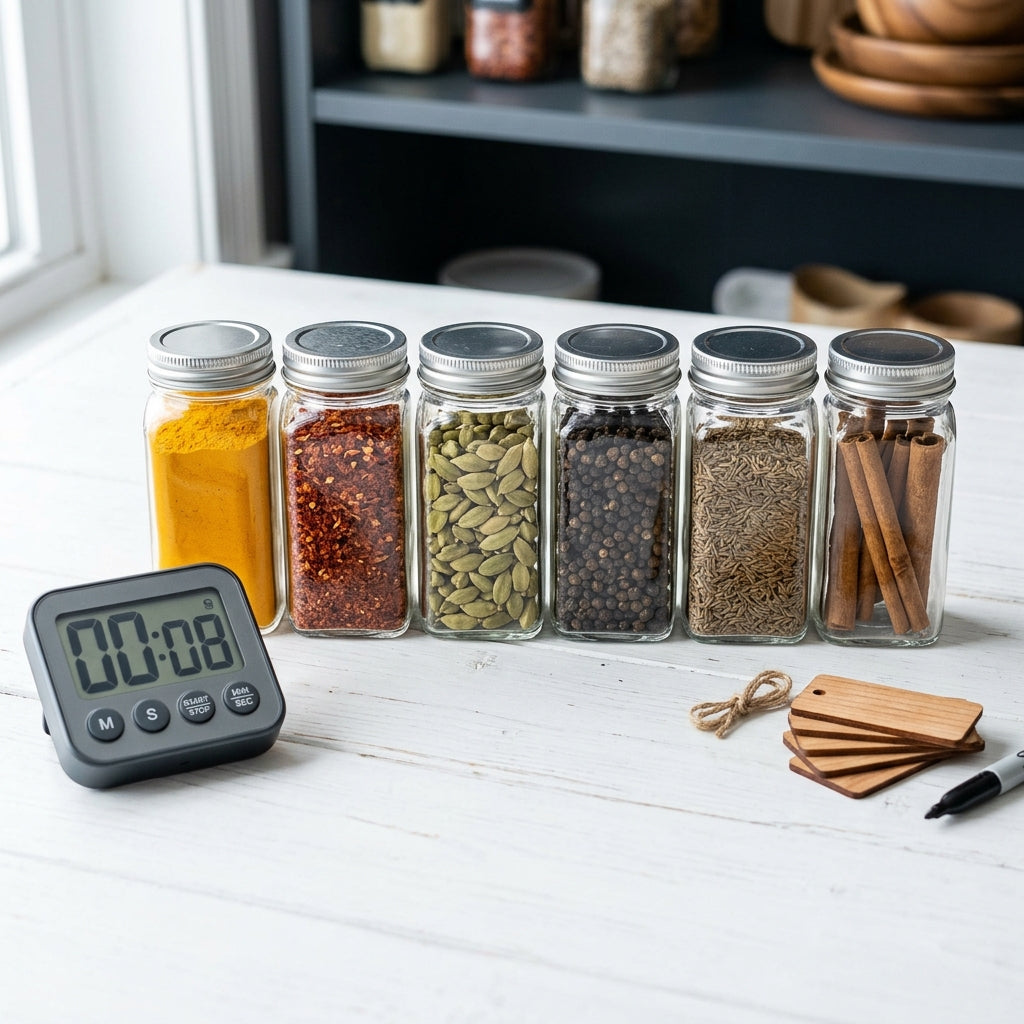
Glass jars with rubber-sealed metal lids are the gold standard for spice storage. They are completely inert (no chemical migration into the spice), transparent for visual identification, and provide excellent airtight sealing. Metal tins are equally good for airtight protection with the additional benefit of complete light blocking. Plastic containers, while common, are less ideal — many plastics absorb aromatic oils over time, dulling strong spices and contaminating mild ones. For commercial storage at scale, triple-layer laminated foil bags with zip locks or heat seals are the industry standard.
🌡️ Temperature: Cool and Consistent
The ideal storage temperature for spices is 15–21°C — cool, stable, and away from heat sources. Every 10°C rise in temperature approximately doubles the rate of chemical degradation in spices. A spice cabinet directly above a stove, or near a wall that receives direct afternoon sun, will see significantly accelerated flavor loss compared to the same spice stored in a cool pantry or lower cabinet. The refrigerator is suitable for long-term storage of high-value spices (saffron, cardamom) in sealed containers — but always allow sealed containers to return to room temperature before opening to prevent condensation forming inside.
🌑 Light: Opaque Containers or Dark Shelves
UV and visible light degrades both volatile oil compounds and color pigments in spices. Clear glass jars displayed on open shelving look beautiful but accelerate quality loss. If you use clear glass, store in a closed cabinet or dark drawer. Opaque containers (metal tins, dark glass) offer the best light protection. For commercial storage, always use opaque laminated foil packaging.
👃 The Rub-and-Smell Freshness Test
The most reliable freshness test for any spice requires no equipment: take a small pinch, rub it firmly between your fingers for 5 seconds, then smell immediately. A fresh, potent spice releases a strong, clear, immediate aroma characteristic of that spice. A degraded spice produces a faint, flat, dusty, or vaguely similar but weak response. If rubbing cardamom produces only a faint suggestion of its floral character rather than an immediate, vivid hit of cineole aroma — the cardamom has passed its useful flavor window. This test works for every spice in the catalog and is the professional standard for sensory quality assessment.
✅ Do's and ❌ Don'ts — Spice Storage
| ✅ Do | ❌ Don't |
|---|---|
| Store in airtight glass or metal containers in a cool, dark place | Store above or beside the stove — heat and steam are the fastest quality killers |
| Label containers with purchase date — not just the spice name | Assume "best before" on a packet means safety cutoff — it is a quality guide only |
| Use dry spoons only — never dip a wet utensil into a spice container | Pour directly from a container over a steaming pot — steam enters and causes clumping/mold |
| Buy whole spices and grind small quantities as needed | Buy large quantities of ground spices and store for years — ground = faster degradation |
| Refrigerate high-value spices (saffron, cardamom) in sealed containers | Open cold spice containers immediately — let them return to room temp first to prevent condensation |
💡 Expert Recommendation
The most overlooked storage mistake in commercial food production is the spice cabinet above the cooking line. Industrial kitchens and food production facilities commonly position spice storage near the cooking zone for convenience — but the sustained heat and humidity that cooking generates consistently destroys spice potency within weeks. At a minimum, all spice storage should be in a separate room or enclosed cold storage away from the production heat zone. The additional 15 seconds it takes a cook to walk to a separate spice storage area is negligible compared to the quality difference between potent, properly stored spices and heat-degraded ones. At 365 Spicery, we ship all products in triple-layer laminated foil with nitrogen flush precisely because we know the quality we've built in can be destroyed by inadequate storage downstream.
🧑🍳 From a Restaurant Manager's Point of View
Karan, operations manager at a chain of North Indian restaurants across Pune, discovered a recurring consistency issue: his chef's special Garam Masala tasted different between the first week of a batch and the last. "We were buying 5 kg bags of blended Garam Masala and storing the opened bag clipped shut near the stove. By week three or four of the bag, the aroma was noticeably weaker. We switched to buying in 500 g sealed foil pouches from 365 Spicery and storing in a cool dry room away from the kitchen. The last portion of each pouch tastes the same as the first. The investment in smaller, properly sealed units actually cost us less per month in flavor consistency than the large bags we were wasting." In food production, storage is part of the quality equation — not an afterthought.
🔑 Key Takeaways
- ⏱️ Whole spices: 2–4 years | Ground spices: 1–2 years | Dried herbs: 6–12 months
- 👃 Rub-and-smell is the most reliable freshness test — immediate strong aroma = still good
- 🌡️ Heat, light, moisture, and oxygen are the four enemies of spice quality
- 🫙 Airtight glass or metal containers in a cool, dark location = correct long-term storage
- 🏭 Commercial kitchens: store spices away from cooking heat zones in sealed, labeled containers
📞 Fresh, Potent Spices Delivered to Your Door from 365 Spicery
Every spice that leaves 365 Spicery's FSSAI and FSSC 22000 certified facility in Mumbai is packed at the peak of its freshness — in triple-layer laminated foil with nitrogen flush that locks in volatile oil content, color, and potency from the moment of grinding to the moment you open the pack. We supply wholesale and private label spice products to food businesses, restaurants, exporters, and retail brands across India and 15+ countries with full batch documentation and best-before dating you can trust. If your current spice supply is delivering inconsistent flavor results, the problem is almost always either spice age or storage conditions — and we can solve both. WhatsApp us at +91 72799 00500 or visit www.365spicery.com to request samples or discuss wholesale supply. Halal and Jain certified. Flexible pack sizes from 100g to 25 kg.
---
Q: How long do spices last?
A: Whole spices last 2–4 years at peak quality. Ground spices maintain peak flavor for 1–2 years. Dried herbs last 6–12 months. Spice blends like Garam Masala last 6–12 months after opening. Spices do not become unsafe after these periods — they lose aroma, flavor potency, and color. The rub-and-smell test is the most reliable freshness indicator.
Q: Do spices expire or go bad?
A: Spices do not "expire" in the food safety sense — they do not become dangerous to consume after their best-before date. What they lose is potency: the volatile oils carrying aroma, pigments carrying color, and active compounds carrying health benefits all degrade over time. A spice that smells flat or dusty has lost its useful flavor contribution to cooking even if it remains technically safe.
Q: What is the best way to store spices?
A: Store spices in airtight glass or metal containers in a cool (15–21°C), dark location away from heat, light, and moisture. Label with the purchase date. Use dry spoons only. Never pour directly from a container over steam. Whole spices last significantly longer than ground — buy whole and grind as needed for maximum freshness.
Q: Can you store spices in the refrigerator?
A: Yes, for high-value spices like saffron and cardamom, refrigerator storage in airtight sealed containers significantly extends shelf life. The key precaution: always allow sealed containers to return to room temperature before opening — this prevents condensation from forming inside the container and introducing moisture that can cause clumping or mold.
Q: Why do my spices clump together?
A: Spice clumping is caused by moisture entering the container — usually from a wet spoon, steam from cooking, or humid storage conditions. Clumping does not necessarily mean the spice is spoiled, but it does indicate improper storage. Break up clumps with a dry spoon and store correctly going forward. Always use dry utensils and never pour directly from a container over a steaming pot.
Q: How do I know if a spice is still good?
A: The rub-and-smell test: take a pinch, rub firmly between fingers for 5 seconds, then smell. A fresh spice produces a strong, immediate, characteristic aroma. A degraded spice produces a faint, flat, or dusty response with little aromatic character. Visual checks: look for vivid color (faded color indicates pigment degradation) and absence of moisture, clumping, or mold.
Q: Should spices be stored in clear or opaque containers?
A: Opaque containers (metal tins, dark glass) are better for preserving color-sensitive spices like turmeric, chilli powder, and paprika — UV and visible light degrades their pigments. If using clear glass, store in a closed cabinet away from direct light. For commercial storage, triple-layer laminated foil packaging provides complete light, oxygen, and moisture barrier protection.
Q: Do ground spices last as long as whole spices?
A: No. Ground spices lose potency 3–4 times faster than whole spices because grinding exposes the volatile oil-containing cells to air, heat, and light. Whole cumin seeds store their aromatic cuminaldehyde in intact oil glands for 3–4 years; ground cumin has maximum useful flavor life of 1–2 years and begins losing intensity within weeks of grinding. For maximum flavor, grind whole spices as close to use as possible.
Q: What happens to spice flavor as it ages?
A: As a spice ages, its volatile aromatic oil content decreases through evaporation and oxidation. The result is progressively muted flavor — a 2-year-old ground cumin tastes noticeably less aromatic than freshly ground cumin, and a 3-year-old version produces little meaningful flavor contribution to a dish. Color pigments (curcumin, capsanthin) also fade with age and UV exposure.
Q: Where should I not store spices?
A: Never store spices above or beside the stove (heat and steam), on open shelves in direct sunlight (UV degrades pigments and volatile oils), near the dishwasher (humidity), or in a bathroom-adjacent cabinet (humidity). The most common kitchen spice storage mistake is positioning the spice rack directly above the cooking surface — which is the worst possible location for spice quality.
---
Spice storage is not a housekeeping matter — it is a flavor quality decision with direct impact on every dish and every product you make with those spices. The difference between a spice at its peak and the same spice two years past its best-before date is not subtle — it is the difference between a dish that smells and tastes alive and one that lands flat despite correct technique. The investments required are minimal: airtight containers, a dark cool cabinet away from the stove, and a regular rub-and-smell audit of your spice collection every 6–12 months. What does your current spice collection smell like?
---
Partner with India's Premium Spice Manufacturer
365 Spicery serves 500+ businesses across India with:
- Wholesale & Bulk Supply
- Private Label / White Label Manufacturing
- Custom Spice Formulations
- Jain & Halal Certified Range
- FSSAI | FSSC 22000 | Lab-Tested Quality
WhatsApp: +91 72799 00500
Website: www.365spicery.com
Location: Mumbai, Maharashtra, India
---


Share:
Complete World Spices Encyclopedia A–Z: Every Spice Explained
How to Detect Adulterated Spices: Complete Lab & Home Testing Guide