


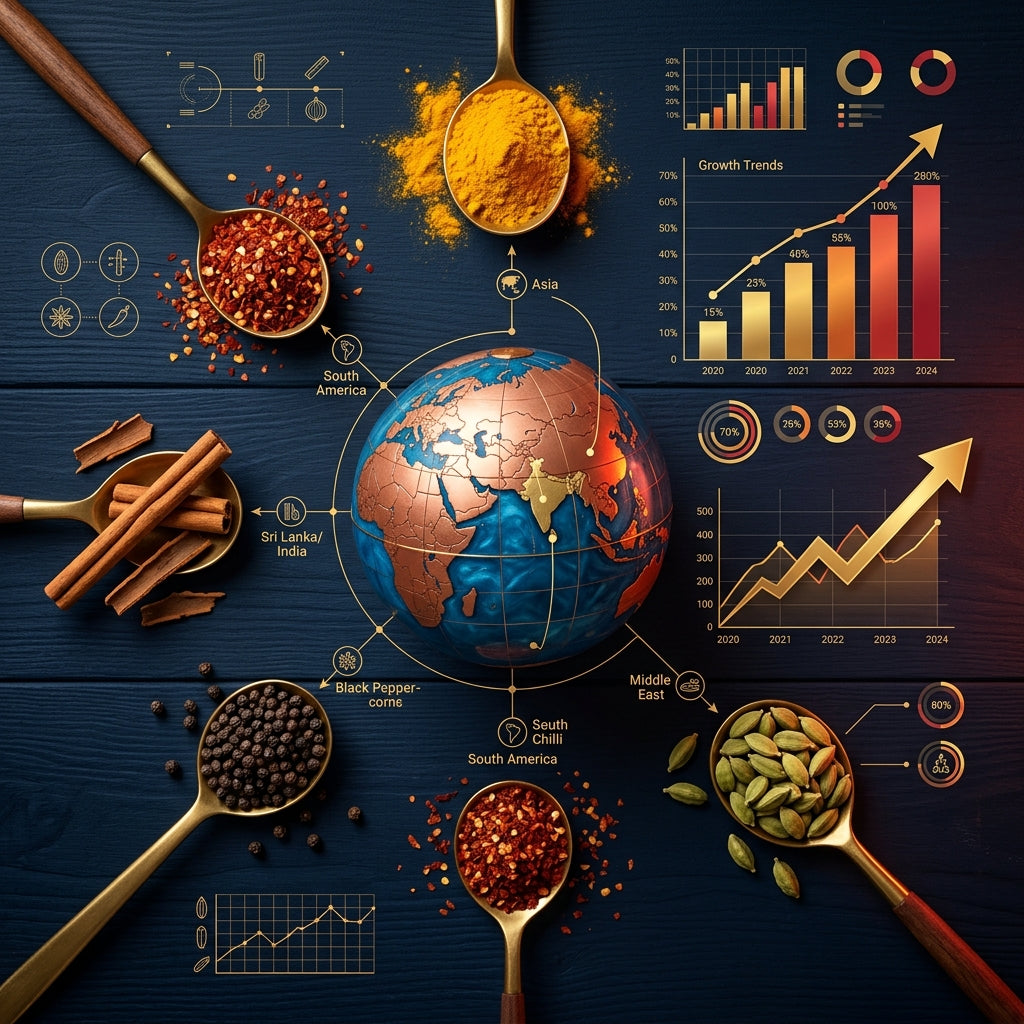
🌍 Global Spice Market Trends & Future Opportunities in 2026
Short answer: The global spice market is projected to exceed $22 billion by 2028, driven by six converging trends: functional and health-positioned spices, clean label demand replacing artificial flavor systems, the globalization of Asian and Indian flavor profiles, private label and D2C brand growth, sustainability and traceability requirements from major retail buyers, and the rapid expansion of the QSR and processed food sectors in Asia-Pacific and the Middle East. For spice manufacturers, exporters, and food brands, each trend represents a distinct and quantifiable market opportunity — the businesses positioning for these trends now will define the category in the next decade.
📈 The Global Spice Market: Where It Stands in 2026
India remains the world's dominant spice producer, exporter, and consumer — producing approximately 75% of global spice volume and exporting to over 180 countries. Indian spice exports crossed ₹32,000 crore in 2025–26. But the global spice story is no longer just about volume — it is increasingly about value. Premium certified products, functional health blends, clean label formulations, and private label manufacturing are growing faster than standard commodity spice exports. The businesses capturing disproportionate value from global spice trade are those that have moved from selling raw commodity to delivering certified, documented, formulation-ready products that align with what international buyers actually need in 2026.
🔥 6 Key Global Spice Market Trends Shaping 2026 and Beyond
🧬 Trend 1 — Functional Spices as Health Ingredients
Turmeric's curcumin, black pepper's piperine, ginger's gingerol, and cinnamon's cinnamaldehyde have transitioned from folk medicine to peer-reviewed pharmaceutical research to mainstream consumer product positioning. The global functional food and beverage market — which incorporates these bioactive spice compounds — is growing at 8–9% annually. Food brands are now actively formulating products that simultaneously deliver flavor and documented health benefits. The manufacturers who can supply spices with certified bioactive content data (curcumin %, piperine %, volatile oil percentage) are capturing premium pricing that standard commodity suppliers cannot access.
🌿 Trend 2 — Clean Label is Now the Retail Entry Requirement
The clean label movement — eliminating artificial colors, synthetic preservatives, MSG, and chemical flavor enhancers from packaged food — has moved from a premium niche to a baseline retail requirement in EU, UK, and increasingly US markets. Natural spices and herb blends are the primary beneficiaries: they deliver the flavor complexity, color, and heat that artificial systems provide, without any of the label claims that trigger consumer rejection. Demand for certified, additive-free spice blends from transparent supply chains is growing faster than the overall spice market. This trend is creating revenue opportunities for certified Indian manufacturers who can supply with clean documentation.
🌏 Trend 3 — Global Crossover of Indian and Asian Flavors
Indian masala blends, Korean gochujang-inspired seasonings, Japanese umami profiles, and Middle Eastern za'atar and baharat are no longer confined to ethnic specialty aisles. They are entering mainstream grocery shelves in North America, Western Europe, and Australia as educated consumers actively seek authentic global flavors. For Indian spice manufacturers, this creates demand for authentic, origin-specific blends that generic Western spice companies cannot accurately replicate. Chaat masala, Chettinad spice blends, Kashmiri chilli, and Andhra-style chilli powders are being searched for and sourced by buyers who a decade ago had never heard of them.
🏷️ Trend 4 — Private Label and D2C Brand Explosion
The economics of private label spice branding have fundamentally changed. Lower MOQs from certified Indian manufacturers, accessible e-commerce infrastructure, and consumer willingness to try unfamiliar brands for premium food products have created a new category of spice businesses: small D2C brands, chef-curated spice lines, and retailer private label ranges that require a certified manufacturing partner rather than their own facility. This segment is growing at double-digit rates in the UK, US, and Australia. For manufacturers, it means more, smaller, higher-margin orders from brand-building clients who need formulation support, packaging options, and export compliance — not just raw product.
♻️ Trend 5 — Sustainability and Supply Chain Transparency
Institutional buyers — major retail chains, food service companies, and ingredient distributors in EU and UK — are now formally requiring sustainability documentation from their spice suppliers. This includes direct farmer sourcing evidence, environmental impact assessments, and third-party supply chain audits. For Indian manufacturers with documented farm-to-facility traceability, this trend is a competitive advantage that pricing alone cannot counter. For those without it, the trend is creating a growing barrier to institutional buyer relationships regardless of product quality or price competitiveness.
🍔 Trend 6 — QSR and Processed Food Sector Expansion in Asia-Pacific
Quick-service restaurant chains are expanding aggressively across India, Southeast Asia, and the Middle East — and every new restaurant opening requires a supply of seasoning blends, cooking masalas, and proprietary flavor systems. The processed food sector in India alone is projected to grow to $535 billion by 2025–26, creating sustained demand for food-grade, consistently formulated spice inputs at scale. This is the largest volume opportunity in the current market, and it rewards manufacturers with FSSC 22000 certification, large-format production capacity, and the ability to maintain formulation consistency across multi-tonne orders.
🌏 Future Market Opportunities: Where to Position Now
| Opportunity | Target Market | Key Requirement |
|---|---|---|
| Functional spice blends with bioactive data | EU, UK, USA, Australia | Lab-certified curcumin / piperine content |
| Halal-certified masala and seasoning export | GCC, Malaysia, Indonesia | Valid Halal certificate + Arabic labeling |
| Clean label seasoning supply to retail chains | EU, UK, USA | No artificial additives + FSSC 22000 |
| Private label spice brands for diaspora markets | UK, USA, Canada, East Africa | Custom packaging + compliance labeling |
| QSR seasoning supply at scale | India, Middle East, Southeast Asia | FSSC 22000 + consistent formulation at volume |
| Organic certified spice export | EU (organic equivalence), USA (NOP) | NPOP / NOP organic certification |
✅ Do's and ❌ Don'ts for Businesses Responding to Spice Market Trends
| ✅ Do | ❌ Don't |
|---|---|
| Invest in certifications (FSSC 22000, Halal, Organic) before targeting institutional buyers | Try to compete on price alone in commodity spice segments |
| Develop bioactive content documentation for functional spice products | Make health claims on spice products without lab-backed bioactive data |
| Build supply chain traceability documentation before EU buyers ask for it | Wait for buyer RFQs to start preparing compliance documentation |
| Target 2–3 trend-aligned segments with deep expertise | Try to address all six trends simultaneously without focused positioning |
| Partner with certified Indian manufacturers who can grow with your volume | Source from uncertified traders because of lower initial per-kg pricing |
💡 Expert Recommendation
The most significant strategic mistake in the global spice business right now is treating certification as a cost rather than an investment. FSSC 22000 certification costs money and time — but it is the access credential for QSR chains, retail buyers, and institutional food companies whose volumes represent orders of magnitude more revenue than uncertified channels. Similarly, Halal certification for GCC market access, and NPOP organic certification for EU premium access, are not optional additions for serious exporters — they are prerequisites. The businesses investing in these credentials in 2026 are building infrastructure that generates returns for 10–15 years. The businesses deferring certification to manage short-term costs are permanently excluding themselves from the highest-value customer segments.
🧑💼 From an Industry Buyer's Point of View
Marcus, Head of Procurement at a European food ingredients distributor based in Hamburg, sources spices from India for clients across 12 EU countries. "In 2020, we had 40 approved Indian suppliers. Today we have 11. The others were removed because they couldn't provide FSSC 22000, couldn't meet MRL documentation requirements for specific EU pesticide limits, or couldn't demonstrate supply chain traceability. The market hasn't become less interested in Indian spices — it's become more demanding about which Indian suppliers qualify. 365 Spicery is on our approved list because they send us what we need without being asked." The global spice market is growing — but the share going to certified, documented suppliers is growing faster than the market itself.
🔑 Key Takeaways
- 📈 Global spice market heading to $22B+ by 2028 — driven by 6 converging trends
- 🧬 Functional spices with bioactive content data command premium pricing in health-positioned markets
- 🌿 Clean label is a retail entry requirement in EU/UK — not a premium differentiation
- 🏷️ Private label and D2C spice brand growth is creating high-margin opportunity for certified manufacturers
- ✅ Certification (FSSC 22000, Halal, Organic) = access to the highest-value buyer segments globally
📞 Position Your Business with 365 Spicery's Market-Ready Supply
Whether you're a food brand responding to clean label demand, an exporter targeting GCC Halal markets, a QSR operator scaling seasoning supply, or an importer building a private label spice range, 365 Spicery delivers the certified, documented, formulation-ready product that global market trends require. Our FSSAI, FSSC 22000, Halal, and Jain certified facility in Mumbai supplies spice businesses across 15+ countries with the compliance credentials, bioactive content data, and traceability documentation that institutional buyers now demand as standard. WhatsApp us at +91 72799 00500 or visit www.365spicery.com to discuss how our manufacturing capabilities align with your market positioning. Sample shipments available. Export documentation provided as standard.
---
Q: What is the global spice market size in 2026?
A: The global spice market is estimated to be valued at approximately $18–20 billion in 2026 and is projected to exceed $22 billion by 2028, growing at a CAGR of 5–7%. Growth is driven by functional food demand, clean label trends, QSR sector expansion in Asia-Pacific, and the globalization of Asian and Indian flavor profiles.
Q: Which country is the largest spice exporter in the world?
A: India is the world's largest spice exporter, accounting for approximately 75% of global spice production and exporting to over 180 countries. India's spice exports crossed ₹32,000 crore in 2025–26. Key export categories include chilli, turmeric, cumin, cardamom, black pepper, coriander, and value-added products like curry powders and masala blends.
Q: What are the biggest trends in the global spice market in 2026?
A: The six biggest trends are: functional and health-positioned spices (curcumin, piperine), clean label demand replacing artificial flavor systems, the global crossover of Indian and Asian flavors into mainstream retail, private label and D2C brand growth, sustainability and supply chain traceability requirements, and QSR and processed food sector expansion in Asia-Pacific and the Middle East.
Q: Why is clean label important in the spice market?
A: Clean label — products without artificial colors, preservatives, MSG, or chemical additives — has become a retail entry requirement in EU, UK, and US markets. Major retail chains increasingly require clean label compliance for shelf placement. Natural spices and herb blends benefit directly from this trend because they deliver flavor, color, and heat without artificial inputs.
Q: What certifications are needed to access premium global spice markets?
A: The key certifications for premium global spice market access are: FSSC 22000 or ISO 22000 (food safety management — required by EU and UK retail chains), Halal (required for GCC and Southeast Asian Muslim markets), NPOP/NOP Organic (required for organic label claims), and FSSAI Central License (mandatory for all Indian food exports). Each certification unlocks a specific buyer segment.
Q: What is the future of the Indian spice export industry?
A: The Indian spice export industry is moving from commodity volume competition to value-added, certified, and formulation-ready product supply. Future growth will be driven by functional spice blends with documented bioactive content, clean label seasoning exports, Halal-certified products for GCC and Southeast Asia, private label manufacturing for international brands, and direct supply to QSR and processed food manufacturers globally.
Q: What is the fastest growing segment of the global spice market?
A: The fastest growing segment is functional and health-positioned spices — turmeric (curcumin), black pepper (piperine), ginger (gingerol), and cinnamon (cinnamaldehyde) products marketed for documented health benefits. This segment is growing at 8–9% annually, significantly faster than the overall spice market, driven by the global functional food and nutraceutical industry.
Q: Which regions have the highest demand for Indian spices?
A: The highest demand regions for Indian spices are: the EU (largest value market), USA (largest single-country destination), GCC countries (UAE, Saudi Arabia, Kuwait, Oman — fast-growing Halal segment), UK, Bangladesh, Sri Lanka, Malaysia, and Australia. Diaspora Indian communities in the UK, USA, Canada, and East Africa also represent significant specialty demand.
Q: How is sustainability affecting the spice supply chain?
A: Major EU and UK retail chains and ingredient distributors now formally require sustainability documentation from spice suppliers — covering direct farmer sourcing evidence, environmental impact assessments, and supply chain traceability. Suppliers without documented sustainable sourcing practices are increasingly being delisted from institutional buyer approved supplier lists regardless of price competitiveness.
Q: How does 365 Spicery align with global spice market trends?
A: 365 Spicery is a FSSAI and FSSC 22000 certified spice manufacturer in Mumbai that supplies clean label blends, Halal and Jain certified products, functional spices with bioactive content data, and private label formulations for the EU, UK, USA, GCC, and Australian markets — directly aligned with all six major global spice market trends in 2026.
---
The global spice market's growth numbers are significant — but the more important story is how the value is being distributed within that growth. Certified manufacturers with traceability documentation, functional product claims backed by lab data, and clean label compliance are capturing a disproportionate share of the value added by market growth. The commodity suppliers competing on per-kg pricing are growing at the market average or below it. The positioning decision — certified, documented, formulation-ready versus price-competitive commodity — is the most consequential strategic choice a spice business can make in 2026. Which side of that divide is your business positioned on?
---
Partner with India's Premium Spice Manufacturer
365 Spicery serves 500+ businesses across India with:
- Wholesale & Bulk Supply
- Private Label / White Label Manufacturing
- Custom Spice Formulations
- Jain & Halal Certified Range
- FSSAI | FSSC 22000 | Lab-Tested Quality
WhatsApp: +91 72799 00500
Website: www.365spicery.com
Location: Mumbai, Maharashtra, India
---


Share:
Herbs vs Spices: Complete Beginner's Guide (Key Differences Explained)
Ultimate Guide to Indian Spices: Types, Uses, Benefits & Buying Tips