


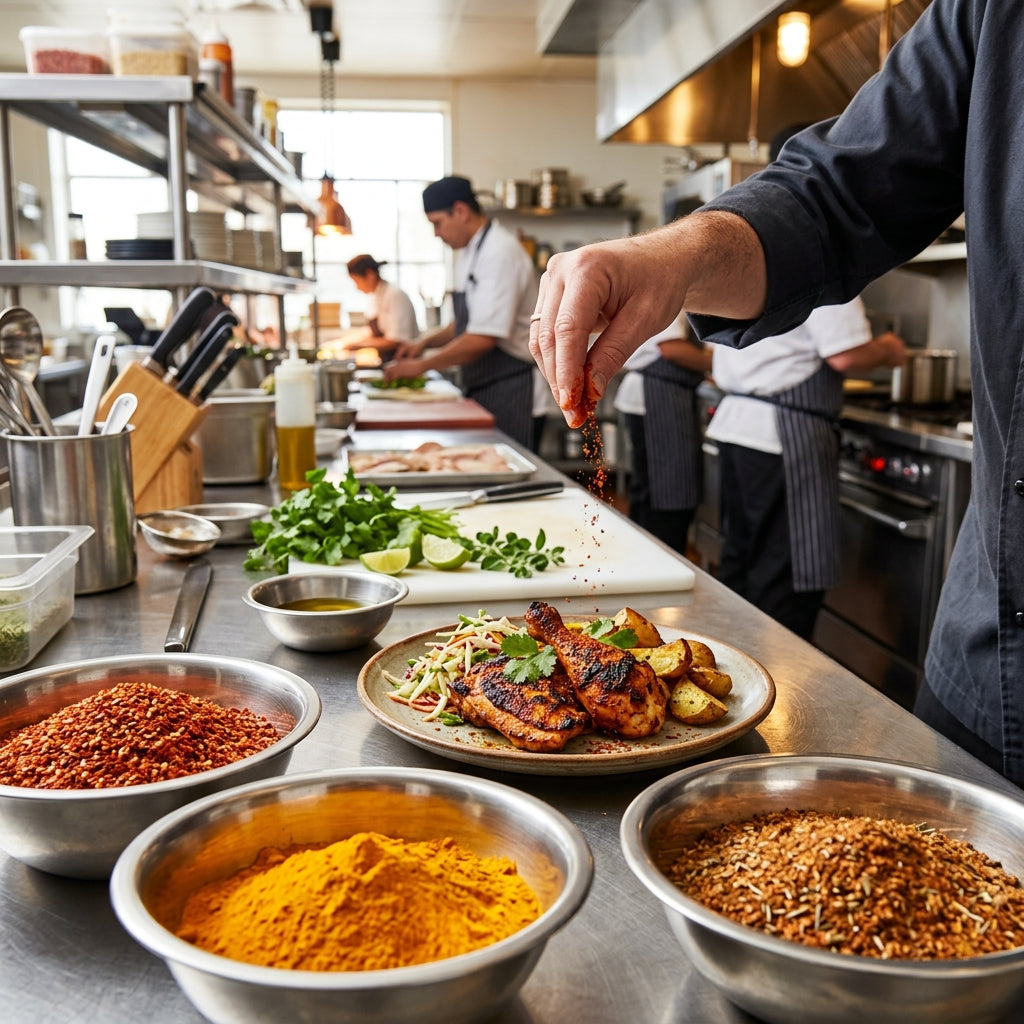
Why Most Kitchens Get Seasoning Consistency Wrong
Here's a fact that surprises many kitchen owners: two dishes made with the "same" seasoning can taste noticeably different if the spice batches behind them weren't processed consistently. This guide to seasonings exists because most cooks focus entirely on the recipe while overlooking the bigger variable — the quality and consistency of the seasoning itself. Cloud kitchens in particular struggle to keep taste identical across branches, often blaming staff training when the real issue is batch-to-batch variation in their spice supply. Hotels and QSR chains face a related problem: retail-branded seasonings are priced and packaged for home cooks, not commercial kitchens ordering in bulk. Understanding what actually goes into a reliable seasoning supply solves both problems at once.
6 Steps to Use Seasonings Like a Professional Kitchen
Professional kitchens follow a disciplined approach to seasoning that home cooks often skip:
This addresses a common voice search query: "which is the best spice blend for a QSR restaurant kitchen?" — consistency of supply matters as much as the blend itself.
Bulk Seasoning Supplier vs. Retail-Branded Seasoning
| Factor | Bulk Seasoning Supplier | Retail-Branded Seasoning |
| Pack sizes | Institutional, 1kg to 50kg | Small, retail-sized jars |
| Pricing | Lower per-kg cost at scale | Higher, built for individual consumers |
| Batch consistency | Documented, lab-tested | Not always disclosed |
| Customization | Custom formulation available | Fixed recipe only |
As a result, hotels and restaurants relying on retail-branded seasonings often overpay while getting less consistency than a proper bulk supplier would provide.
What the Data Says About Seasoning Quality and Grinding
Food scientists have found that volatile oils, the compounds responsible for aroma and flavor intensity in seasonings, degrade rapidly when exposed to heat during grinding. Studies show that cryogenic grinding can preserve over 95% of these oils, compared to roughly 60% retained through conventional hot grinding. According to industry reports on Indian spice quality, adulteration and inconsistent processing remain widespread challenges across the unorganized supply chain. The single most important stat for buyers: up to 40% of a seasoning's aroma can be lost to heat in conventional grinding, a gap that directly explains why some seasonings taste noticeably weaker than others despite similar ingredient lists.
How 365 Spicery Supplies Seasonings for Every Kitchen
Whether you're running a five-star hotel kitchen or a single cloud kitchen outlet, sourcing a consistently flavorful seasoning supply at scale is harder than it should be. At 365 Spicery, our seasonings and premix range — including Pizza, Peri Peri, BBQ, Chaat Masala, and Shawarma Seasoning — is processed using Cryogenic Grinding Technology and manufactured in a facility that is FSSAI certified, FSSC 22000 compliant, and Halal certified, with lab-testing on every batch. This is what allows restaurants and hotels to maintain identical flavor across every order, not just the first batch. At 365 Spicery, we also support private label and custom formulation for QSR chains and cloud kitchens wanting a signature seasoning of their own, with flexible MOQs and institutional packs from 1kg to 50kg.
---
Key Takeaways:
- Batch-to-batch consistency, not just the recipe, is often the real reason dishes taste different across locations.
- Weighing seasonings by weight rather than volume improves consistency significantly across kitchen staff.
- Cryogenic grinding preserves over 95% of a seasoning's volatile oils compared to conventional methods.
- Bulk seasoning suppliers offer better pricing and consistency than retail-branded jars for commercial kitchens.
- 365 Spicery's certified seasoning range helps hotels, QSRs, and cloud kitchens maintain flavor consistency at scale.
---
#
Q: What is the best guide to seasonings for a commercial kitchen?
A: A reliable guide covers standardizing recipes by weight, sourcing from a certified bulk supplier, and understanding how grinding method affects flavor intensity. Consistency across batches matters more than the recipe alone. 365 Spicery's seasoning range is built around solving this exact consistency challenge.
Q: What are the different types of seasonings used in professional kitchens?
A: Professional kitchens typically use single spice powders, blended masalas, all-purpose seasonings like Peri Peri or BBQ, and specialty premixes like Chaat Masala or Shawarma Seasoning. Each serves a different flavor role depending on the dish. 365 Spicery manufactures across all these categories.
Q: How do I choose a reliable seasoning supplier for my restaurant?
A: Look for FSSAI and FSSC 22000 certification, lab-tested batches, and documented grinding methods rather than just a trusted brand name. Requesting a sample batch helps confirm consistency before bulk ordering. 365 Spicery meets these certification requirements as a Mumbai-based manufacturer.
Q: Does 365 Spicery supply seasonings for restaurants and hotels?
A: Yes, 365 Spicery's seasoning and premix range, including Pizza, Peri Peri, and BBQ Seasoning, is cryogenically ground and produced in an FSSAI, FSSC 22000, and Halal certified facility. Every batch is lab-tested. This suits hotels, QSR chains, and cloud kitchens needing consistent bulk supply.
Q: Can I order seasonings in bulk for my restaurant or hotel?
A: Yes, 365 Spicery supplies its seasoning range in institutional packs from 1kg to 50kg, with private label and custom formulation options available. Flexible MOQs suit both independent restaurants and multi-outlet chains. Wholesale pricing is available on request via WhatsApp.
Q: Which is the best spice blend for a QSR restaurant kitchen?
A: The best blend depends on the cuisine, but consistency across outlets matters more than the specific recipe for QSR chains. Sourcing from a single certified, cryogenically ground supplier is what actually keeps flavor identical across branches. 365 Spicery supports QSR chains with exactly this kind of consistent bulk supply.
Q: Are 365 Spicery's seasonings suitable for Jain and Halal menus too?
A: Yes, 365 Spicery manufactures a dedicated Jain range alongside its broader Halal certified seasoning portfolio, all from the same certified facility. This lets restaurants serve diverse dietary requirements without switching suppliers. Every batch undergoes lab testing regardless of the range.
---
#
The real lesson behind any thorough guide to seasonings is that consistency, not the recipe alone, is what separates a professional kitchen's flavor from an inconsistent one. Weighing ingredients properly, storing seasonings correctly, and sourcing from a single certified, cryogenically ground supplier all compound into noticeably better results at scale. Hotels, QSR chains, and cloud kitchens that get this foundation right spend far less time troubleshooting flavor complaints. 365 Spicery's seasoning range was built to give kitchens exactly this consistency. What seasoning do you rely on most in your own kitchen?
---
#


Share:
Global Spice Import & Export Guide for 2026 Buyers
Spice Processing Explained: The Complete Farm to Fork Guide