


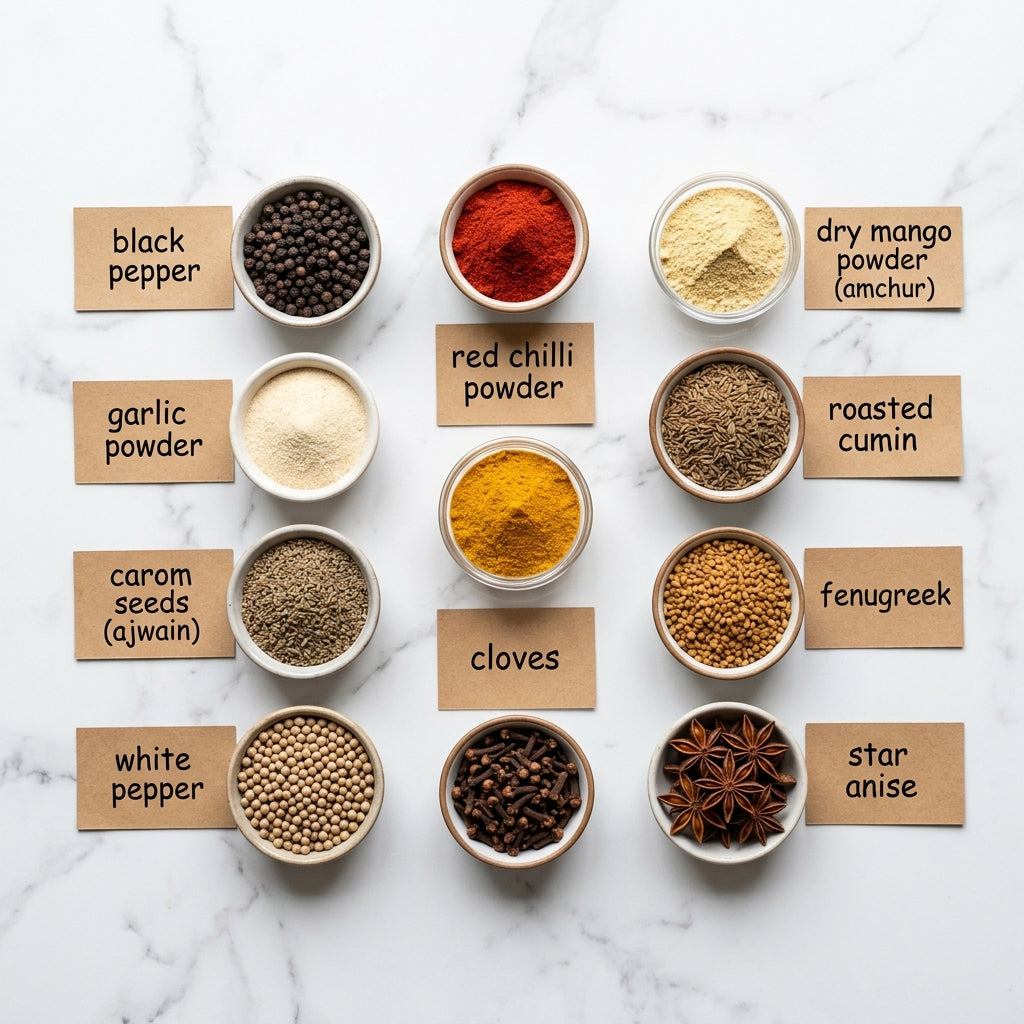
🌶️ Types of Masala Powder Used in Indian Cooking
Short answer: Indian cooking uses over 30 distinct masala powders, but the most essential ones are Garam Masala, Chole Masala, Rajma Masala, Biryani Masala, Sambar Powder, Rasam Powder, Pav Bhaji Masala, Chaat Masala, Kitchen King Masala, and Coriander-Cumin (Dhana Jeera) powder. Each is formulated for a specific dish or application, with unique spice ratios that cannot be substituted with a generic all-purpose blend without losing flavor authenticity.
🍛 Why Indian Cooking Uses So Many Different Masala Powders
India's culinary diversity spans 29 states, each with distinct cooking traditions, regional ingredients, and flavor preferences. A masala powder used in Chettinad cooking in Tamil Nadu tastes nothing like the blends used in Punjabi cuisine — and neither resembles the masalas of Rajasthan or Maharashtra. This regional specificity is why Indian cooking has so many distinct masala powders rather than one general-purpose blend. Each masala is calibrated for a specific cooking method (tempering, slow cooking, dry roasting), a specific protein or vegetable (lentils, chickpeas, mutton), and a specific flavor destination (sour and tangy, rich and warming, sharp and pungent). Understanding which masala to use where is the foundation of consistent Indian cooking — whether in a home kitchen or a professional food production facility.
📋 Essential Types of Masala Powder in Indian Cooking
🫙 1. Garam Masala
The most internationally recognized Indian spice blend. Garam Masala is a warming blend of whole spices — typically black pepper, cardamom, cinnamon, cloves, cumin, and coriander — ground together after dry roasting. It's used as a finishing spice added at the end of cooking to preserve its aromatic compounds. Every region has its own Garam Masala formula: Punjabi versions are heavy on cardamom and cloves, while South Indian variants include star anise and marathi mokku. Quality Garam Masala has an immediate, sharp aroma when opened — if it smells flat, the volatile oils have been lost during grinding.
🌿 2. Coriander-Cumin Powder (Dhana Jeera)
The workhorse blend of everyday Indian cooking. A 2:1 or 3:1 ratio of coriander to cumin, Dhana Jeera forms the flavor base of hundreds of curries, sabzis (vegetable dishes), and dals across Gujarat, Rajasthan, and Maharashtra. It's used in larger quantities early in cooking to build the foundational flavor, unlike Garam Masala which is used sparingly at the end.
🫘 3. Chole Masala
Specifically formulated for chickpea preparations (Chole / Chana Masala). Contains amchur (dry mango powder) for tartness, pomegranate seed powder (anardana) for sourness, and a mix of coriander, cumin, black cardamom, and chilli for the characteristic dark, tangy flavor of Punjabi Chole. Cannot be substituted with Garam Masala without losing the dish's defining character.
🫘 4. Rajma Masala
Designed for red kidney bean (Rajma) preparations, popular in North India. Heavier on cumin, coriander, and tomato-compatible spices. Slightly milder than Chole Masala, with a rounder, less tangy flavor profile suited to the kidney bean's dense texture and mild taste.
🍚 5. Biryani Masala
A complex, layered blend used for rice-based preparations. Typically contains 15–20 spices including star anise, mace, nutmeg, kewra, bay leaf, black and green cardamom, and various peppers. Regional variations are significant — Hyderabadi Biryani Masala differs meaningfully from Lucknawi (Awadhi) or Kolkata Biryani Masala in ingredient selection and roasting profile.
🍲 6. Sambar Powder
The defining spice blend of South Indian cuisine. Contains coriander, cumin, chilli, black pepper, curry leaves, urad dal, chana dal, and turmeric — all dry roasted and ground together. The roasting of legumes (dals) in the blend is a characteristic that separates Sambar Powder from North Indian masalas. Karnataka and Tamil Nadu versions differ in chilli quantity and legume ratio.
🥣 7. Rasam Powder
Used specifically for Rasam (a thin, peppery South Indian soup). Dominated by black pepper and cumin with supporting coriander and chilli. Produces a distinctively sharp, peppery, digestive flavor that makes Rasam one of Indian cuisine's most widely used comfort foods. Should not be confused with or substituted with Sambar Powder.
🥘 8. Pav Bhaji Masala
A vibrant, tangy-spicy blend developed specifically for Mumbai's iconic street food. Contains a unique combination of coriander, cumin, amchur, fennel, chilli, and cloves with a distinctive flavor that makes the dish immediately recognizable. This masala is one of the most widely exported Indian spice blends to Indian diaspora communities globally.
🍋 9. Chaat Masala
A pungent, tangy finishing blend used on fruit chaat, papri chaat, dahi puri, and street food preparations. Dominated by amchur (dry mango powder), black salt (kala namak), and roasted cumin — the combination delivers a distinctive sour-savory-umami punch that is uniquely Indian. Used as a condiment sprinkled after preparation, not cooked into dishes.
👑 10. Kitchen King Masala
A versatile all-purpose masala popular in North and Central India. Designed to work across multiple vegetable and legume dishes when a specific masala isn't available. Contains a balanced mix of coriander, cumin, turmeric, chilli, and Garam Masala spices. Less specialized than dish-specific blends but more flavorful than using individual spices alone.
✅ Do's and ❌ Don'ts When Buying Masala Powder
| ✅ Do | ❌ Don't |
|---|---|
| Smell the masala — strong aroma means fresh volatile oils | Substitute one masala for another in the same recipe |
| Check for FSSAI certification on packaged masala products | Buy loose unpackaged masala with no traceability |
| Store in airtight containers away from heat and light | Keep masala jars near the stove or in open sunlight |
| Ask for cryogenically ground masala for stronger aroma | Buy in bulk without checking manufacturing date |
| Request lab-tested masala with no artificial colors added | Use masala past its best-before date for food business |
💡 Expert Recommendation
For food businesses sourcing masala powders for commercial production, the most important question to ask any supplier is: "What is the volatile oil content in your Garam Masala, and can you share the last batch test report?" This single question reveals whether the spices in the blend were processed in a way that preserved their aromatic compounds. A Garam Masala with high volatile oil content — achievable only through cryogenic grinding — will deliver the same aroma intensity in your dish whether it's the first batch or the tenth. A Garam Masala that smells strong in month one but weak by month three has lost its oils during processing and was never truly premium.
🧑🍳 From a Chef's Point of View
Kavita, a catering professional in Ahmedabad who runs large-scale corporate lunch services, had been using a single "all-purpose masala" across her entire menu for cost efficiency. After switching to category-specific masalas from 365 Spicery — Chole Masala for chickpea dishes, Sambar Powder for South Indian items, Biryani Masala for rice preparations — her client feedback scores improved significantly within a month. "Guests started asking what changed. I hadn't changed any recipe — just the masala. The flavors were suddenly more defined, more authentic." Using the right masala for the right dish is not an additional cost — it's the correct way to cook at scale.
🔑 Key Takeaways
- 🌶️ Indian cooking uses 30+ distinct masala powders, each formulated for specific dishes
- 🫙 The 10 most essential: Garam Masala, Dhana Jeera, Chole, Rajma, Biryani, Sambar, Rasam, Pav Bhaji, Chaat, Kitchen King
- 👃 Aroma is the best freshness test — rub and smell before purchasing or using
- ❄️ Cryogenically ground masalas retain stronger aroma and longer shelf life
- 🏭 365 Spicery manufactures the full range of Indian masala powders from its Mumbai facility
📞 Source Authentic Indian Masala Powders with 365 Spicery
Whether you need a single masala for your kitchen or a full range of certified masala powders for wholesale, private label, or export, 365 Spicery manufactures India's most authentic blends from its FSSAI and FSSC 22000 certified facility in Mumbai. Every masala is cryogenically ground for maximum aroma, lab-tested before dispatch, and available in custom formulations for food businesses with specific regional or dietary requirements. WhatsApp us at +91 72799 00500 or visit www.365spicery.com to explore our full masala range, request samples, and discuss wholesale pricing. Halal certified. Jain variants available. Export-ready.
---
Q: What are the most common types of masala powder used in Indian cooking?
A: The most common masala powders in Indian cooking are Garam Masala, Coriander-Cumin Powder (Dhana Jeera), Chole Masala, Rajma Masala, Biryani Masala, Sambar Powder, Rasam Powder, Pav Bhaji Masala, Chaat Masala, and Kitchen King Masala. Each is formulated for specific dishes and cannot be directly substituted for one another.
Q: What is the difference between Garam Masala and other Indian masala powders?
A: Garam Masala is a warming, aromatic finishing spice added at the end of cooking to preserve its volatile oils. Other masalas like Chole Masala or Sambar Powder are used earlier in the cooking process and contain dish-specific ingredients — such as amchur for tanginess or roasted dals — that Garam Masala does not include.
Q: Can I use Garam Masala instead of Chole Masala for chickpeas?
A: Not as a direct substitute. Chole Masala contains amchur (dry mango powder) and anardana (pomegranate seed) for the characteristic tartness of Punjabi Chole that Garam Masala lacks. Using Garam Masala alone will produce a different flavor profile that does not replicate authentic Chole.
Q: What masala powder is used for Biryani?
A: Biryani Masala is the specific blend used for rice-based Biryani preparations. It contains 15–20 spices including star anise, mace, nutmeg, bay leaf, and multiple types of cardamom. Regional variations — Hyderabadi, Lucknawi, Kolkata — differ in ingredient selection and roasting profile.
Q: What is Chaat Masala made of?
A: Chaat Masala is primarily made of amchur (dry mango powder), black salt (kala namak), roasted cumin, coriander, and chilli. The combination delivers a sour-savory-umami flavor used as a finishing condiment on chaats, fruits, snacks, and street food — sprinkled after preparation rather than cooked in.
Q: How do I know if a masala powder is fresh and good quality?
A: The best test is rub-and-smell: take a pinch, rub between your fingers for 2–3 seconds, and smell immediately. Fresh, potent masala releases a strong, clear aroma instantly. Flat, dusty, or faint smell indicates the volatile oils have degraded and the masala has lost its potency.
Q: What is Sambar Powder made of?
A: Sambar Powder is a South Indian blend containing coriander, cumin, black pepper, dry chilli, curry leaves, turmeric, and roasted legumes (urad dal and chana dal). The roasted lentils are a characteristic feature that gives Sambar its distinctive earthy, slightly nutty base flavor.
Q: Is Pav Bhaji Masala the same as regular masala?
A: No. Pav Bhaji Masala is a specific blend formulated for Mumbai's Pav Bhaji street food, containing a distinctive combination of coriander, cumin, amchur, fennel, cloves, and chilli in ratios designed to produce the tangy, vibrant flavor of authentic Pav Bhaji. It cannot be replicated with generic masala blends.
Q: Can masala powders be used for export and private label products?
A: Yes. Certified Indian manufacturers like 365 Spicery supply Indian masala powders for export with full documentation, Halal certification, and lab test reports. Private label and custom formulation services are also available for food brands wanting proprietary masala blends under their own packaging.
Q: Does 365 Spicery supply the full range of Indian masala powders?
A: Yes. 365 Spicery manufactures and supplies the complete range of Indian masala powders — Garam Masala, Chole Masala, Biryani Masala, Sambar Powder, Rasam Powder, Pav Bhaji Masala, Chaat Masala, and more — from its FSSAI and FSSC 22000 certified facility in Mumbai. Wholesale, private label, and export orders are available.
---
Indian masala powders are not interchangeable — they're each a precisely calibrated formula for a specific culinary outcome. Using the right masala for the right dish is the difference between authentic regional flavor and a generic approximation. For food businesses, that difference shows up directly in customer feedback, recipe consistency, and repeat orders. At 365 Spicery, we manufacture the full range of Indian masala powders with cryogenic grinding and lab verification because authentic Indian flavor should taste the same in your kitchen on batch one and batch one hundred. Which masala in your range needs upgrading?
---
Partner with India's Premium Spice Manufacturer
365 Spicery serves 500+ businesses across India with:
- Wholesale & Bulk Supply
- Private Label / White Label Manufacturing
- Custom Spice Formulations
- Jain & Halal Certified Range
- FSSAI | FSSC 22000 | Lab-Tested Quality
WhatsApp: +91 72799 00500
Website: www.365spicery.com
Location: Mumbai, Maharashtra, India
---


Share:
How Custom Seasoning Blends Are Developed: A Step-by-Step Guide
Paprika vs Chili Powder: Complete Comparison Guide