


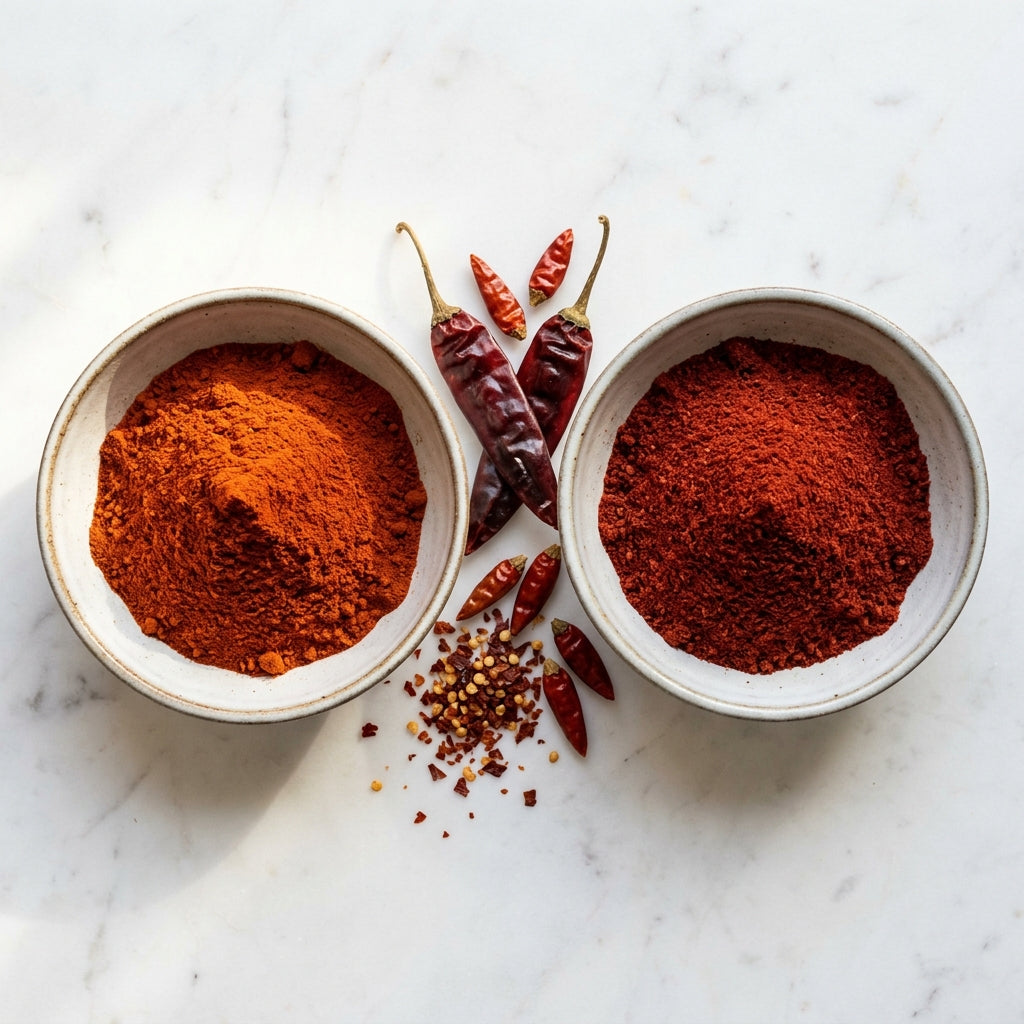
🌶️ Paprika vs Chili Powder: Complete Comparison Guide
Short answer: Paprika and chili powder are not the same thing. Paprika is made from dried, ground sweet or mildly hot red peppers and is primarily used for color and mild sweetness. Chili powder is a blend (or single-spice ground hot chilli) used specifically for heat and bold flavor. Paprika adds vibrant red color with little to no heat; chili powder adds heat with varying color contribution depending on the variety. Using one instead of the other in a recipe changes both the heat level and the flavor profile significantly.
🔴 What Is Paprika?
Paprika is produced by drying and grinding specific varieties of Capsicum annuum peppers that are bred for color and mild flavor rather than heat. The most prized paprika varieties come from Hungary and Spain, where the pepper selection, drying method, and grinding process have been refined over centuries. Paprika ranges from sweet (no heat) to hot (mild-moderate heat), but its defining characteristic is always its vivid red-orange color and the sweet, slightly fruity flavor underneath. In Indian spice manufacturing, Kashmiri chilli is the closest equivalent — a low-heat, high-color pepper that functions similarly to paprika in delivering color without dominant heat. At 365 Spicery, our Kashmiri chilli powder is specifically sourced for its color value (ASTA rating) rather than capsaicin content, making it the correct choice when paprika-like results are needed in Indian or fusion applications.
🌶️ What Is Chili Powder?
Chili powder exists in two distinct forms that are frequently confused. The first is single-spice ground chilli — simply dried, ground hot chilli peppers with no other additions. This is what most Indian homes and food manufacturers mean when they say "chilli powder" — it delivers direct heat, color (depending on variety), and the characteristic sharp pungency of capsaicin. The second is American-style chili powder — a pre-mixed blend of ground chilli, cumin, garlic powder, oregano, and sometimes salt, designed specifically for Tex-Mex chili con carne. These are entirely different products with different applications. When a recipe calls for "chili powder," context determines which version is needed.
📊 Paprika vs Chili Powder — Head-to-Head Comparison
| Factor | Paprika | Chili Powder |
|---|---|---|
| Base Ingredient | Sweet/mild Capsicum annuum | Hot chilli pepper varieties |
| Heat Level | Mild to none (0–500 SHU) | Moderate to very hot (1,000–100,000+ SHU) |
| Primary Use | Color + mild sweetness | Heat + bold flavor |
| Color Contribution | Deep red-orange, high ASTA value | Red to dark red, varies by variety |
| Flavor Profile | Sweet, fruity, slightly earthy | Sharp, pungent, hot |
| Indian Equivalent | Kashmiri chilli powder | Guntur / Byadagi / Sannam chilli |
| Best For | Coloring soups, stews, rubs, hummus | Indian curries, hot sauces, marinades |
| Interchangeable? | Not for heat-sensitive recipes | Not for color-critical recipes |
🎨 When to Use Paprika vs Chili Powder
🖌️ Use Paprika When...
- You want vibrant red-orange color without adding heat (grilled chicken, deviled eggs, hummus)
- The dish is served to heat-sensitive consumers (children, elderly, low-heat preference markets)
- You need color in a sauce or soup without altering the base flavor profile significantly
- You're developing a European-style dish (Hungarian goulash, Spanish patatas bravas) where paprika is the defining spice
- Heat is a deliberate part of the dish's flavor identity (Indian curries, hot sauces, spicy marinades)
- You need the sharp pungency of capsaicin as a key flavor note, not just a background element
- The recipe specifies measured Scoville heat and color is secondary
- You're making authentic Indian preparations where Guntur or Byadagi chilli delivers the correct flavor
- 🎨 Paprika = color + mild sweetness; Chili Powder = heat + pungency — not interchangeable
- 🇮🇳 Kashmiri chilli = Indian paprika equivalent; Guntur/Byadagi = heat-forward chilli powders
- 📊 ASTA value measures color; SHU / capsaicin % measures heat — always specify both
- 🔬 Color and heat are independent compounds — a visually red spice can be very mild or very hot
- 🌍 EU export compliance requires knowing exact capsaicin levels — variety specification is mandatory
🔥 Use Chili Powder When...
🇮🇳 The Indian Context: Kashmiri Chilli vs Guntur Chilli
In Indian spice terminology, the paprika-chili powder distinction maps directly onto Kashmiri chilli versus Guntur (or Byadagi, or Sannam) chilli. Kashmiri chilli is the Indian spice industry's high-color, low-heat variety — it contributes the vivid red color to tandoori preparations, butter chicken, and Kashmiri dishes without overwhelming heat. Guntur chilli from Andhra Pradesh is one of the world's hottest commercial chillies, with capsaicin content that delivers serious heat alongside strong color. Byadagi chilli from Karnataka is medium heat with outstanding color value. Understanding which variety to specify matters enormously for both flavor outcome and export market compliance — especially in EU markets with strict capsaicin and MRL limits.
✅ Do's and ❌ Don'ts — Paprika and Chili Powder
| ✅ Do | ❌ Don't |
|---|---|
| Use Kashmiri chilli powder as paprika substitute in Indian cooking | Substitute hot chili powder for paprika in heat-sensitive recipes |
| Check ASTA color value when sourcing paprika or Kashmiri chilli | Assume all red powders deliver the same color result |
| Specify variety when ordering chilli powder (Guntur, Byadagi, Sannam) | Order generic "chili powder" without specifying heat level or origin |
| Request lab reports showing capsaicin content for heat verification | Rely on visual color alone to judge heat level — color and heat are independent |
| Store both in airtight containers away from light to preserve color | Mix batches of different origins without re-testing the blend |
💡 Expert Recommendation
Food manufacturers and recipe developers frequently underestimate how independently color and heat behave in chilli-based spices. A common mistake is sourcing a high-color chilli expecting it to also deliver high heat — or vice versa. Color comes from carotenoid compounds (primarily capsanthin); heat comes from capsaicin. These are produced in different glands of the pepper and can be selectively bred for. Always ask your supplier for separate data on ASTA color value and Scoville Heat Units (SHU) or capsaicin percentage for any red pepper product you use in commercial production. Making formulation decisions based on one without the other leads to inconsistent product batches.
🧑🍳 From a Product Developer's Point of View
Priya, a product developer at a Mumbai-based snack manufacturing company, was reformulating a "smoky paprika" coated pea snack for the UK market. She initially specified "red chilli powder" from her usual supplier — the product came back from UK consumer testing as "too hot and not red enough." Her supplier had sent Guntur chilli, which was high heat and moderate color. After switching to Kashmiri chilli powder from 365 Spicery with a high ASTA color value and a lab-confirmed low capsaicin level, the product passed UK testing and was listed in three major supermarket chains. Color and heat are different specifications. Treating them as interchangeable is a product development mistake with commercial consequences.
🔑 Key Takeaways
📞 Source the Right Chilli Powder for Your Application
Whether you need high-color, low-heat Kashmiri chilli powder for tandoori and color-forward applications, or bold heat-first Guntur chilli for authentic Indian preparations, 365 Spicery supplies lab-verified chilli powders from certified Indian origins with ASTA color data and capsaicin content documented per batch. We also supply custom heat-blend formulations calibrated to specific SHU targets for food manufacturers who need precise, reproducible heat levels across production batches. WhatsApp us at +91 72799 00500 or visit www.365spicery.com to request a sample or discuss your specific color and heat requirements. FSSAI, FSSC 22000, and Halal certified. Mumbai-based. Export-ready.
---
Q: What is the main difference between paprika and chili powder?
A: Paprika is made from mild sweet red peppers and is primarily used for color and mild sweetness, with little to no heat. Chili powder is made from hot chilli varieties and is used for heat and bold flavor. They are not interchangeable — substituting one for the other significantly changes both the heat level and flavor profile of a dish.
Q: Can I substitute paprika for chili powder?
A: Paprika can partially substitute for chili powder in color-forward applications where heat is not required, but it will not replicate the heat level of chili powder. If you need both color and heat, use a combination of paprika (or Kashmiri chilli) for color and a small amount of cayenne or chili for heat.
Q: What is the Indian equivalent of paprika?
A: Kashmiri chilli powder is the closest Indian equivalent to paprika — it provides vibrant red-orange color with low to mild heat. It's widely used in tandoori marinades, butter chicken, and Kashmiri preparations where color is more important than heat intensity.
Q: Is paprika hotter than chili powder?
A: No. Paprika ranges from 0–500 Scoville Heat Units (SHU) for sweet varieties and up to 1,000 SHU for hot paprika. Standard Indian chili powder from Guntur varieties can reach 50,000–100,000 SHU. Paprika is significantly milder than most chili powders.
Q: What is ASTA value in chilli powder?
A: ASTA (American Spice Trade Association) value measures the color strength of chilli-based spices. Higher ASTA values indicate more vibrant, deeper red color. Kashmiri chilli typically has an ASTA value of 80–120, while Hungarian paprika can reach 200+. Color and heat are measured independently.
Q: What are the different types of chili powder in India?
A: The main Indian chili powder varieties are Kashmiri (high color, low heat), Guntur (high heat, good color), Byadagi (high color, medium heat), Sannam (medium heat and color), and Reshampatti (medium heat, good color). Each variety has different heat levels and color values suited to different applications.
Q: Why does my red dish turn out pale even with chili powder?
A: Pale color despite using chili powder usually means the chili variety used has low ASTA color value, the spice is old and oxidized, or the powder was heat-processed in a way that degraded carotenoid compounds. Switch to Kashmiri chilli or a high-ASTA variety and ensure cryogenically processed stock for best color retention.
Q: Is smoked paprika the same as regular paprika?
A: No. Smoked paprika (Pimentón de la Vera from Spain) is made from peppers that are wood-smoked before grinding, giving it a distinctive smoky flavor that sweet or hot paprika does not have. Smoked paprika is not interchangeable with regular paprika or chili powder in applications where smokiness is not desired.
Q: Can chili powder be used for coloring food?
A: Yes, but results vary by variety. High-color varieties like Kashmiri or Byadagi chilli can effectively color food. However, the heat level must be factored in for heat-sensitive products. For pure color with no heat, Kashmiri chilli or standardized paprika oleoresin extracts are the preferred commercial options.
Q: Does 365 Spicery supply Kashmiri chilli powder and other varieties separately?
A: Yes. 365 Spicery supplies Kashmiri chilli powder, Guntur chilli powder, Byadagi chilli powder, and custom heat-calibrated red chilli blends with documented ASTA color values and capsaicin content per batch. Contact us at +91 72799 00500 for samples and wholesale pricing.
---
Paprika and chili powder look similar in color but perform differently in every meaningful way — heat, flavor, and culinary application. Understanding the distinction, and knowing which Indian chilli variety maps to which global spice standard, gives food developers and buyers a significant advantage in formulation accuracy and export compliance. At 365 Spicery, we supply both ends of the spectrum — high-color, low-heat Kashmiri for paprika applications and heat-verified Guntur or Byadagi for bold chili formulations — with the lab documentation that makes product development precise rather than approximate. Which red spice does your recipe actually need?
---
Partner with India's Premium Spice Manufacturer
365 Spicery serves 500+ businesses across India with:
- Wholesale & Bulk Supply
- Private Label / White Label Manufacturing
- Custom Spice Formulations
- Jain & Halal Certified Range
- FSSAI | FSSC 22000 | Lab-Tested Quality
WhatsApp: +91 72799 00500
Website: www.365spicery.com
Location: Mumbai, Maharashtra, India
---


Share:
Types of Masala Powder Used in Indian Cooking
Garam Masala: Ingredients, Uses, Benefits & Recipes