


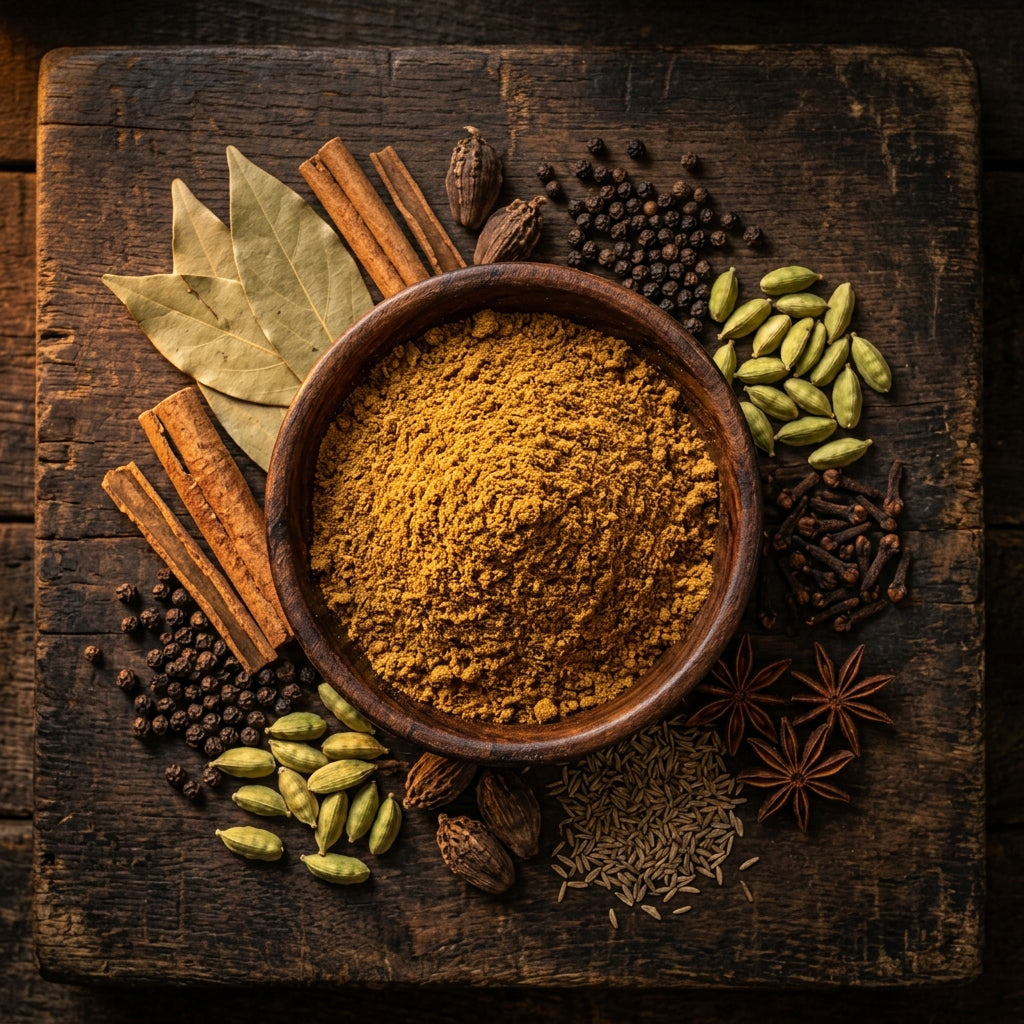
🫙 Garam Masala: Ingredients, Uses, Benefits & Recipes
Short answer: Garam Masala is India's most iconic spice blend — a warm, aromatic mixture of whole spices including black pepper, cardamom, cinnamon, cloves, cumin, and coriander, dry-roasted and ground together. It is used as a finishing spice added at the end of cooking to deliver maximum aroma, and carries documented health benefits from its bioactive compounds including piperine, cinnamaldehyde, and cineole. Every region in India has its own version, but the warming, fragrant character is universal.
🌿 What Makes Garam Masala Different from Other Masalas
Unlike most Indian masalas that are added early in cooking to build flavor into the base, Garam Masala is a finishing spice. It is added in the last 2–3 minutes of cooking, or sprinkled directly on a dish before serving. This late addition preserves the delicate volatile oils in the blend — compounds that evaporate quickly at high temperatures. When Garam Masala is added early in cooking, those oils are destroyed by heat, leaving behind only the structural flavor components and none of the signature warmth and aroma. This is why dishes made with Garam Masala at the start often lack the characteristic fragrance of authentic Indian cooking. Quality Garam Masala — made from cryogenically ground, freshly roasted whole spices — releases its aroma the moment it hits a hot pan surface at the finish, creating the characteristic fragrant bloom that defines well-made Indian food.
🧾 Garam Masala Ingredients: The Classic Whole Spice Blend
The exact composition varies by region and family tradition, but the most widely used authentic Garam Masala formula includes:
| Spice | Role in Blend | Typical % in Blend |
|---|---|---|
| Coriander Seeds | Earthy, citrusy base note | 25–30% |
| Cumin Seeds | Warm, smoky depth | 20–25% |
| Black Pepper | Sharp heat and piperine | 15–20% |
| Green Cardamom | Floral, cooling sweetness | 10–15% |
| Cinnamon | Warm sweetness, cinnamaldehyde | 8–12% |
| Cloves | Intense, pungent warmth | 5–8% |
| Bay Leaf | Subtle herbal background | 3–5% |
| Black Cardamom | Smoky, camphor note | 3–5% |
| Nutmeg / Mace | Warm, nutty complexity | 2–4% |
🍛 How to Use Garam Masala in Cooking
⏱️ When to Add It
Add Garam Masala in the last 2–3 minutes of cooking, or as a dry sprinkle just before serving. Never add it at the start of cooking with oil tempering — the aromatic compounds will evaporate before the dish reaches the plate.
🥘 Best Applications
- 🍛 Curries and gravies — Butter chicken, dal makhani, palak paneer (finish, not start)
- 🍚 Rice dishes — Biryani, pulao (layered in the middle and on top)
- 🍗 Marinades — Mix with yogurt, ginger, garlic for tandoori-style meat and paneer
- 🫘 Lentils and legumes — Stir into dal tarka 2 minutes before serving
- 🥗 Roasted vegetables — Toss root vegetables with Garam Masala and oil before roasting
- 🥚 Eggs — Sprinkle on scrambled eggs or egg bhurji at the finish
- 🌡️ Black Pepper (Piperine) — Enhances bioavailability of other nutrients by up to 2000%, particularly curcumin from turmeric. Anti-inflammatory properties.
- 💛 Cinnamon (Cinnamaldehyde) — Associated with blood sugar regulation and insulin sensitivity in multiple peer-reviewed studies.
- 🌿 Cardamom (Cineole) — Supports digestive function and has demonstrated antioxidant activity. Traditional use for bloating and indigestion.
- ❤️ Cloves (Eugenol) — One of the highest antioxidant ORAC values of any spice. Anti-inflammatory and antimicrobial properties.
- 🧠 Cumin (Cuminaldehyde) — Digestive enzyme stimulation, historically used across Ayurveda and Unani medicine for gut health.
- 🫙 Garam Masala = dry-roasted whole spices ground to powder; use as a finishing spice, not a base
- ⏱️ Add in the last 2–3 minutes of cooking to preserve volatile oil aroma
- 💊 Key bioactives: piperine, cinnamaldehyde, cineole, eugenol, cuminaldehyde — all with health evidence
- 👃 The rub-and-smell test is the fastest quality check — strong, immediate aroma = potent blend
- ❄️ Cryogenically ground Garam Masala retains significantly more aroma and stays potent longer
💊 Garam Masala Health Benefits
Garam Masala's health benefits come directly from the bioactive compounds in its individual spice components:
🍽️ Simple Garam Masala Recipes
🥘 Classic Butter Chicken Finish
Add ½ tsp of Garam Masala to your butter chicken sauce in the last 3 minutes of simmering. Stir gently, cover for 2 minutes, then serve. The result: an aromatic bloom that lifts the entire dish from good to restaurant-quality.
🥗 Garam Masala Roasted Cauliflower
Toss cauliflower florets with 2 tbsp oil, 1 tsp Garam Masala, ½ tsp turmeric, and salt. Roast at 200°C for 25 minutes until golden. Finish with a squeeze of lemon and fresh coriander. One of the simplest and most flavorful vegetarian sides in Indian cooking.
🍗 Garam Masala Tandoori Marinade
Mix 2 tsp Garam Masala, 3 tbsp thick yogurt, 1 tsp ginger paste, 1 tsp garlic paste, 1 tsp Kashmiri chilli, 1 tsp salt, and juice of ½ lemon. Marinate chicken, paneer, or vegetables for 2–6 hours and grill or bake. This is the backbone of tandoori flavor.
✅ Do's and ❌ Don'ts for Using Garam Masala
| ✅ Do | ❌ Don't |
|---|---|
| Add at the end of cooking to preserve aroma | Add to hot oil at the start — all aroma evaporates |
| Start with ¼ tsp and taste before adding more | Overuse — too much Garam Masala makes dishes bitter |
| Buy from cryogenically ground sources for stronger aroma | Use Garam Masala that smells flat or dusty — it's degraded |
| Store in airtight glass containers away from heat | Leave the lid off while cooking — steam degrades the blend |
| Request volatile oil content data when sourcing commercially | Substitute Garam Masala with individual spices without adjusting ratios |
💡 Expert Recommendation
The quality difference in Garam Masala is immediately detectable by smell — no lab test required at the consumer level. Open any packet, take a small pinch, rub between your fingers for 3 seconds, and inhale. Premium Garam Masala — made from whole spices that were dry-roasted before grinding using cryogenic methods — produces an immediate, complex, warm fragrance with distinct cardamom and clove notes. A degraded blend smells generically dusty or faintly spiced at best. For commercial buyers, supplement the smell test with a volatile oil content report. At 365 Spicery, our Garam Masala is tested batch-by-batch for volatile oil percentage because the number that matters most to flavor quality cannot be faked by smell alone in bulk sourcing.
🧑🍳 From a Home Cook's Point of View
Deepa, a food content creator from Pune with 200,000+ followers on Instagram, tested five brands of Garam Masala blind in her kitchen and documented the results for her audience. "The 365 Spicery one was the only one where my husband walked into the kitchen and asked what I was cooking — from a different room. The aroma was that different." She now uses it exclusively and has made it a feature in three of her most-watched recipe videos. Aroma that travels across a room isn't a marketing claim — it's a function of how the spice was processed. Cryogenic grinding preserves that aroma. Conventional grinding often doesn't.
🔑 Key Takeaways
📞 Source Authentic Garam Masala from 365 Spicery
365 Spicery's Garam Masala is made from whole spices sourced from verified Indian origins — cardamom from Wayanad, black pepper from Malabar, cinnamon from Sri Lanka, cloves from Zanzibar — dry-roasted in-house and cryogenically ground for maximum volatile oil retention. Every batch is lab-tested and available for wholesale, private label, and export with full documentation. If you've been using a Garam Masala that doesn't deliver consistent aroma, we'd like to change that. WhatsApp us at +91 72799 00500 or visit www.365spicery.com to request a sample. FSSAI, FSSC 22000, Halal, and Jain certified facility in Mumbai.
---
Q: What are the main ingredients in Garam Masala?
A: The core ingredients in Garam Masala are coriander seeds, cumin, black pepper, green cardamom, cinnamon, cloves, bay leaf, black cardamom, and nutmeg or mace. The exact ratios vary by regional recipe — Punjabi versions are clove-heavy, while South Indian variants often add star anise and marathi mokku.
Q: When should you add Garam Masala to a dish?
A: Add Garam Masala in the last 2–3 minutes of cooking, or as a finishing sprinkle just before serving. This preserves the volatile aromatic compounds that evaporate when exposed to high heat for extended periods. Adding it at the start destroys the aroma that defines a quality Garam Masala.
Q: What does Garam Masala taste like?
A: Garam Masala tastes warm, aromatic, and complex — with notes of floral sweetness from cardamom, sharp warmth from black pepper and cloves, woody sweetness from cinnamon, and earthy depth from cumin and coriander. It is not a hot spice — the warmth is aromatic rather than chilli-based.
Q: What is Garam Masala used for?
A: Garam Masala is used as a finishing spice in Indian curries, biryanis, dals, tandoori marinades, roasted vegetables, and egg preparations. It is also used internationally in fusion cooking — it complements roasted meats, soups, and even some baked goods when used in small quantities.
Q: Is Garam Masala healthy?
A: Yes. The spices in Garam Masala contain documented bioactive compounds: piperine (black pepper) enhances nutrient absorption; cinnamaldehyde (cinnamon) supports blood sugar regulation; cineole (cardamom) supports digestion; eugenol (cloves) has antioxidant and anti-inflammatory properties. These benefits are most potent when the blend is made from fresh, high-quality spices.
Q: Can I substitute Garam Masala with individual spices?
A: You can approximate the flavor using individual spices (cumin, coriander, cardamom, cinnamon, cloves, pepper), but the pre-roasted, ground blend delivers a more integrated flavor profile than adding individual spices separately. For the exact character of Garam Masala, use the blend as formulated rather than building it from scratch per dish.
Q: How long does Garam Masala last?
A: Garam Masala typically lasts 1–1.5 years in an airtight container in a cool, dark place. Cryogenically ground blends retain peak aroma significantly longer than conventionally processed alternatives. Test freshness by rubbing a pinch between your fingers — strong immediate aroma means it's still good; faint or flat smell means it needs replacing.
Q: What is the difference between Punjabi and South Indian Garam Masala?
A: Punjabi Garam Masala is heavy on cardamom, cloves, and black pepper, giving it a bolder, more intensely warming character. South Indian variants often include star anise, kalpasi (stone flower), and marathi mokku, producing a more complex, slightly earthy and less clove-forward blend. Both are authentic expressions of regional cooking traditions.
Q: Can Garam Masala be used in marinades?
A: Yes. Garam Masala is a key ingredient in tandoori-style marinades, typically mixed with yogurt, ginger, garlic, Kashmiri chilli, and salt. When used in marinades, the spice compounds penetrate the protein during the resting period, delivering flavor throughout — not just on the surface.
Q: Does 365 Spicery supply Garam Masala for wholesale and private label?
A: Yes. 365 Spicery supplies Garam Masala in standard and custom regional formulations for wholesale, private label, and export from its FSSAI and FSSC 22000 certified facility in Mumbai. Batch-level lab reports and full export documentation are provided as standard.
---
Garam Masala is the spice that defines the finishing character of Indian cooking — the aroma that makes a dish feel complete, that travels across a room and announces a meal before the first bite. Getting that effect requires the right blend from the right source, added at the right moment. At 365 Spicery, we've built our Garam Masala formulation around that single goal: maximum aroma at the moment of use, batch after batch. If your current Garam Masala doesn't make someone walk into the kitchen to ask what's cooking, it's time to try a different source. What would authentic Garam Masala aroma do for your dishes?
---
Partner with India's Premium Spice Manufacturer
365 Spicery serves 500+ businesses across India with:
- Wholesale & Bulk Supply
- Private Label / White Label Manufacturing
- Custom Spice Formulations
- Jain & Halal Certified Range
- FSSAI | FSSC 22000 | Lab-Tested Quality
WhatsApp: +91 72799 00500
Website: www.365spicery.com
Location: Mumbai, Maharashtra, India
---


Share:
Paprika vs Chili Powder: Complete Comparison Guide
Peri Peri Seasoning: Ingredients, Uses & Recipe Ideas