


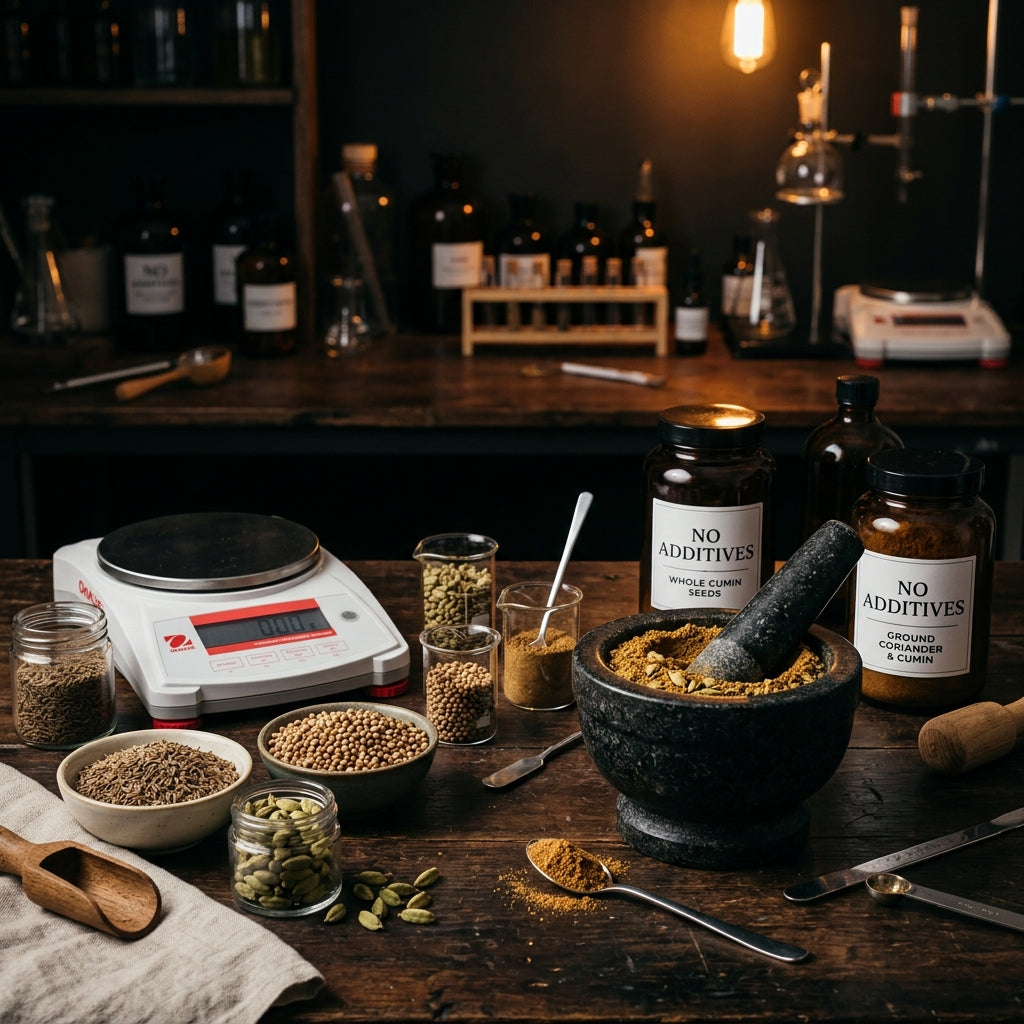
⚗️ How Custom Seasoning Blends Are Developed: A Step-by-Step Guide
Short answer: Custom seasoning blend development follows six stages: defining the flavor brief, selecting and sourcing ingredients, creating prototype formulations, conducting sensory and lab evaluation, refining based on feedback, and scaling to production with full documentation. The entire process — from brief to approved blend — typically takes 2–6 weeks depending on complexity and iteration rounds. Getting each stage right determines whether the final product delivers consistent flavor batch after batch.
🤔 Why Custom Blends Matter More Than Off-the-Shelf Seasonings
Off-the-shelf seasoning blends give every business that uses them the same flavor profile. For a food brand, a restaurant chain, or a QSR operator building a signature product, that's a competitive disadvantage — because the same flavor is available to every competitor. Custom seasoning blends are proprietary formulations developed specifically for one brand's application, target market, and flavor identity. They're also optimizable for specific requirements that generic blends cannot address: Jain certification, Halal compliance, clean label, reduced sodium, specific heat levels, or shelf life targets. At 365 Spicery, custom blend development is one of our core services — and the process behind every successful blend follows the same structured methodology.
🔄 The 6 Stages of Custom Seasoning Blend Development
📋 Stage 1 — The Flavor Brief
Everything starts with a precise brief. A good flavor brief answers six questions: What is the end application (snack coating, marinade, instant mix, table seasoning)? Who is the target consumer? What is the target flavor profile (heat level, aroma direction, regional inspiration)? Are there any ingredient restrictions (no onion/garlic for Jain, no allergens, clean label)? What is the required certification (Halal, FSSAI, organic)? What is the target shelf life and packaging format? The quality of the brief directly determines the efficiency of the development process. Vague briefs produce multiple misaligned prototypes. Specific briefs produce first-round samples that are close to the target.
🌿 Stage 2 — Ingredient Selection and Sourcing
Based on the flavor brief, the formulation team selects individual spice and herb ingredients from verified sources. Origin matters significantly — turmeric from Erode (Tamil Nadu) has higher curcumin content than material from other regions. Guntur chilli delivers the heat profile that Kashmiri chilli cannot. Cardamom from Wayanad (Kerala) carries different essential oil characteristics than Guatemalan cardamom. At 365 Spicery, ingredient selection is informed by regional sourcing knowledge and backed by incoming quality checks on volatile oil content, moisture, and purity before any ingredient enters a custom blend.
⚗️ Stage 3 — Prototype Formulation
The formulation team develops initial prototypes based on the flavor brief. This typically involves testing 2–4 starting ratios of key ingredients, then adjusting individual components for heat balance, aroma intensity, color contribution, and texture. For complex blends with 8–15 ingredients, this is an iterative process — small adjustments to one component can shift the entire profile. Each prototype is documented with precise ingredient percentages so that any approved formulation can be reproduced exactly in full production scale.
👃 Stage 4 — Sensory and Lab Evaluation
Prototype samples are evaluated on two levels simultaneously. Sensory evaluation covers appearance (color and particle size), aroma (volatile oil intensity), taste (heat, salt, sweetness balance), and performance in the intended application (how the blend behaves when applied to the actual food product or cooking process). Lab evaluation covers moisture content, volatile oil percentage, microbiological safety, and any client-specified parameters such as curcumin or capsaicin content. Both evaluations are necessary — a blend that smells and tastes excellent but fails moisture specs will have shortened shelf life. A blend that passes lab tests but underperforms sensorially won't satisfy end consumers.
🔁 Stage 5 — Iteration and Client Approval
Client feedback on the initial prototype typically produces one or two rounds of refinement. Common adjustments include increasing or decreasing heat intensity, modifying salt levels, adjusting aroma balance (more herbal vs. more spicy), or changing particle size for better visual or textural effect. Each revision is documented and compared against the previous version so the client can clearly articulate what changed and why. The goal is a formulation that both passes internal quality benchmarks and satisfies the client's sensory expectations — simultaneously, not separately.
🏭 Stage 6 — Scale-Up and Documentation
Once a formulation is approved, it's scaled from bench prototype to full production batch. This stage validates that the blend profile is consistent at scale — because ingredient ratios that work perfectly at 100g sometimes behave differently at 50kg due to mixing dynamics, particle size distribution, or moisture migration. Full production documentation includes the final formulation spec sheet, ingredient lot traceability, batch-level lab report, and packaging specifications. Every approved blend at 365 Spicery is assigned a formulation code that can be reproduced identically for every future order.
✅ Do's and ❌ Don'ts When Developing a Custom Seasoning Blend
| ✅ Do | ❌ Don't |
|---|---|
| Prepare a detailed flavor brief before the first call | Start with "make something like this" without specifics |
| Request sensory AND lab evaluation on every prototype | Approve a blend based on taste alone — lab spec matters |
| Ask for formulation code and spec sheet at approval | Assume verbal approval is sufficient — document everything |
| Test the blend in your actual end application, not standalone | Evaluate seasoning only in isolation — context changes flavor |
| Confirm shelf life testing before launch | Skip scale-up validation assuming bench results will hold |
💡 Expert Recommendation
The most common reason custom seasoning projects run over budget and timeline is an under-specified flavor brief at the start. Invest 30 minutes before the first supplier call to write down your target application, three flavor references you want to be close to, any hard ingredient restrictions, and your target shelf life. Share this in writing with your manufacturer. A formulation team that receives a detailed brief can produce a first-round prototype that's 70–80% of the way to the final product. A team working from a vague description starts from scratch after every client feedback session. Specificity at the brief stage saves weeks and money at the development stage.
🧑🍳 From a Food Brand's Point of View
Arjun, founder of a packaged snack brand in Chennai, spent three months and four prototype rounds with a local blender before approaching 365 Spicery for his signature tangy masala coating. "When I first called them, they asked me to describe three snacks I'd eaten recently that were close to what I wanted — and then asked what was missing from each one. No one had asked me that before. That conversation produced a first sample that was already 80% right." The quality of the development conversation reflects the quality of the formulation team. The right manufacturer asks the right questions before making anything.
🔑 Key Takeaways
- 📋 A detailed flavor brief is the single most important input for efficient custom blend development
- ⚗️ Development follows 6 stages: brief → ingredient selection → prototype → sensory & lab eval → iteration → scale-up
- 🌿 Ingredient origin significantly affects the final flavor — regional sourcing knowledge matters
- 🧪 Sensory and lab evaluation must both pass — neither alone is sufficient for approval
- 📄 A formulation code and spec sheet at approval guarantees reproducibility for every future batch
📞 Develop Your Custom Seasoning Blend with 365 Spicery
If you have a flavor in mind — or even just a direction — 365 Spicery's formulation team can develop a custom seasoning blend that delivers it consistently, compliantly, and at scale. We work with food brands, QSR chains, cloud kitchens, and export buyers on everything from simple two-ingredient blends to complex multi-component masalas with specific bioactive or certification requirements. WhatsApp us at +91 72799 00500 or visit www.365spicery.com to start your custom blend project. First samples available at low MOQ. FSSAI, FSSC 22000, Halal, and Jain certified facility in Mumbai.
---
Q: How long does it take to develop a custom seasoning blend?
A: Custom seasoning blend development typically takes 2–6 weeks from brief to approved formulation, depending on complexity and number of iteration rounds. Simple 3–5 ingredient blends can be approved in 2 weeks; complex multi-component masalas with specific certification requirements may take 4–6 weeks.
Q: What information do I need to provide to develop a custom seasoning blend?
A: Provide a flavor brief covering: the end application (snack, marinade, instant mix), target consumer and market, desired flavor profile (heat level, aroma direction, regional inspiration), any ingredient restrictions (no onion/garlic, no allergens, clean label), required certifications, and target shelf life and packaging format.
Q: How many prototype rounds are typical for custom seasoning development?
A: Most custom seasoning blends require 2–3 prototype rounds before client approval. A well-specified flavor brief reduces this to 1–2 rounds. Vague briefs often require 4–5 iterations, significantly extending the development timeline and cost.
Q: Can I get a proprietary custom seasoning blend that no competitor can copy?
A: Yes. A fully documented custom formulation with a unique specification code is your proprietary product. Reputable manufacturers like 365 Spicery do not share client formulations with other buyers. Ensure your agreement includes a confidentiality clause covering the formulation specifications.
Q: What certifications can custom seasoning blends have?
A: Custom seasoning blends can be developed to meet FSSAI, FSSC 22000, Halal, Jain (no onion/garlic), organic, and clean label requirements. The certifications available depend on the manufacturer's facility credentials. 365 Spicery's facility is certified for FSSAI, FSSC 22000, Halal, and Jain formulations.
Q: What is the minimum order quantity (MOQ) for a custom seasoning blend?
A: MOQ varies by manufacturer and product complexity. At 365 Spicery, custom seasoning blends are available at low initial MOQs for sample and trial orders, scaling to full production quantities once the formulation is approved. Contact us at +91 72799 00500 for specific MOQ details for your project.
Q: How is custom seasoning blend consistency maintained across batches?
A: Consistency is maintained through a documented formulation spec sheet with precise ingredient percentages, a traceability system linking each production batch to specific ingredient lots, and batch-level lab testing that verifies key quality parameters before dispatch. A unique formulation code ensures every reorder matches the approved prototype.
Q: Can a custom seasoning blend be scaled from small batch to bulk production?
A: Yes, but scale-up validation is a distinct stage in the development process. Ingredient ratios that produce the correct profile at 100g may behave differently at 50kg due to mixing dynamics and moisture migration. A responsible manufacturer validates the blend at production scale before confirming it as production-ready.
Q: How does ingredient origin affect a custom seasoning blend?
A: Ingredient origin significantly affects flavor. Erode turmeric has higher curcumin content than other origins. Guntur chilli delivers different heat profiles than Kashmiri chilli. Wayanad cardamom carries different essential oil characteristics than Guatemalan cardamom. Regional sourcing knowledge in your manufacturer's team directly affects the quality and authenticity of the final blend.
Q: Does 365 Spicery offer custom seasoning blend development services?
A: Yes. 365 Spicery develops custom seasoning blends for food brands, QSR chains, cloud kitchens, and export buyers from its FSSAI and FSSC 22000 certified facility in Mumbai. Services include full formulation development, sensory and lab evaluation, scale-up validation, and private label packaging.
---
Custom seasoning blend development is a manufacturing capability that most food brands underutilize because they don't know it's accessible at reasonable MOQs and timelines. But the brands that invest in a proprietary formulation build something that off-the-shelf seasonings can never deliver: a flavor that's theirs alone. The six-stage process outlined here is the same one used by professional food manufacturers globally — and the difference between a successful first prototype and months of revisions comes down almost entirely to how well the flavor brief is written before the first sample is made. What flavor are you trying to create?
---
Partner with India's Premium Spice Manufacturer
365 Spicery serves 500+ businesses across India with:
- Wholesale & Bulk Supply
- Private Label / White Label Manufacturing
- Custom Spice Formulations
- Jain & Halal Certified Range
- FSSAI | FSSC 22000 | Lab-Tested Quality
WhatsApp: +91 72799 00500
Website: www.365spicery.com
Location: Mumbai, Maharashtra, India
---


Share:
Food Seasoning Trends Shaping the Global Market in 2026
Types of Masala Powder Used in Indian Cooking