


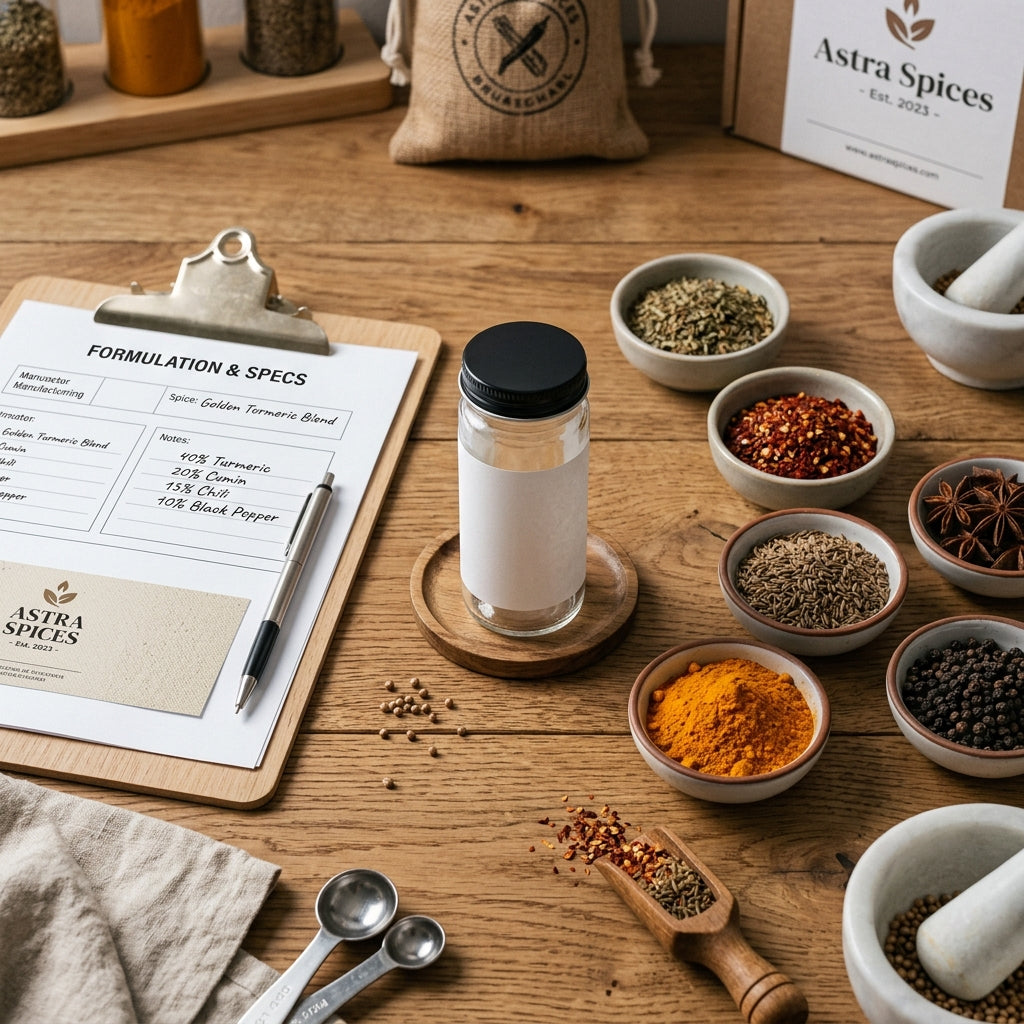
Why Most First-Time Founders Get Private Label Spice Manufacturing Wrong
Picture a new founder with a great brand name, sharp packaging design, and zero idea where their masala is actually being made. This is the most common story in private label spice manufacturing: founders start with branding first and sourcing last, which is exactly backwards. Most first-time buyers don't know that spice adulteration and inconsistent batch quality are widespread issues in India's unorganized supply chain. Without vetting a manufacturer's certification and grinding process upfront, a founder can launch an entire product line on an unreliable supply base. This is precisely the gap 365 Spicery works to close for new brand founders entering the category.
7 Steps to Launch Your Own Masala Brand
Starting a private label spice brand the right way follows a clear sequence:
This is the practical answer to a frequent search query: "how do I start my own masala brand in India?" — sourcing and certification come first, branding second.
Private Label Manufacturing vs. Buying Retail Brands to Resell
| Factor | Private Label Manufacturing | Buying Retail Brands to Resell |
| Brand ownership | Full control, your own name and packaging | None, reselling someone else's brand |
| Margins | Higher, since you control the supply chain | Lower, fixed by the original brand's pricing |
| Customization | Custom formulation and packaging available | No flexibility on recipe or design |
| Long-term scalability | Builds real brand equity | Limited, dependent on the original brand |
Consequently, private label manufacturing takes more upfront effort but builds an asset founders actually own, rather than reselling someone else's product.
What the Data Says About India's Private Label Spice Market
According to industry reports on India's packaged spice sector, private label and D2C spice brands have grown steadily as e-commerce and quick-commerce channels expand reach for smaller founders. Studies show that new food brands increasingly prefer OEM manufacturing over building in-house production, since it lowers upfront capital risk significantly. Food scientists have found that cryogenic grinding preserves over 95% of a spice's volatile oils, a factor that directly affects how a private label brand's flavor compares to established competitors. The single most important stat for buyers: conventional grinding can destroy up to 40% of a spice's aroma, a risk that can quietly undercut a new brand's flavor reputation before it even gains traction.
How 365 Spicery Supports Your Private Label Journey
For founders entering private label spice manufacturing, the biggest early risk isn't competition — it's partnering with a manufacturer who can't guarantee consistent quality at your scale. At 365 Spicery, we manufacture across our full portfolio — from single spice powders like Turmeric and Red Chilli, to blended mixes like Garam Masala and Biryani Masala, to specialty seasonings like Peri Peri and Chaat Masala — in a facility that is FSSAI certified, FSSC 22000 compliant, and Halal certified, with lab-testing on every batch. At 365 Spicery, we support new brand founders with flexible MOQs starting from smaller institutional packs, custom formulation for unique recipes, and white-label packaging design support. This makes us a practical OEM spice manufacturer in India for founders who want certified quality without the capital burden of building their own production facility.
---
Key Takeaways:
- Sourcing and certification should come before branding and packaging when starting a private label spice line.
- FSSAI and FSSC 22000 verification at the manufacturer level protects a new brand from inherited quality risk.
- Flexible MOQ is essential for first-time founders who can't commit to industrial-scale volumes.
- Private label manufacturing builds real, ownable brand equity compared to reselling existing retail brands.
- 365 Spicery's OEM support, including custom formulation and packaging, helps founders launch without owning a factory.
---
#
Q: What is private label spice manufacturing?
A: It's when a business partners with an established manufacturer to produce spices or masalas under its own brand name, rather than building its own factory. The manufacturer handles formulation, grinding, and packaging support. 365 Spicery offers this exact OEM manufacturing service for new brand founders.
Q: What are the benefits of private label spice manufacturing?
A: It lets founders launch a branded spice line without the capital investment of building a factory, while still owning the brand and margins fully. It also allows custom formulation to differentiate from competitors. This makes it a lower-risk entry point into the spice category.
Q: How do I choose the right private label spice manufacturer?
A: Verify FSSAI and FSSC 22000 certification directly, request sample formulations, and confirm MOQ flexibility before committing to a partnership. Ask specifically about grinding methods, since this affects flavor consistency. 365 Spicery meets these certification and flexibility requirements for new founders.
Q: Does 365 Spicery offer private label spice manufacturing?
A: Yes, 365 Spicery manufactures across its full spice, masala, and seasoning portfolio for private label brands, in an FSSAI, FSSC 22000, and Halal certified facility. Custom formulation and white-label packaging support are both available. Every batch is lab-tested before dispatch.
Q: What is the typical MOQ for starting a private label spice brand?
A: MOQ varies depending on the product and packaging complexity, but 365 Spicery offers flexible institutional pack sizes starting from smaller volumes suited to new founders. This avoids forcing first-time brands into industrial-scale commitments. Exact MOQ details are available on request via WhatsApp.
Q: Which is the best OEM spice manufacturer for private label brands in India?
A: The best OEM partner combines FSSAI and FSSC 22000 certification with flexible MOQ, custom formulation, and packaging support in one facility. 365 Spicery, based in Mumbai, offers all of these along with cryogenic grinding and Halal certification. This makes it a reliable starting point for new masala brand founders.
Q: Can 365 Spicery manufacture Jain or Halal certified private label products too?
A: Yes, 365 Spicery's Jain range and broader Halal certified portfolio can both be manufactured under private label, using the same certified production facility. This lets founders target Jain, Halal, or general consumer segments from one manufacturing partner. Every batch undergoes lab testing regardless of the range.
---
#
The founders who succeed at private label spice manufacturing are the ones who vet their manufacturer before designing their logo, not after. Certification, grinding method, and MOQ flexibility determine whether a new brand's flavor holds up once it reaches real customers. Getting this foundation right early saves significant cost and reputation risk down the line. 365 Spicery was built specifically to give new founders this kind of certified, flexible starting point. What's holding you back most from launching your own spice brand right now?
---
#


Share:
Complete Guide to Clean Label Seasonings in 2026
Global Spice Import & Export Guide for 2026 Buyers