


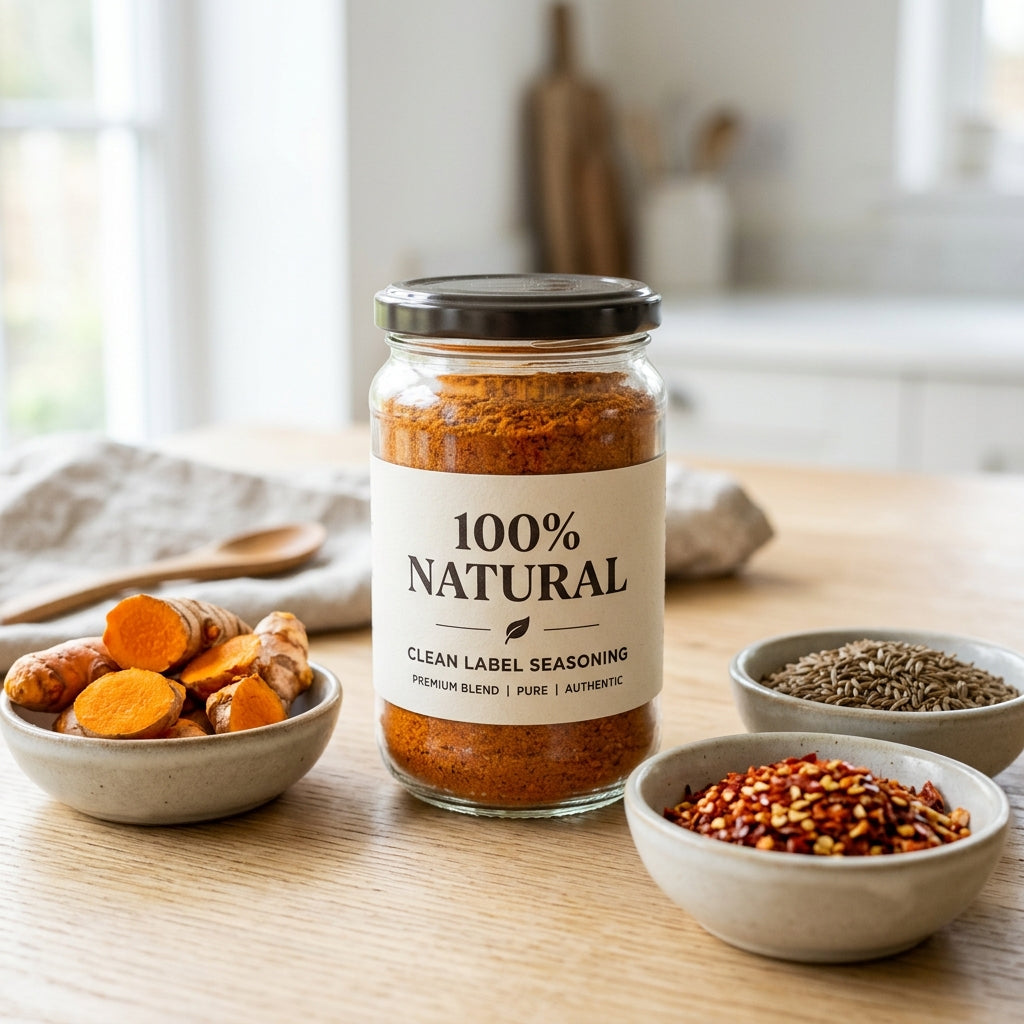
Why Clean Label Seasonings Are Harder to Source Than They Sound
Here's a fact that surprises most FMCG buyers: many products marketed as "natural" or "clean label" still contain undisclosed flavor enhancers or ambiguous "spices" listed as a single catch-all ingredient. Genuine clean label seasonings require full ingredient transparency, natural sourcing, and no artificial additives, yet this standard is rarely audited at the manufacturing level. This is a direct extension of a bigger issue in Indian spice sourcing: adulteration and inconsistent labeling remain common, making clean label claims difficult for buyers to verify. Food manufacturers building or reformulating seasoning SKUs face real regulatory and reputational risk if a supplier's clean label claim doesn't hold up. At 365 Spicery, this exact gap shapes how our seasonings are formulated and certified.
6 Steps to Build a Genuine Clean Label Seasoning
Reformulating or launching a clean label seasoning takes a structured approach, not just an ingredient swap:
This directly answers a growing search query: "what is a clean label seasoning and how is it different from regular seasoning?" — the difference lies in traceable, natural ingredients over synthetic shortcuts.
Clean Label Seasoning vs. Conventional Flavor-Enhanced Blend
| Factor | Clean Label Seasoning | Conventional Flavor-Enhanced Blend |
| Ingredient list | Recognizable natural spices | Often includes MSG, additives, vague terms |
| Processing | Cryogenic grinding, natural aroma retention | Conventional grinding, may rely on flavor boosters |
| Consumer trust | High, ingredient-transparent | Increasingly scrutinized |
| Certification | FSSAI, FSSC 22000, lab-tested | Varies, rarely fully documented |
As a result, the real differentiator between these two categories isn't marketing language — it's what's genuinely inside the pack and how it was processed.
What the Data Says About Clean Label Demand
According to industry reports on packaged food trends, clean label claims have become one of the fastest-growing purchase drivers across Indian FMCG and QSR categories. Studies show that consumers increasingly associate shorter, recognizable ingredient lists with higher trust in a brand, even for processed products. Food scientists have found that cryogenic grinding preserves over 95% of a spice's volatile oils, letting natural aromatics carry flavor intensity that synthetic enhancers are otherwise used to simulate. The single most important stat for buyers: conventional grinding can destroy up to 40% of a spice's aroma-carrying oils, a loss many manufacturers quietly compensate for with additives — the exact shortcut clean label formulations move away from.
How 365 Spicery Manufactures Genuine Clean Label Seasonings
For food manufacturers and private label founders, the hardest part of going clean label isn't the decision — it's finding a manufacturer who can deliver natural flavor intensity without synthetic shortcuts. At 365 Spicery, our seasonings and premixes — including Pizza Seasoning, Peri Peri Seasoning, Chaat Masala, and Kitchen King Masala — are formulated from whole and single-ground spices, processed using Cryogenic Grinding Technology, and manufactured in a facility that is FSSAI certified, FSSC 22000 compliant, and Halal certified, with lab-testing on every batch. This combination is what allows a genuinely clean label product to still deliver restaurant-grade flavor without artificial additives. At 365 Spicery, we also support private label and custom formulation for FMCG brands reformulating existing seasoning SKUs toward clean label standards, with flexible MOQs and institutional packs from 1kg to 50kg.
---
Key Takeaways:
- Clean label seasonings require transparent, recognizable ingredients — not just a "natural" claim on packaging.
- Vague terms like "spice extract" often hide synthetic flavor enhancers that undermine a genuine clean label claim.
- Cryogenic grinding lets natural spices carry flavor intensity without relying on additives.
- FSSAI and FSSC 22000 certification at the manufacturing level is what actually proves a clean label claim.
- 365 Spicery's seasoning range is built on whole and single-ground spices, letting brands go clean label without losing flavor.
---
#
Q: What is a clean label seasoning?
A: It's a seasoning blend made entirely from recognizable, natural ingredients like whole spices and single spice powders, without artificial flavor enhancers or vague additive terms. It prioritizes ingredient transparency over synthetic shortcuts. 365 Spicery's seasoning range is formulated specifically around this standard.
Q: Why does clean label matter for seasonings specifically?
A: Seasonings are especially prone to synthetic flavor enhancers since they need strong, consistent taste in small doses. A clean label seasoning proves this intensity comes from natural spices, not additives. This matters increasingly to consumers who read ingredient lists before buying.
Q: How do I choose a genuine clean label seasoning supplier?
A: Look for a manufacturer that lists specific spices rather than vague terms like "flavoring" or "spice extract," and verify FSSAI and FSSC 22000 certification directly. Requesting a sample batch helps confirm consistency. 365 Spicery meets both certification requirements as a Mumbai-based manufacturer.
Q: Does 365 Spicery manufacture clean label seasonings?
A: Yes, 365 Spicery's seasoning and premix range, including Pizza, Peri Peri, and Chaat Masala, is built from whole and cryogenically ground spices in an FSSAI, FSSC 22000, and Halal certified facility. Every batch is lab-tested. This suits FMCG brands, HoReCa buyers, and private label founders.
Q: Can I get clean label seasonings in bulk for my brand?
A: Yes, 365 Spicery supplies its seasoning range in institutional packs from 1kg to 50kg, with private label and custom formulation options available. Flexible MOQs suit both new private label founders and established FMCG buyers. Wholesale pricing is available on request via WhatsApp.
Q: Which is the best clean label spice manufacturer in India?
A: A genuine clean label manufacturer should combine natural ingredient sourcing with verifiable FSSAI and FSSC 22000 certification, not just a marketing claim. 365 Spicery, based in Mumbai, meets this standard through cryogenic grinding and Halal certification as well. This makes it a reliable choice for brands scaling clean label SKUs.
Q: Are 365 Spicery's clean label seasonings also Halal certified?
A: Yes, the same production facility manufacturing the seasoning range holds Halal certification alongside FSSAI and FSSC 22000 compliance. This allows one certified line to serve clean label, Jain, and Halal-specific buyers together. Every batch undergoes lab testing before dispatch.
---
#
Genuine clean label seasonings come down to one thing: transparency, both in the ingredient list and in how the spices were processed. Brands that source whole and single-ground spices, verify certification at the manufacturing level, and choose cryogenic grinding over synthetic shortcuts are the ones building real consumer trust in 2026. 365 Spicery's seasoning range was built around exactly this standard from the start. Has your brand already started auditing its ingredient list for clean label reformulation?
---
#


Share:
Cryogenic Grinding Technology Explained: Complete Guide
Private Label Spice Manufacturing: The Complete Guide