


Intro
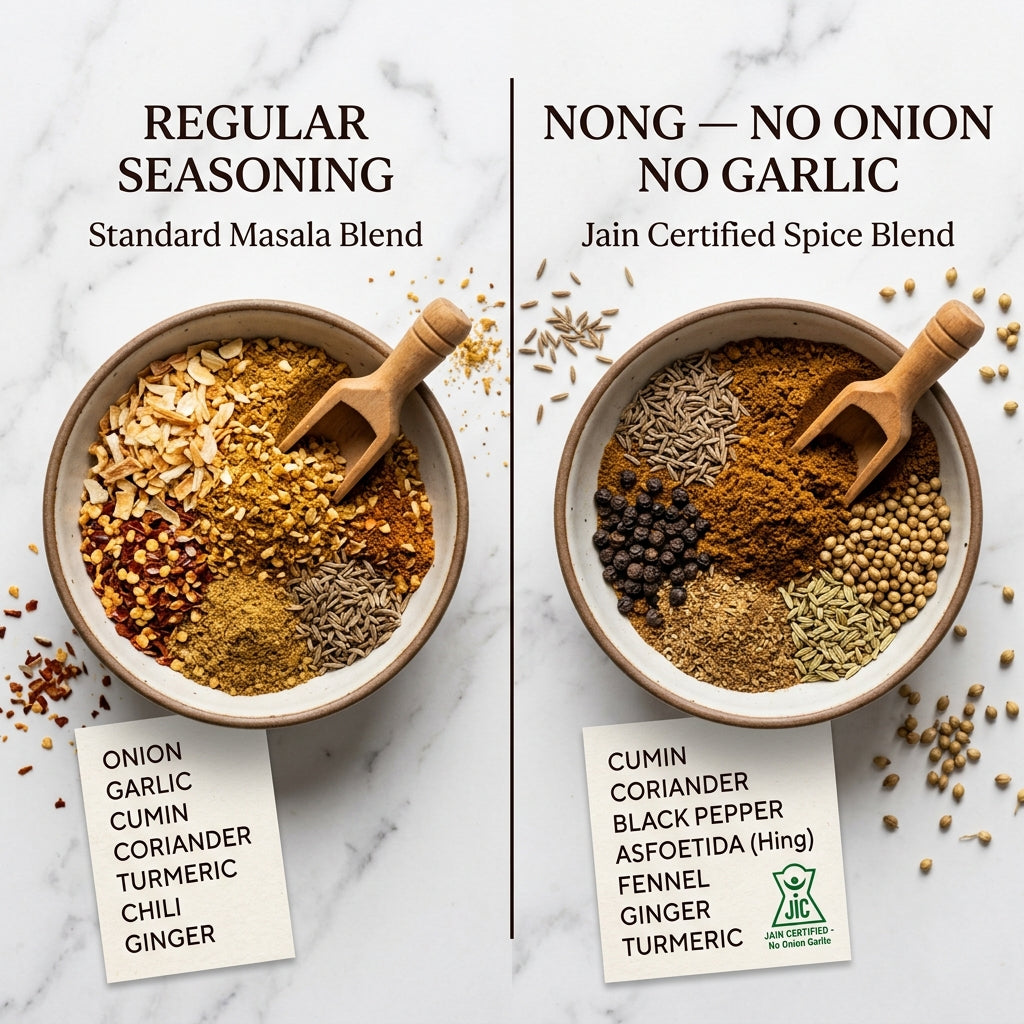
Here's a question most buyers don't think to ask: if you remove onion and garlic from a masala blend, what actually replaces the flavor they provided? The answer to that question is the difference between a genuinely engineered no onion no garlic vs regular seasoning and a standard blend with two ingredients quietly left out. The distinction matters commercially, culinarily, and from a compliance standpoint. Most buyers discovering NONG products for the first time assume the difference is only dietary. The real differences run much deeper — into formulation philosophy, processing requirements, and manufacturing infrastructure. At 365 Spicery, we manufacture both categories separately and the gap between them is visible from the first batch. This article maps every meaningful difference so buyers, brands, and food operators know exactly what they're sourcing.
What Actually Separates NONG Seasonings from Regular Ones
The most common misconception about NONG spices India is that they are simply regular masalas with onion and garlic removed. In practice, onion and garlic together provide a significant proportion of the savory depth, moisture-binding capacity, and base flavor foundation in most standard masala formulations. Removing them without reformulating the rest of the blend produces a flat, incomplete product that will fail on the plate. Additionally, the volatile oils in spices that carry aromatic complexity must work harder in a NONG blend — there is no allium base to anchor the flavor profile. Products like Jain Garam Masala or Jain Chole Masala require careful ratio adjustment of remaining spices like cumin, coriander, and black pepper to compensate meaningfully, not just proportionally.
How to Tell a Genuine NONG Seasoning from a Relabeled Regular Blend: 4 Checks
What are Jain spices and how do buyers verify they're genuinely NONG? Four practical checks before sourcing:
Therefore, the safest procurement approach treats NONG sourcing as a supplier qualification exercise, not simply a product selection decision.
No Onion No Garlic vs Regular Seasonings: A Direct 7-Point Comparison
| Factor | Regular Seasoning | No Onion No Garlic Seasoning |
| Base flavor source | Onion, garlic, and spice blend | Spice-only formulation, no alliums |
| Formulation complexity | Standard ratio balancing | Re-engineered without allium depth |
| Processing requirement | Standard shared production lines | Dedicated NONG-only lines mandatory |
| Certification needed | FSSAI standard | FSSAI + Jain certification |
| Suitable consumer groups | General market | Jain, vegan, sattvic, FODMAP-sensitive |
| Flavor risk if done poorly | Minimal — allium provides base | High — flat and unconvincing without re-engineering |
| Export market compatibility | Broad | Broader — adds Jain diaspora and allium-free segments |
As a result, a well-made NONG seasoning is not a lesser version of a regular one — it is a more technically demanding product that serves a wider combined audience when executed correctly.
What the Science Shows About Allium-Free Flavor Engineering
According to industry reports, onion and garlic contribute a complex sulfur-compound flavor base that requires deliberate spice ratio compensation when removed, not simply a one-to-one replacement with more of the remaining ingredients. Studies show that terpene preservation grinding — specifically cryogenic processing at -40°C to -80°C — is significantly more critical in NONG blends than in regular seasonings, because every remaining aromatic compound must carry proportionally more flavor weight. Furthermore, food scientists have found that cryogenic grinding retains over 95% of a spice's volatile oils, compared to roughly 60% in conventional hot grinding — a gap that is far more consequential in NONG formulations where there is no allium depth to absorb the shortfall.
How 365 Spicery Manufactures NONG and Regular Seasonings Separately
At 365 Spicery, our NONG and regular seasoning ranges are manufactured on completely separate processing lines within our FSSAI, FSSC 22000, and Halal certified Mumbai facility. This separation is non-negotiable — cross-contamination between lines would invalidate the Jain certification that makes our NONG products commercially credible. Our Jain range includes Jain Garam Masala, Jain Chole Masala, Jain Kitchen King, Jain Biryani Masala, and Jain Sambar Powder, all formulated using cryogenically ground masala with individually re-engineered spice ratios. For the Jain no onion no garlic garam masala in bulk segment particularly, this separation and formulation rigor is what separates a trustworthy NONG supplier from one simply relabeling regular stock. Whether you need wholesale supply or private label, both ranges are lab-tested and fully documented before dispatch.
Key Takeaways:
- NONG seasonings are separately engineered products, not regular blends with ingredients removed
- Onion and garlic provide savory depth that must be deliberately compensated through spice ratio re-engineering
- Dedicated processing lines are non-negotiable for valid Jain certification
- Cryogenic grinding matters more in NONG blends because every remaining spice carries more flavor weight
- 365 Spicery manufactures NONG and regular ranges on completely separate lines with full documentation
---
Q: What is the difference between no onion no garlic and regular seasonings?
A: No onion no garlic seasonings are separately engineered blends where onion and garlic are excluded by formulation design, not simply omitted from a standard recipe. The remaining spices are re-balanced to compensate for lost flavor depth. 365 Spicery formulates both no onion no garlic vs regular seasonings on entirely separate processing lines.
Q: Why does removing onion and garlic require a reformulated seasoning?
A: Onion and garlic provide a significant sulfur-compound flavor base that cannot simply be removed without leaving the blend flat and incomplete. A genuine NONG seasoning compensates through deliberate spice ratio adjustments. This is why NONG spices India products require separate formulation, not just ingredient omission.
Q: How do I verify a NONG seasoning is genuinely allium-free?
A: Request full ingredient documentation, Jain certification in writing, and confirmation of dedicated NONG-only processing lines. Also taste-test sample batches — a genuine NONG blend tastes complete, while a relabeled regular blend tastes noticeably flat. 365 Spicery provides full documentation and sample batches on request.
Q: Does 365 Spicery manufacture NONG and regular seasonings separately?
A: Yes, 365 Spicery operates completely separate processing lines for our Jain NONG range and our standard seasonings within our FSSAI and FSSC 22000 certified Mumbai facility. This separation prevents cross-contamination and maintains the integrity of our Jain certified spices India products. Every batch from both lines is lab-tested before dispatch.
Q: Can I order both NONG and regular seasonings from 365 Spicery in bulk?
A: Yes, 365 Spicery supplies both ranges in flexible MOQs from 1kg up to 50kg, with private label and white label options available for both. This allows food brands to build a combined product portfolio from a single certified manufacturer. Contact us via WhatsApp for current pricing across both ranges.
Q: Which is the best supplier for no onion no garlic masala in bulk in India?
A: 365 Spicery, based in Mumbai, is an FSSAI and FSSC 22000 certified manufacturer supplying NONG spices India on dedicated processing lines with full Jain certification. Our cryogenically ground Jain range includes Garam Masala, Biryani Masala, and Kitchen King. Orders are placed directly via WhatsApp or our website.
Q: Are NONG seasonings suitable for Halal consumers as well as Jain?
A: Yes, 365 Spicery's NONG range is manufactured in a Halal certified facility alongside Jain-compliant formulation. This dual compliance makes our adulteration-free spices suitable for both Jain and Halal-conscious buyers simultaneously. It is one reason our NONG range is increasingly sought after by export buyers targeting multiple dietary segments.
---
The difference between no onion no garlic and regular seasonings is not a dietary footnote — it's a formulation philosophy, a processing infrastructure decision, and a certification commitment all at once. Buyers who understand this source NONG products from manufacturers who have built dedicated systems around it, not those who simply print a new label on existing stock. The commercial upside for brands and food operators who get this right is real: a single genuinely certified NONG product line simultaneously serves Jain, vegan, sattvic, and FODMAP-sensitive consumers. At 365 Spicery, our NONG and regular ranges are built as separate products for exactly this reason. When you next evaluate a NONG supplier, which of the four verification checks above will you start with?
---


Share:
Clean Label Foods Future: What Seasoning Manufacturers Need
Top Ingredients Used in No Onion No Garlic Seasonings