


Intro
Most food buyers assume that a no onion no garlic seasoning simply has a shorter ingredient list than a regular masala. The opposite is often true. A well-engineered no onion no garlic seasoning ingredients list is actually more carefully considered than a standard blend, because every ingredient must pull significantly more flavor weight without allium support. The buyer pain point here is real and underappreciated: suppliers who don't understand this formulation challenge produce flat, unconvincing NONG blends that fail in the kitchen. At 365 Spicery, ingredient selection for our Jain range follows a separate formulation protocol entirely, not a modified version of our standard process. This article identifies the top ingredients that make NONG seasonings work and explains exactly why each one earns its place in a certified blend.
Why the Ingredients in a NONG Seasoning Matter More Than in a Regular Blend
Onion and garlic together contribute a sulfur-compound savory base that most Indian masala formulations are built around. When both are removed, the remaining ingredients don't simply step into that space automatically — each one must be deliberately elevated in either quantity, quality, or both. This is where volatile oils in spices become the central formulation variable: spices with high natural volatile oil content, when properly preserved through cryogenic grinding, can compensate for the lost allium depth more effectively than conventionally ground alternatives. Products like Jain Biryani Masala and Jain Kitchen King depend on this compensation working correctly across every batch. Additionally, food adulteration India concerns are heightened in NONG products because adulterated base spices with low volatile oil content make the compensation task impossible, regardless of the ratio used.
Top 12 Ingredients That Build Flavor in No Onion No Garlic Seasonings
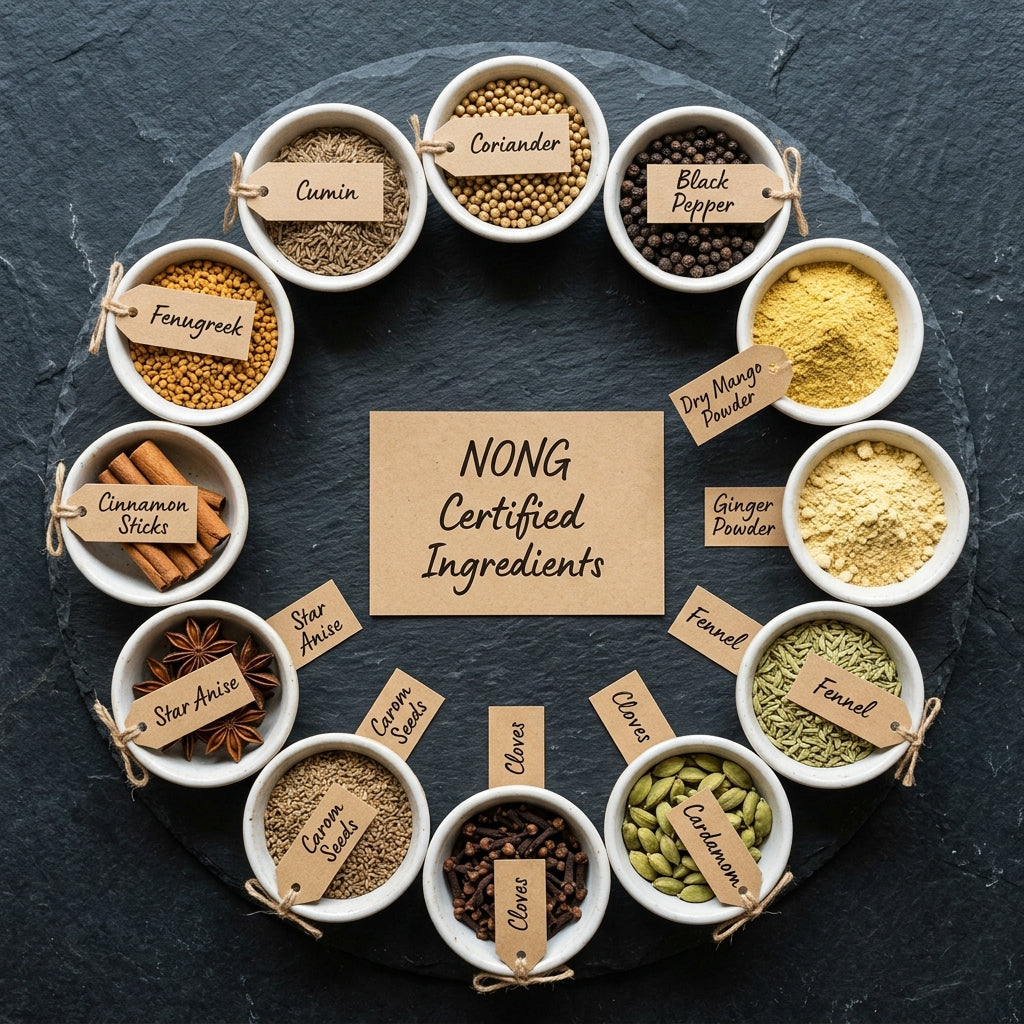
What are the top ingredients used in no onion no garlic seasonings that actually deliver results? Here are the twelve that certified NONG formulators rely on:
Therefore, a strong NONG formulation doesn't rely on any single ingredient to replace allium depth — it distributes the compensation across multiple spices working together.
NONG Ingredient Selection: Weak Formulation vs. Strong Formulation
| Factor | Weak NONG Formulation | Strong NONG Formulation |
| Allium replacement strategy | Simply omitted, no compensation | Distributed across 4-6 spice substitutes |
| Grinding method | Conventional, volatile oil loss up to 40% | Cryogenic, 95%+ volatile oil retention |
| Ginger powder role | Absent or minimal | Elevated as primary pungency substitute |
| Dry mango powder | Not included | Used for acidity and complexity layering |
| Fenugreek | Optional | Deliberate savory undertone inclusion |
| Resulting flavor | Flat, noticeably incomplete | Bold, complete, authentic |
As a result, the quality gap between a weak and a strong NONG formulation is immediately detectable on the plate, which is why ingredient selection and grinding method cannot be treated as separate decisions.
What Food Science Shows About Allium-Free Flavor Building
According to industry reports, onion and garlic together account for a significant proportion of the savory flavor base in traditional Indian masala formulations through their sulfur compounds and natural sweetness when cooked. Studies show that terpene preservation grinding via cryogenic processing retains the monoterpenes and sesquiterpenes in cumin, coriander, and cardamom that are most critical for allium-free flavor reconstruction. Furthermore, food scientists have found that cryogenic grinding retains over 95% of a spice's volatile oils, compared to roughly 60% in conventional hot grinding — a difference that is particularly consequential in NONG blends, where the cumulative aromatic output of the remaining spices must carry the full flavor load.
How 365 Spicery Sources and Grinds Ingredients for NONG Blends
At 365 Spicery, every ingredient entering our Jain NONG range is sourced for verified volatile oil content and processed on dedicated NONG-only lines within our FSSAI, FSSC 22000, and Halal certified Mumbai facility. We use cryogenically ground masala as our standard process across the entire NONG portfolio, ensuring that cumin, coriander, black pepper, cardamom, and every other ingredient retains maximum aromatic potency before blending. Our Jain range — including Jain Garam Masala, Jain Biryani Masala, Jain Chole Masala, Jain Sambar Powder, and Jain Chutney Powder — is formulated using individually re-engineered spice ratios, not adapted from standard recipes. Whether you need Jain no onion no garlic garam masala in bulk for institutional supply or a custom NONG blend for private label, every batch is lab-tested for moisture content and color value before dispatch.
Key Takeaways:
- NONG seasoning ingredients must be deliberately elevated — allium removal is never automatic compensation
- Ginger powder, amchur, and fenugreek are the three most functionally critical NONG substitutes
- Cryogenic grinding is essential — it maximizes the volatile oil contribution each ingredient can make
- Strong NONG formulation distributes compensation across 4-6 spice substitutes, not one replacement
- 365 Spicery formulates its entire Jain range with re-engineered ratios and cryogenic processing
---
Q: What ingredients are used in no onion no garlic seasonings?
A: No onion no garlic seasonings rely on cumin, coriander, black pepper, ginger powder, dry mango powder, fennel, cardamom, cloves, carom seeds, star anise, cinnamon, and fenugreek to build flavor depth without alliums. Each ingredient is elevated to compensate for lost onion and garlic flavor. 365 Spicery formulates its NONG range around these no onion no garlic seasoning ingredients specifically.
Q: Why are the ingredients in NONG seasonings more carefully chosen than in regular blends?
A: Because onion and garlic provide a significant savory base that must be actively replaced through deliberate ratio engineering across multiple spices. A NONG formulation with weak ingredient selection tastes flat and unconvincing. This makes NONG spices India ingredient quality and grinding method more critical than in standard masala production.
Q: How does cryogenic grinding improve ingredient performance in NONG blends?
A: Cryogenic grinding at -40°C to -80°C preserves over 95% of each spice's volatile oils, maximizing the aromatic contribution every ingredient makes to the final blend. This is especially critical in NONG blends where the cumulative output of remaining spices must compensate for allium depth. 365 Spicery uses cryogenic grinding across its entire Jain range as standard.
Q: Which ingredient best replaces garlic pungency in a NONG seasoning?
A: Ginger powder is the closest functional substitute for garlic pungency in NONG blends, providing warmth and sharp aromatic notes. Black pepper adds additional heat and sharpness. 365 Spicery elevates both in its Jain certified spices India formulations alongside fenugreek for savory undertone depth.
Q: Can 365 Spicery formulate custom NONG seasoning blends for private label?
A: Yes, 365 Spicery supports full custom NONG formulation for private label and white label buyers, with flexible MOQs from 1kg up to 50kg. We re-engineer spice ratios specifically for each customer's flavor target. Contact us via WhatsApp to discuss your custom no onion no garlic seasoning ingredients requirements.
Q: Where can food manufacturers buy wholesale NONG seasoning with verified ingredient sourcing?
A: 365 Spicery, based in Mumbai, supplies wholesale NONG seasonings with fully verified ingredient sourcing from our FSSAI and FSSC 22000 certified facility. Every batch is lab-tested for moisture content, color value, and adulterant absence. We are a trusted Jain certified spices India supplier for food manufacturers and bulk buyers.
Q: Are the ingredients in 365 Spicery's NONG blends also Halal certified?
A: Yes, 365 Spicery's entire ingredient sourcing and processing chain holds Halal certification alongside Jain-compliant formulation. This dual compliance applies across all raw materials in our NONG range, including cumin, coriander, cardamom, and every other ingredient. It makes our NONG spices India blends suitable for both Jain and Halal-conscious markets.
---
The quality of a no onion no garlic seasoning is ultimately a function of two things: which ingredients were chosen and how well their volatile oils were preserved during grinding. A supplier who understands only the first part produces a decent NONG blend. A supplier who masters both produces one that's genuinely indistinguishable from — or better than — a standard masala in terms of flavor impact. That's the formulation standard that earns repeat orders, retail listings, and export buyer trust. At 365 Spicery, our Jain range is built around both sides of that equation simultaneously. Which ingredient in your current NONG blend do you think is doing the most heavy lifting — and is your current supplier actually preserving it properly?
---


Share:
No Onion No Garlic vs Regular Seasonings: Key Differences
How to Create Authentic Flavor Without Onion and Garlic