


Intro
Most seasoning manufacturers in India are still treating clean label as a marketing upgrade rather than a manufacturing requirement. That distinction is about to become expensive. The clean label foods future isn't a distant industry shift — it's already visible in procurement decisions, export buyer checklists, and quick commerce platform filters that now surface ingredient transparency as a search signal. Buyers who once accepted "natural flavors" as acceptable label language are increasingly rejecting it in favor of fully named, traceable ingredients. At 365 Spicery, we've seen this expectation arrive from both domestic FMCG clients and international buyers simultaneously. This article explains exactly what seasoning manufacturers need to change, and why the window to do it proactively is narrowing.
Why Clean Label Is No Longer a Trend — It's a Baseline
A trend is something that gives early movers an advantage. Clean label has moved past that stage. In 2026, urban Indian consumers, export buyers, and retail channel partners increasingly treat short, recognizable ingredient lists as a minimum expectation rather than a premium differentiator. This shift directly addresses a core buyer pain point: most suppliers have no proper certifications and continue relying on additive-dependent formulations that are increasingly difficult to defend in audit situations. The FSSAI regulations spices landscape is also tightening, with traceability and labeling standards evolving in the direction of greater ingredient transparency. Seasoning manufacturers who haven't already audited their formulations for hidden additives — including anti-caking agents, flow agents, and generic "natural flavor" entries — are operating on borrowed time.
5 Things Seasoning Manufacturers Must Get Right for Clean Label
What is the future of clean label seasoning manufacturing, and how should producers prepare? Five non-negotiables are emerging:
Therefore, manufacturers who treat these five requirements as a package — not individual optional upgrades — build the compliance infrastructure that future procurement decisions will require.
Conventional Seasoning Manufacturing vs. Future-Ready Clean Label Manufacturing
| Factor | Conventional Manufacturing | Future-Ready Clean Label Manufacturing |
| Grinding method | Hot grinding, 40% volatile oil loss | Cryogenic grinding, 95%+ oil retention |
| Additive reliance | Flavor enhancers and color required | No additives needed |
| Certification | FSSAI only | FSSAI + FSSC 22000 + Halal |
| Traceability | Ingredient-level traceability limited | Full batch and raw material traceability |
| Buyer compatibility | Declining among premium and export buyers | Required for FMCG, export, and modern trade |
As a result, the manufacturing gap between conventional and clean label is not just a formulation difference — it's a market access difference that will widen significantly over the next few years.
What the Data Shows About the Clean Label Trajectory
According to industry reports, clean label product launches in India have been growing year on year, with FMCG companies increasingly citing clean label reformulation as a core product development priority for 2026 and beyond. Studies show that export buyers, particularly in the EU and the US, are making FSSC 22000 certification and full ingredient traceability standard procurement requirements rather than preferred-supplier bonuses. Furthermore, food scientists have found that cryogenic grinding retains over 95% of a spice's essential oils and volatile flavor compounds, compared to roughly 60% in conventional hot grinding — a quality gap that is increasingly visible to consumers who have experienced premium clean label products and expect that standard consistently.
How 365 Spicery Is Built for the Clean Label Future
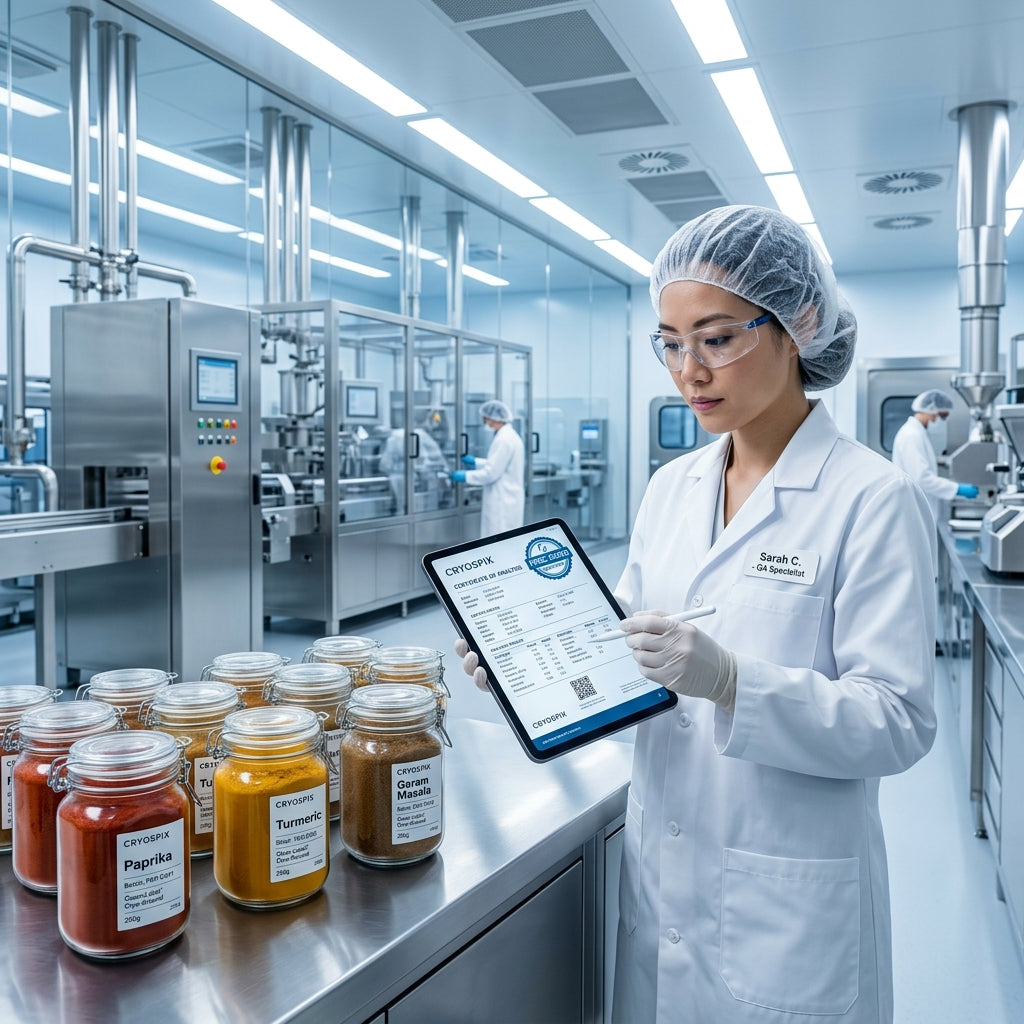
At 365 Spicery, we haven't retrofitted clean label onto an existing manufacturing process — it's the foundation our Mumbai facility was built on. Our FSSAI, FSSC 22000, and Halal certified facility uses cryogenic grinding as a default, lab-tests every batch for moisture content, color value, and adulterant absence, and maintains full ingredient-level traceability across every formulation. This makes us a strong fit for the FSSC 22000 certified spice manufacturer India segment, serving FMCG clients, private label brands, and export buyers who need documentation that survives procurement audits. Whether you need Garam Masala, Pav Bhaji Masala, or a custom seasoning formulated without additives, every product we supply is built to meet tomorrow's clean label standards today. At 365 Spicery, we believe the manufacturers who invest in clean label infrastructure now will be the only ones export and premium domestic buyers call in five years.
Key Takeaways:
- Clean label has shifted from a trend to a baseline expectation across domestic and export markets
- Cryogenic grinding is now a manufacturing prerequisite, not a premium option
- FSSC 22000 certification is becoming a standard procurement requirement for FMCG and export buyers
- Batch-specific lab testing and traceability are replacing annual audits as standard buyer expectations
- 365 Spicery is built around clean label infrastructure from the ground up, not retrofitted
---
Q: What is the future of clean label foods in the seasoning industry?
A: The future of clean label foods in seasoning manufacturing is one where short, traceable ingredient lists and certified production infrastructure are baseline buyer expectations, not premium differentiators. FSSAI and FSSC 22000 compliance will increasingly become minimum entry requirements. 365 Spicery is built around this clean label foods future standard.
Q: Why should seasoning manufacturers invest in clean label now?
A: Manufacturers who invest in clean label infrastructure now — cryogenic grinding, FSSC 22000 certification, batch traceability — will meet procurement requirements that are already standard among export and FMCG buyers. Delaying creates a market access gap that becomes progressively harder to close. Natural spices no preservatives formulations are increasingly the only acceptable standard.
Q: How does cryogenic grinding support clean label seasoning manufacturing?
A: Cryogenic grinding processes spices at -40°C to -80°C, preserving over 95% of volatile oils compared to roughly 60% in conventional hot grinding. This eliminates the flavor loss that makes synthetic additives necessary in the first place. It is the single most important manufacturing decision a clean label seasoning producer can make.
Q: How is 365 Spicery prepared for the future of clean label seasoning manufacturing?
A: 365 Spicery uses cryogenic grinding as standard, holds FSSAI, FSSC 22000, and Halal certification, and lab-tests every batch for moisture, color value, and adulterant absence. Full ingredient traceability is built into our sourcing process. This makes us a future-ready FSSC 22000 certified spice manufacturer India partner for FMCG and export buyers.
Q: Can 365 Spicery supply custom clean label seasonings for FMCG or export buyers?
A: Yes, 365 Spicery supports full custom formulation for FMCG and export buyers, with flexible MOQs from 1kg to 50kg and private label packaging. Every custom formulation is lab-tested and documented to meet procurement audit requirements. Contact us via WhatsApp to discuss your specific formulation and compliance needs.
Q: Which certifications do seasoning manufacturers need for clean label in 2026?
A: FSSAI certification is the domestic baseline, but FSSC 22000 is increasingly required by FMCG procurement teams and is an absolute prerequisite for export buyers, particularly in the EU and US. Halal certification significantly expands addressable export markets. 365 Spicery holds all three, supporting buyers across custom spice formulation India and international supply.
Q: How does 365 Spicery ensure batch-to-batch clean label consistency?
A: 365 Spicery lab-tests every production batch for moisture content, color value, and adulterant absence at our certified Mumbai facility. Full ingredient traceability is maintained from raw material sourcing through to dispatch. This batch-specific documentation approach meets the evolving procurement standards of FMCG and export buyers.
---
The seasoning manufacturers who will lead the Indian market and export landscape in the next five years aren't the ones with the most product SKUs — they're the ones with the most defensible manufacturing infrastructure behind every label. Clean label is no longer about what you remove from a formulation; it's about what your entire production system was built to deliver from the ground up. Grinding technology, certification depth, and batch traceability are the three pillars that separate manufacturers with a future in this space from those who will be squeezed out by buyer requirements they didn't anticipate. At 365 Spicery, we built around these pillars from day one. Is your manufacturing infrastructure ready to meet the clean label standard your next big buyer will expect?
---


Share:
QSR & Restaurants Using No Onion No Garlic Seasonings
No Onion No Garlic vs Regular Seasonings: Key Differences