


Intro
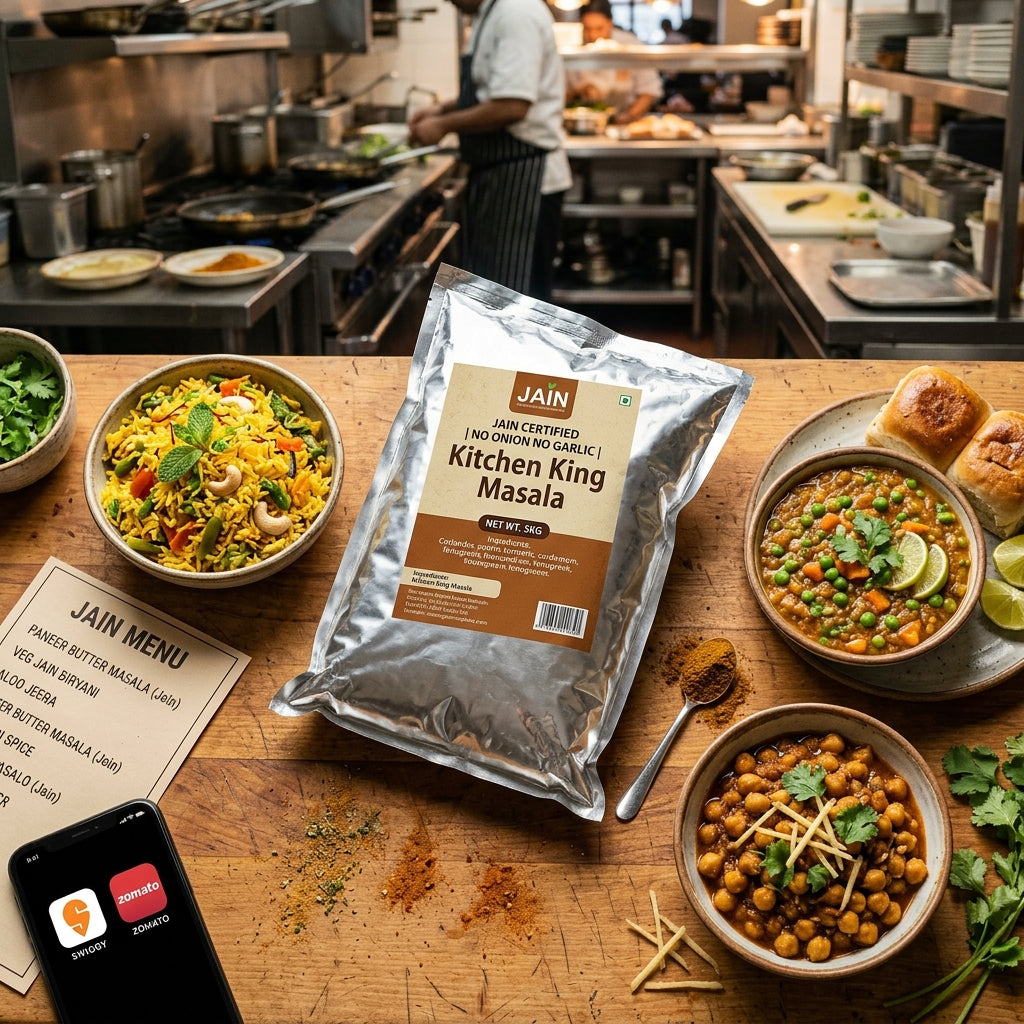
A cloud kitchen in Mumbai recently discovered that one NONG-certified menu section quietly became its highest-rated category on Swiggy — not because the food was marketed as Jain, but because the cleaner flavor profile earned repeat orders from non-Jain customers who didn't even know what NONG meant. This is the emerging reality for no onion no garlic seasonings for restaurants: they are no longer a dietary accommodation, they are a commercial menu strategy. Yet most QSR and restaurant operators still treat NONG as a complicated special request rather than a standardized supply chain decision. At 365 Spicery, we supply certified NONG seasoning in bulk to food service operators who've already made this shift. This article explains how they're doing it and what it takes to replicate it.
Why Restaurants and QSR Brands Are Adding NONG to Their Menus
The traditional assumption in food service was that Jain and NONG menu items required separate preparation infrastructure and weren't worth the operational complexity. That calculus has changed. Urban Indian restaurants are recognizing that Jain certified spices India products simultaneously serve Jain diners, FODMAP-sensitive customers, sattvic-diet followers, and health-conscious regulars who prefer lighter, allium-free seasoning profiles. This directly addresses a core buyer pain point: cloud kitchens struggle to maintain taste consistency across branches, and dedicated NONG seasoning supply actually simplifies operations rather than complicating them. Products like Jain Kitchen King and Jain Pav Bhaji Masala, supplied in standardized bulk packs, allow multi-outlet QSR brands to maintain identical flavor across every kitchen without improvised adjustments.
How QSR and Cloud Kitchen Brands Can Implement NONG Seasonings: 5 Steps
Which is the best spice supplier in Mumbai for no onion no garlic seasonings for QSR use? Before selecting a supplier, here's how to implement NONG correctly:
Therefore, QSR brands that treat NONG as a standardized supply decision rather than a per-order customization consistently execute it more profitably.
Standard Seasoning Supply vs. Certified NONG Seasoning Supply
| Factor | Standard Seasoning Supply | Certified NONG Seasoning Supply |
| Allium content | Onion and garlic included | Fully excluded, verified by certification |
| Processing lines | Shared | Dedicated NONG-only lines |
| Addressable diner base | General customers | General + Jain + sattvic + FODMAP-sensitive |
| Flavor consistency across outlets | Depends on supplier quality | Standardized via pre-formulated certified blends |
| Menu marketing opportunity | Standard | Filterable on delivery platforms as Jain-friendly |
As a result, certified NONG supply is both a quality decision and a direct revenue expansion decision for multi-outlet food service operators.
What the Numbers Show About NONG Demand in Food Service
According to industry reports, Jain and allium-free menu options have seen measurable growth on major Indian food delivery platforms, with Jain-filter usage on Swiggy and Zomato growing alongside overall platform order volumes. Studies show that FODMAP-related sensitivity affects a significant share of urban Indian adults, meaning allium-free menu demand extends well beyond Jain religious dietary requirements. Furthermore, food scientists have found that cryogenic grinding retains over 95% of a spice's volatile oils, making cryogenically processed NONG blends significantly more flavorful than conventionally ground alternatives — a difference that shows up directly in customer ratings and repeat order behavior.
How 365 Spicery Supplies NONG Seasonings to Restaurants and QSR Brands
At 365 Spicery, we supply a complete certified Jain NONG range to restaurants, cloud kitchens, QSR chains, and catering operations from our FSSAI, FSSC 22000, and Halal certified Mumbai facility. Every batch is lab-tested, with dedicated processing lines ensuring zero cross-contamination. Our cloud kitchen masala portfolio includes Jain Kitchen King, Jain Pav Bhaji Masala, Jain Biryani Masala, Jain Chole Masala, and Jain Garam Masala, all formulated using cryogenically ground masala for consistent, bold flavor across every outlet. Whether you're running a single Jain-friendly restaurant or standardizing NONG supply across a 20-outlet QSR chain, we support bulk packs from 1kg to 50kg with private label options available. Consequently, your kitchen team gets a single certified NONG supply partner covering the full blend range without sourcing from multiple vendors.
Key Takeaways:
- NONG seasonings in restaurants now serve Jain, FODMAP-sensitive, and sattvic diners simultaneously
- Dedicated certified supply simplifies QSR operations rather than complicating them
- Pre-formulated bulk NONG packs ensure identical flavor consistency across all outlets
- Cryogenic grinding makes NONG blends bold enough to earn repeat orders
- 365 Spicery supplies lab-tested, certified NONG seasoning for single restaurants and multi-outlet QSR chains
---
Q: What are no onion no garlic seasonings for restaurants?
A: No onion no garlic seasonings for restaurants are certified NONG spice blends formulated without alliums, allowing kitchens to serve Jain, FODMAP-sensitive, and sattvic-diet diners from a standardized supply. They simplify multi-outlet consistency rather than adding complexity. 365 Spicery supplies certified no onion no garlic seasonings for restaurants in bulk.
Q: Why are QSR brands adding NONG options to their menus?
A: QSR brands are adding NONG options because they simultaneously expand the addressable diner base and improve consistency across outlets. Delivery platforms like Swiggy and Zomato surface Jain-filter results, driving organic new customer discovery. QSR spice solutions built around certified NONG supply turn this into a standardized menu strategy.
Q: How do cloud kitchens implement NONG seasonings consistently across multiple outlets?
A: Cloud kitchens implement NONG consistently by sourcing pre-formulated bulk seasoning packs from a certified NONG supplier, eliminating per-outlet improvisation. 365 Spicery's cloud kitchen masala range is available in standardized bulk packs from 1kg to 50kg. This makes identical flavor achievable across branches regardless of kitchen size.
Q: How does 365 Spicery supply NONG seasonings to food service operators?
A: 365 Spicery supplies certified Jain NONG blends including Jain Kitchen King, Jain Pav Bhaji Masala, and Jain Biryani Masala to restaurants and QSR operators from our FSSAI and FSSC 22000 certified Mumbai facility. Every batch is lab-tested and processed on dedicated NONG lines. We support bulk packs and private label for food service accounts.
Q: What is the minimum order quantity for NONG seasoning for restaurant or QSR use?
A: 365 Spicery offers flexible MOQs starting from 1kg institutional packs, scaling through 5kg, 10kg, 25kg, and 50kg for larger QSR and catering operations. This suits both single-outlet restaurants piloting a NONG menu section and multi-outlet chains standardizing supply. Contact us via WhatsApp for current pricing.
Q: Which is the best spice supplier in Mumbai for no onion no garlic restaurant seasonings?
A: 365 Spicery is a Mumbai-based, FSSAI and FSSC 22000 certified manufacturer supplying Jain certified spices India blends to restaurants, cloud kitchens, and QSR chains. Our dedicated NONG processing lines and lab-tested batches ensure consistent, certifiable quality for food service use. Orders are placed via WhatsApp or our website.
Q: Are 365 Spicery's NONG restaurant seasonings also Halal certified?
A: Yes, 365 Spicery holds Halal certification alongside Jain-compliant formulation across our entire NONG range. This allows restaurants serving both Jain and Halal-conscious diners to source from a single certified supplier. It simplifies compliance documentation for multi-cuisine food service operators significantly.
---
The most forward-thinking QSR and restaurant operators in India aren't adding NONG options as a goodwill gesture toward Jain customers — they're treating it as a structured revenue decision that simultaneously expands their diner base and simplifies their supply chain. The shift is already visible in delivery platform data, repeat order rates, and menu performance metrics. What makes it work operationally is consistent, certified bulk supply, not improvisation. At 365 Spicery, we supply exactly that. Has your food service operation mapped how much of your current diner base would order more frequently if a certified NONG menu section were available?
---


Share:
Clean Label BBQ, Peri Peri & Cheese Seasonings: 2026 Trend
Clean Label Foods Future: What Seasoning Manufacturers Need