


Why Indian Spices Remain the World's Most Sought-After Flavoring Ingredient
India produces over 70 varieties of spices and contributes approximately 75% of global spice production — yet a surprisingly large share of exported Indian spices lose between 30% and 40% of their natural aroma before they even leave the country. The reason is almost always the same: conventional grinding technology generates heat that destroys the volatile oils responsible for a spice's potency, color, and shelf stability. This is one of the most consequential hidden facts about Indian spices explained for international buyers and domestic food manufacturers alike. At 365 Spicery, our cryogenic grinding process exists specifically to close this gap. This guide covers the most commercially important Indian spices, their uses and benefits, and what export buyers must verify before sourcing at scale.
Indian spices have commanded global trade for centuries, and their dominance isn't nostalgia — it's botany. India's climate, soil diversity, and agricultural traditions produce spice varieties with measurably higher essential oil content than equivalent crops grown in other regions. This translates directly into more potent flavor, deeper color, and longer shelf stability. However, a critical buyer pain point undermines this natural advantage: spice adulteration is rampant in India, with color, starch, and synthetic compounds added at processing and packaging stages. Additionally, oleoresin yield — the industry standard measure of a spice's active flavor compound concentration — varies dramatically between certified and uncertified suppliers. Buyers who source on price alone consistently discover this gap in the kitchen, not on the invoice.
Top 10 Indian Spices: Uses and Benefits Every Buyer Should Know
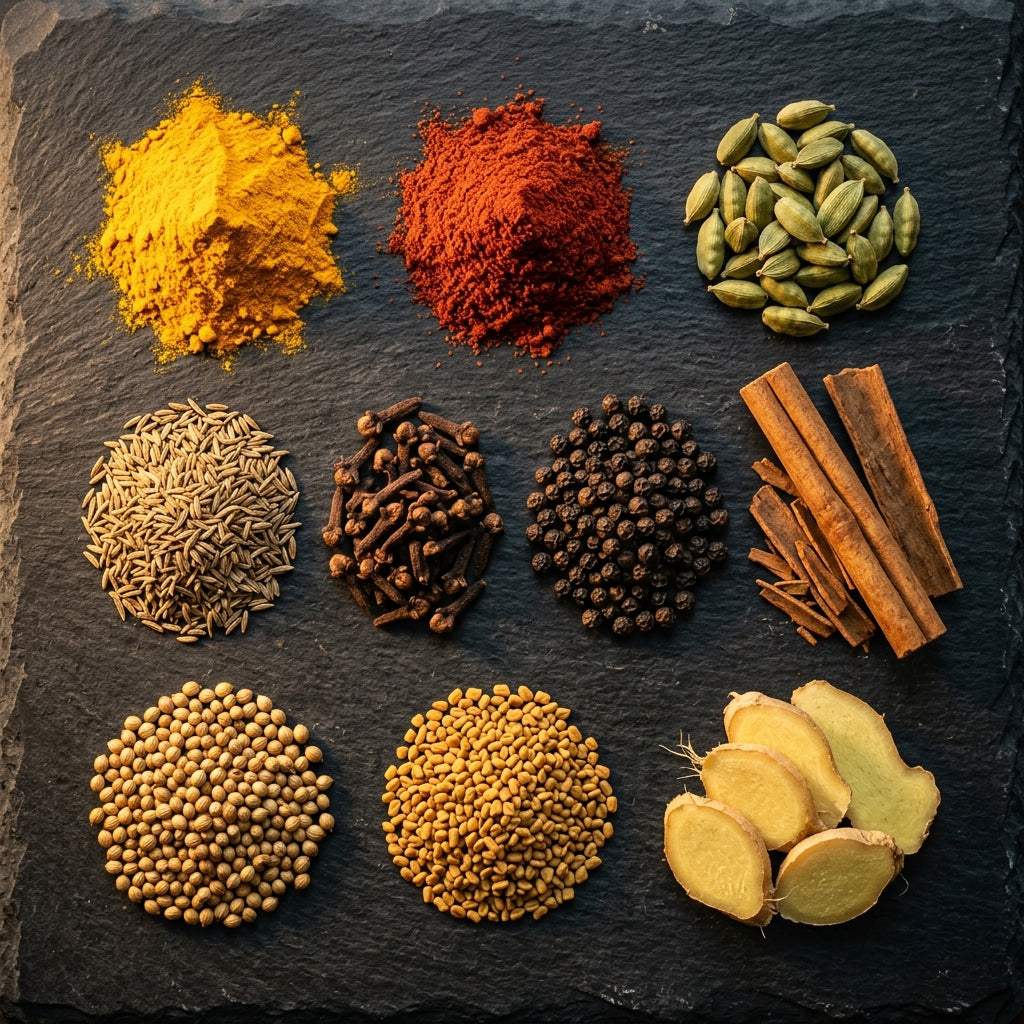
Which Indian spices deliver the most commercial value for food manufacturers, restaurants, and exporters? Here are the ten that matter most:
Therefore, buyers sourcing Indian spices at scale should evaluate each variety against specific quality benchmarks — color value, volatile oil content, moisture percentage — rather than relying on visual inspection alone.
Domestic Spice Supply vs. Export-Grade Spice Supply: 3 Key Differences
| Factor | Domestic Spice Supply | Export-Grade Spice Supply |
| Certification scope | FSSAI standard | FSSAI + FSSC 22000 + Halal + phytosanitary compliance |
| Grinding method | Often conventional, volatile oil loss up to 40% | Cryogenic preferred — 95%+ volatile oil retention |
| Documentation | Basic invoice and batch record | Lab test reports, COA, traceability records for customs |
As a result, the gap between domestic and export-grade supply is primarily a documentation and processing standard gap, not a raw material gap — the same Indian spices, handled differently, perform very differently in international procurement.
What the Data Shows About India's Spice Export Industry
According to industry reports, India's spice export value has grown consistently over recent years, with the US, China, Vietnam, Bangladesh, and the UAE among the largest volume buyers. Studies show that value-added spice exports — ground, blended, and certified products — are growing faster than raw commodity exports, reflecting global buyers' preference for processed, quality-assured supply over bulk raw material. Furthermore, food scientists have found that cryogenic grinding retains over 95% of a spice's volatile oils and flavor compounds, making cryogenically processed Indian spices measurably superior in aroma intensity, color stability, and shelf life — three variables that export buyers test directly during supplier qualification.
How 365 Spicery Supplies Export-Grade Indian Spices Globally
At 365 Spicery, we supply the full spectrum of Indian spices — whole, single-powder, and blended — from our FSSAI, FSSC 22000, and Halal certified Mumbai facility, using cryogenic grinding as our production standard. Every batch is lab-tested for moisture content, color value (ASTA), and adulterant absence before dispatch, with full documentation supporting customs and retail compliance for international buyers. Our whole spice range includes Whole Cumin, Whole Coriander, Black Pepper, Green Cardamom, Cloves, Star Anise, Cinnamon Sticks, and Turmeric Finger. Our cryogenically ground powder range covers Turmeric Powder, Red Chilli Powder, Cumin Powder, Coriander Powder, Black Pepper Powder, Ginger Powder, and Cardamom Powder, among others. Whether you're an Indian spice exporter building a certified supply chain or a food manufacturer sourcing bulk spice export India volumes, At 365 Spicery, we provide a single partner covering formulation, grinding, certification, and export documentation.
Key Takeaways:
- India produces 75% of global spice output — but processing quality determines what buyers actually receive
- Evaluate spices on ASTA color value, volatile oil content, and moisture percentage — not price alone
- Export-grade supply requires FSSC 22000, Halal certification, and batch-specific lab documentation
- Cryogenic grinding preserves 95%+ volatile oils — critical for export shelf life and aroma performance
- 365 Spicery supplies certified, cryogenically ground Indian spices with full export documentation
---
Q: What are the most important Indian spices for food manufacturers and exporters?
A: The ten most commercially important Indian spices are turmeric, red chilli, cumin, coriander, black pepper, cardamom, ginger, cinnamon, cloves, and fenugreek. Each has specific quality benchmarks — ASTA color value, volatile oil content, moisture percentage — that determine commercial grade. 365 Spicery supplies all ten as Indian spices explained for export and domestic buyers.
Q: Why are Indian spices considered the world's best quality?
A: India's climate, soil diversity, and agricultural traditions produce spice varieties with measurably higher essential oil content and oleoresin yield than equivalent crops from other regions. However, post-harvest processing quality determines whether this natural advantage reaches the buyer. Export-grade spices India from certified facilities with cryogenic grinding deliver this quality consistently.
Q: How do I choose a reliable Indian spice exporter?
A: Verify FSSAI, FSSC 22000, and Halal certification, request batch-specific lab test reports covering color value and moisture content, and confirm the grinding method used. Cryogenic processing significantly outperforms conventional hot grinding for export applications. 365 Spicery provides full documentation across all these requirements.
Q: How does 365 Spicery supply export-grade Indian spices?
A: 365 Spicery processes its entire spice range using cryogenic grinding at our FSSAI, FSSC 22000, and Halal certified Mumbai facility. Every batch is lab-tested for ASTA color value, moisture content, and adulterant absence before dispatch. This makes us a reliable Indian spice exporter for food manufacturers, importers, and diaspora grocery buyers globally.
Q: What is the minimum order quantity for bulk Indian spice export from 365 Spicery?
A: 365 Spicery offers flexible MOQs starting from 1kg institutional packs, scaling through 5kg, 10kg, 25kg, and 50kg for larger export volumes. This allows buyers to validate quality on trial shipments before committing to container-level orders. Contact us via WhatsApp for current export pricing and documentation support.
Q: Which countries import the most Indian spices?
A: The largest import markets for Indian spices include the US, China, Vietnam, Bangladesh, and the UAE, with growing demand from the EU, UK, and Southeast Asian markets. Bulk spice export India volumes are rising particularly in value-added categories — ground, blended, and certified specialty spices — rather than raw commodity formats.
Q: Are 365 Spicery's exported Indian spices Halal certified?
A: Yes, 365 Spicery holds Halal certification alongside FSSAI and FSSC 22000 across our entire spice range. This Halal compliance is particularly important for buyers supplying the Middle East, Southeast Asia, and Muslim-majority markets globally. It makes our export-grade spices India range suitable for the broadest possible international buyer base.
---
Indian spices are the foundation of global flavor — but their quality at the buyer's end is entirely a function of what happens between the farm and the grinder. The natural advantage India holds in spice production is real, documented, and measurable in volatile oil content and color value. What's equally measurable is how much of that advantage gets destroyed by poor processing and uncertified supply chains before the spice reaches a kitchen or a factory floor. At 365 Spicery, our job is to ensure that advantage survives every step of the process. When you next evaluate an Indian spice supplier, which quality benchmark on this list will you lead with?
---


Share:
75 Popular Spice Blends from Around the World
50 Science-Backed Health Benefits of Common Spices