


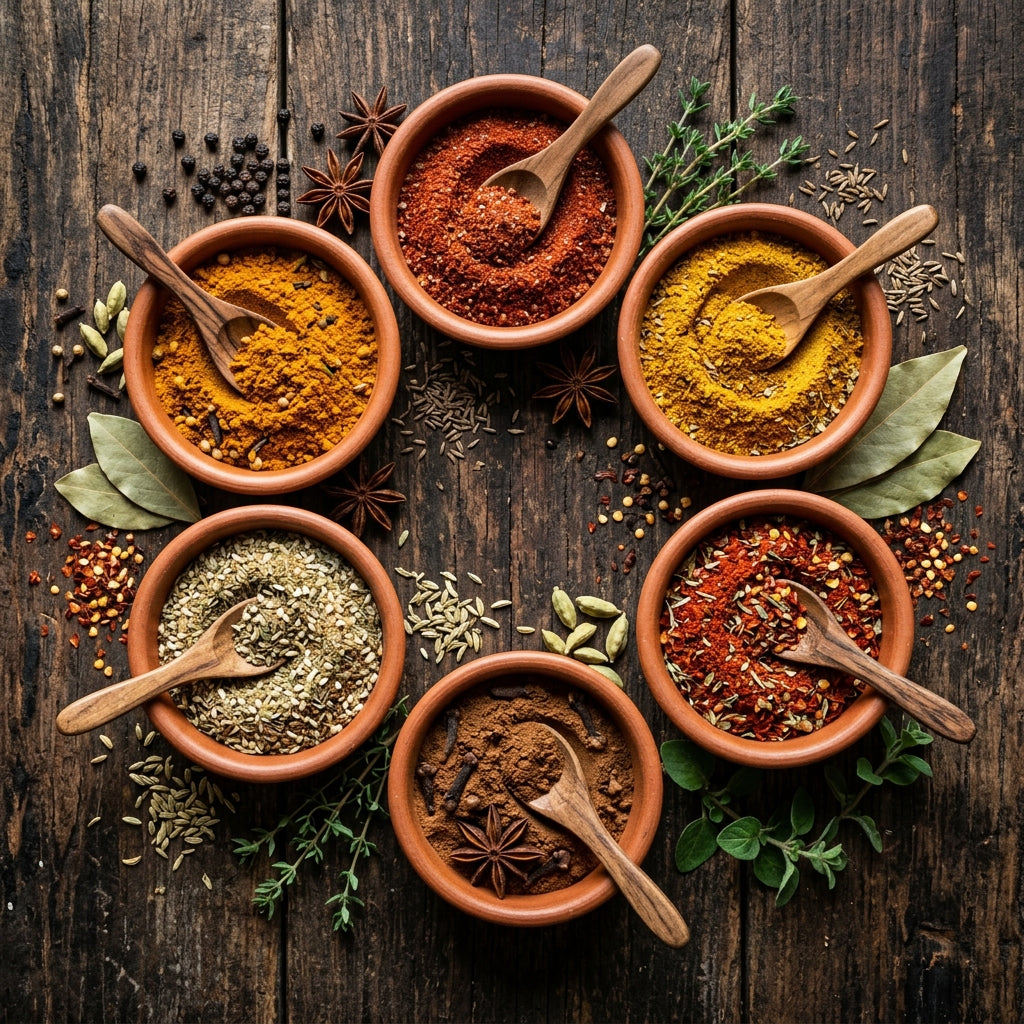
Why Spice Blends Vary So Much by Region
Every cuisine has developed its own signature spice blends from around the world, and the differences run deeper than taste preference — they reflect climate, available crops, and centuries of trade routes. Indian kitchens layer whole and ground spices into complex masalas, while Middle Eastern cooking leans on dry rubs like za'atar, and North American kitchens favor simpler salt-forward blends like taco seasoning. This variety creates a real sourcing challenge for hotels and food brands wanting to offer multi-cuisine menus: finding one manufacturer who genuinely understands and can produce blends across these different traditions is rare. Most suppliers specialize narrowly in one regional style, forcing buyers to juggle multiple vendors. At 365 Spicery, our blend portfolio was built specifically to span this range.
6 Regional Categories Covering 75 Popular Spice Blends
Global spice blends are easier to understand when grouped by regional tradition:
This structure answers a frequent search query: "what are the most popular spice blends used worldwide?" — these six regional categories cover the vast majority of blends found on global menus today.
Freshly Blended vs. Long-Stored Spice Mixes
| Factor | Freshly Blended (Cryogenically Ground) | Long-Stored Spice Mixes |
| Volatile oil retention | 95%+ preserved | Declines steadily over storage time |
| Aroma intensity | Strong, close to fresh-ground | Noticeably fades |
| Flavor consistency | Stable across batches | Varies as older stock is used |
| Shelf presentation | Vivid color, potent aroma | Often duller after extended storage |
As a result, even a globally popular blend recipe can taste disappointing if the spices behind it were ground conventionally or held in storage too long before use.
What the Data Says About Global Blend Demand
According to industry reports on packaged food trends, blended seasoning and masala categories have grown steadily as multi-cuisine menus become more common across hotels, QSRs, and cloud kitchens. Studies show that consumers increasingly seek convenience through pre-blended seasonings rather than sourcing individual spices for each regional recipe. Food scientists have found that cryogenic grinding preserves over 95% of a spice blend's volatile oils, compared to roughly 60% retained through conventional hot grinding. The single most important stat for buyers: up to 40% of a blend's aroma can be lost to heat during conventional processing, a loss that's especially noticeable in complex multi-spice blends where several aromatic compounds are competing for balance.
How 365 Spicery Manufactures Blends Across These Categories
For hotels and food brands building multi-cuisine menus, sourcing consistently flavorful blends across Indian, Middle Eastern, American, and Asian categories from one manufacturer solves a genuine supply chain problem. At 365 Spicery, our blended spice mix range spans Garam Masala, Biryani Masala, and Sambar Masala from the Indian subcontinent, alongside global seasonings like Peri Peri, BBQ, Taco, and Shawarma Seasoning, all processed using Cryogenic Grinding Technology in a facility that is FSSAI certified, FSSC 22000 compliant, and Halal certified, with lab-testing on every batch. This is what allows us to offer global masala blends that taste consistently potent, not diminished by conventional grinding or long storage. At 365 Spicery, we also support private label and custom formulation for brands wanting to build their own signature blend inspired by any of these regional traditions, with flexible MOQs and institutional packs from 1kg to 50kg.
---
Key Takeaways:
- Spice blends reflect regional climate, crops, and trade history, which is why cuisines differ so much in flavor profile.
- 75 popular global blends fall into 6 regional categories, from Indian subcontinent masalas to fusion crossover mixes.
- Cryogenic grinding preserves over 95% of a blend's volatile oils, keeping complex multi-spice mixes balanced and potent.
- Long-stored spice mixes lose aroma steadily, which is why freshness matters as much as the recipe itself.
- 365 Spicery's blend portfolio spans Indian, Middle Eastern, American, and Asian categories from a single certified source.
---
Q: What are the most popular spice blends from around the world?
A: Popular global blends include garam masala and biryani masala from India, shawarma seasoning and za'atar from the Middle East, BBQ rub and taco seasoning from North America, and five-spice powder from East Asia. Each reflects its region's culinary traditions. 365 Spicery manufactures across all these regional categories.
Q: Why do spice blends vary so much between cuisines?
A: Regional blends developed based on locally available crops, climate, trade history, and culinary tradition, which is why an Indian garam masala tastes completely different from a Middle Eastern baharat. Understanding this helps buyers choose the right blend for a specific cuisine. It also explains why one supplier rarely covers all regional styles well.
Q: How do I choose a quality spice blend supplier for multi-cuisine menus?
A: Look for a manufacturer with genuine experience across multiple regional blend categories, backed by FSSAI and FSSC 22000 certification and documented grinding methods. Requesting sample batches across different cuisines helps confirm consistency. 365 Spicery meets these requirements as a Mumbai-based manufacturer.
Q: Does 365 Spicery manufacture spice blends from multiple global cuisines?
A: Yes, 365 Spicery's blend portfolio spans Indian subcontinent masalas like Garam Masala and Biryani Masala, alongside global seasonings like Peri Peri, BBQ, and Shawarma Seasoning, all cryogenically ground and produced in an FSSAI, FSSC 22000, and Halal certified facility. Every batch is lab-tested. This suits hotels and multi-cuisine restaurants.
Q: Can I order global spice blends in bulk for my restaurant?
A: Yes, 365 Spicery supplies its full blend range in institutional packs from 1kg to 50kg, with private label and custom formulation options available. Flexible MOQs suit both independent restaurants and multi-outlet chains sourcing across cuisines. Wholesale pricing is available on request via WhatsApp.
Q: Which is the best spice blend manufacturer for multi-cuisine restaurants in India?
A: The best manufacturer should offer genuine expertise across multiple regional blend categories, backed by certified processing and consistent batch quality. 365 Spicery, based in Mumbai, covers Indian, Middle Eastern, American, and Asian blend styles through FSSAI, FSSC 22000, and Halal certification. This makes it a practical single-source option for multi-cuisine buyers.
Q: Are global spice blends from 365 Spicery available in Jain and Halal certified versions?
A: Yes, 365 Spicery manufactures a dedicated Jain range alongside its broader Halal certified blend portfolio, all from the same certified facility. This lets buyers source across dietary requirements without switching suppliers. Every batch undergoes lab testing regardless of the blend category.
---
The 75 blends covered across these 6 regional categories show just how much spice blends from around the world reflect the culture and history behind them, from Indian garam masala to Middle Eastern za'atar to North American BBQ rub. However, a great recipe still depends on how the underlying spices were ground and stored, since even a well-known blend can taste flat if processed poorly. Hotels and multi-cuisine brands who understand both the regional traditions and the processing science behind them source far better ingredients. 365 Spicery's blend portfolio was built to cover this global range from one certified source. Which regional spice blend do you find yourself reaching for most often?
---


Share:
Seasoning vs Spice vs Herb: The Complete Comparison
Indian Spices Explained: Uses, Benefits & Export Guide