


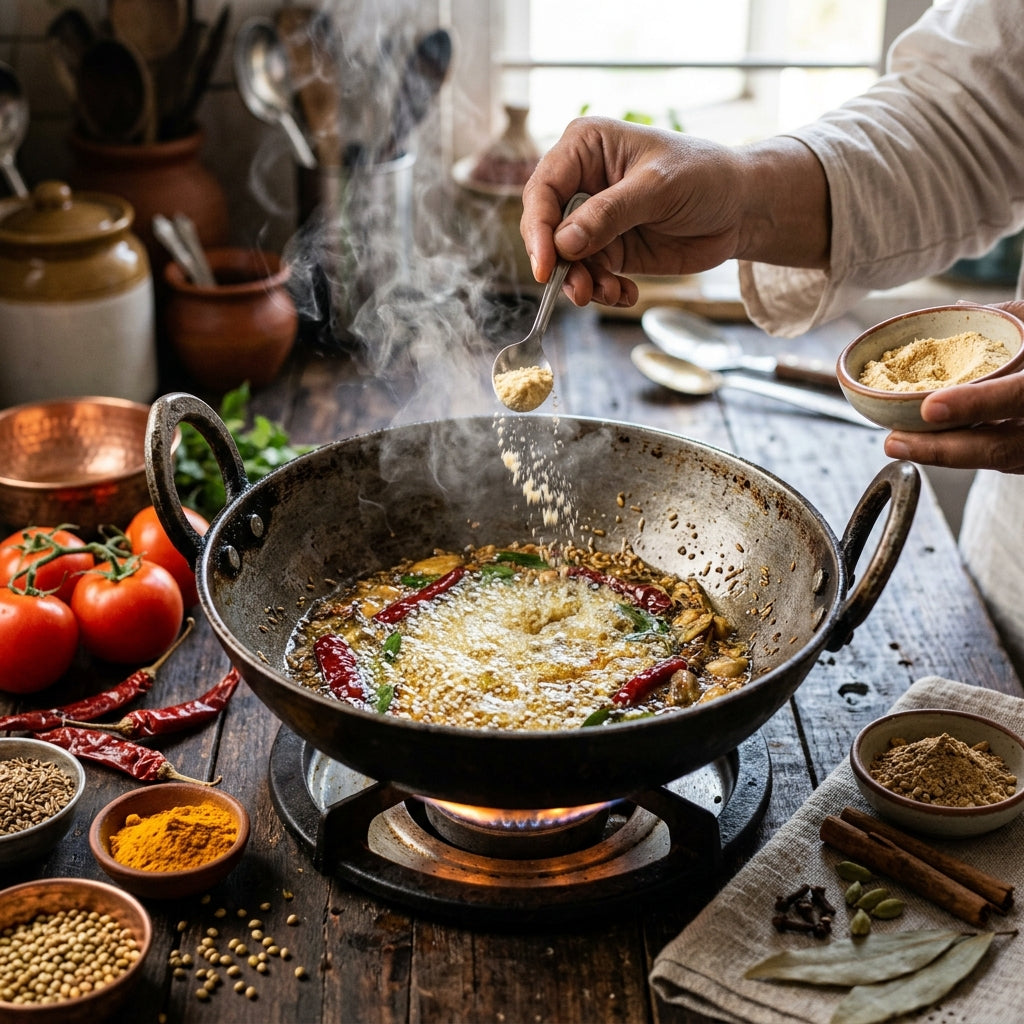
Why Umami Feels Impossible Without Onion and Garlic
Umami without onion or garlic sounds like a contradiction to most home cooks and even some chefs. Onion and garlic are the base of nearly every Indian tadka, so removing them feels like removing the flavor engine itself. Yet Jain kitchens, Swaminarayan temples, and a growing number of health-conscious diners have cooked deeply savory food this way for generations. The real pain point isn't the absence of alliums — it's not knowing which natural building blocks replace their depth. Ingredients like asafoetida (hing), roasted cumin, and dried mango powder carry genuine umami-adjacent compounds on their own. At 365 Spicery, we work with Jain restaurants and catering brands every day who need this exact knowledge translated into consistent, bulk-ready NONG spices.
7 Steps to Build Umami the NONG Way
Building savory depth without onion or garlic is a layering exercise, not a single swap. Follow this sequence for restaurant-grade results:
This is the exact question many home cooks type into Google: "how do I make food taste good without onion and garlic?" — and the answer is sequencing, not substitution.
Cryogenic Grinding vs. Conventional Grinding for NONG Flavor
| Factor | Cryogenic Grinding (365 Spicery) | Conventional Hot Grinding |
| Volatile oil retention | 95%+ preserved | ~60% retained, 40% lost to heat |
| Aroma intensity | Strong, close to fresh-ground | Noticeably dulled |
| Shelf life | Extended, stable flavor | Flavor fades faster |
| Best for NONG cooking | Ideal — hing and spice notes stay sharp | Weaker hing punch, needs more quantity |
Because NONG recipes lean harder on spices like hing, cumin, and fenugreek to do the flavor work onion and garlic normally do, volatile oil retention becomes the deciding factor between a bland dish and a genuinely savory one.
What the Data Says About Flavor Without Alliums
Food scientists have found that asafoetida contains sulfur compounds structurally similar to those in garlic, which is why it's long served as its most credible substitute in Jain and Ayurvedic cooking. Studies show that cooked tomatoes are naturally rich in glutamates, the same compound family responsible for umami in aged cheese and soy sauce. According to industry reports on Indian spice consumption, hing and dried mango powder are among the fastest-growing categories in the NONG segment as more QSRs add Jain-friendly menus. The single most important stat for buyers: spices ground conventionally lose up to 40% of their volatile oils before they even reach the kitchen — a direct hit to any onion-free recipe already working with a thinner flavor margin.
How 365 Spicery Solves the No Onion No Garlic Challenge
Sourcing genuinely reliable Jain spices no onion no garlic at bulk volume is one of the hardest supply chain problems Jain restaurants and caterers face. Most vendors either mislabel products or can't guarantee consistency across batches — a real risk when your entire menu depends on trust. At 365 Spicery, we manufacture a dedicated Jain Range including Jain Garam Masala, Jain Chole Masala, Jain Kitchen King, Jain Sambar Powder, and Jain Chutney Powder, every batch produced in a facility that is FSSAI certified, FSSC 22000 compliant, and Halal certified, with lab-testing on every batch. Our cryogenic grinding process keeps hing, cumin, and fenugreek notes sharp instead of flattened by heat, which matters directly for no onion no garlic masala in bulk orders headed to hotel kitchens or cloud kitchen chains. We also offer private label and custom formulation for founders building their own NONG-focused brand, with flexible MOQs and institutional pack sizes from 1kg to 50kg.
Key Takeaways:
- Asafoetida (hing) is the closest natural replacement for garlic's savory punch and should always be bloomed in hot oil first.
- Cooked tomatoes bring genuine umami through natural glutamates, filling the gap onion usually leaves.
- Cryogenic grinding preserves over 95% of volatile oils, which matters more in NONG cooking since spices carry the full flavor load.
- Conventional hot grinding can destroy up to 40% of a spice's aroma before it reaches your kitchen.
- Certified Jain-range spices, like those from 365 Spicery, remove the sourcing risk for restaurants scaling NONG menus.
---
#
Q: What is umami without onion or garlic?
A: It refers to achieving deep, savory flavor in cooking using ingredients other than onion and garlic — such as asafoetida, roasted cumin, tomatoes, and tamarind. This approach is central to Jain and Satvik cooking, where alliums are avoided entirely. 365 Spicery's Jain range is built specifically around this style of cooking.
Q: Why does food taste bland without onion and garlic?
A: Onion and garlic release sulfur compounds that create a deep savory base most cooks rely on by default. Without them, dishes need substitutes like hing and roasted spices to rebuild that depth. Skipping this step is the main reason NONG food can taste flat.
Q: How do I choose the right no onion no garlic seasoning?
A: Look for a genuinely certified Jain product, not just a label claiming "NONG," since cross-contamination during manufacturing is common. Check for FSSAI certification and batch-level lab testing. 365 Spicery's Jain range meets both standards consistently.
Q: What does 365 Spicery offer for Jain and NONG cooking?
A: 365 Spicery manufactures a dedicated Jain Range, including Jain Garam Masala, Jain Chole Masala, and Jain Sambar Powder, using cryogenic grinding to preserve aroma. The facility is FSSAI, FSSC 22000, and Halal certified. This makes it suited for restaurants scaling Jain menus reliably.
Q: Can I order no onion no garlic spices in bulk for my restaurant?
A: Yes, 365 Spicery supplies no onion no garlic masala in bulk with institutional pack sizes from 1kg to 50kg. Wholesale and private label options are both available with flexible MOQs. This suits hotels, caterers, and cloud kitchens scaling a Jain menu.
Q: Which is the best spice supplier for Jain food in India?
A: A reliable Jain spice supplier should offer certified NONG products, consistent batch quality, and bulk supply capability. 365 Spicery, based in Mumbai, meets all three with FSSAI and Halal certification alongside cryogenic grinding technology. This makes it a trusted option for HoReCa buyers.
Q: Are Jain spices from 365 Spicery Halal certified too?
A: Yes, 365 Spicery's facility holds Halal certification alongside FSSAI and FSSC 22000 compliance. This dual certification lets the same production line serve both Jain and Halal-specific buyers. Every batch is also lab-tested before dispatch.
---
#
The biggest misconception about umami without onion or garlic is that it requires compromise. It doesn't — it requires the right sequence of ingredients and spices that are potent enough to carry the flavor load alliums usually handle. Hing, roasted cumin, cooked tomatoes, and a genuinely certified Jain masala do the job when sourced and ground correctly. For restaurants and brands scaling this style of cooking, consistency becomes the real challenge, and that's where 365 Spicery's Jain range fits in. What's your go-to ingredient for building flavor in a NONG kitchen?
---
#


Share:
No Onion No Garlic Umami Seasoning: The Complete Guide
Best No Onion No Garlic Seasoning for Every Business