


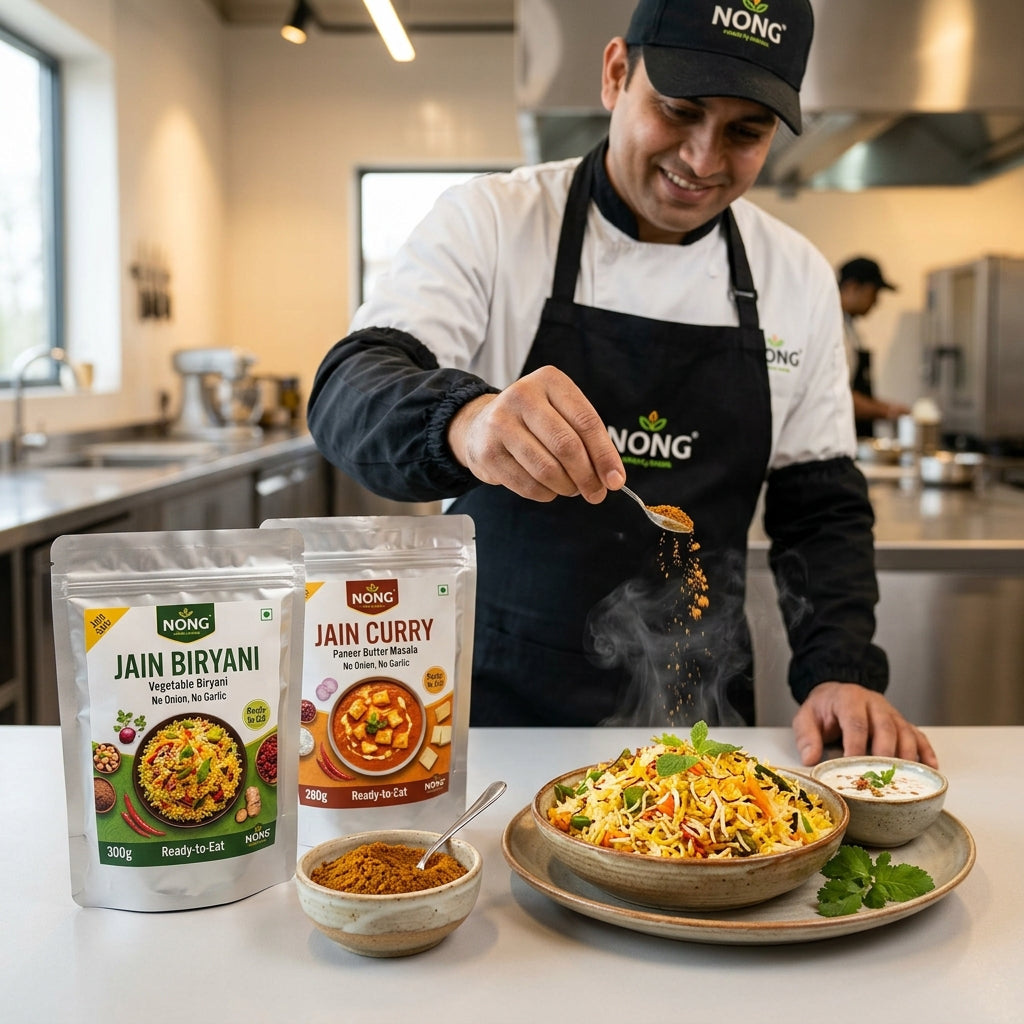
Intro
India's ready-to-eat food market is expanding rapidly, yet one segment within it remains consistently underserved: certified no onion no garlic seasonings for ready-to-eat foods. RTE manufacturers producing Jain-friendly meals, clean label convenience foods, and export-ready products face a recurring supply problem — most seasoning suppliers either lack Jain certification entirely, or produce NONG blends so flat in flavor that consumers don't reorder. The commercial consequence is direct: an RTE product with weak NONG seasoning gets one purchase and no repeat. At 365 Spicery, we supply NONG seasonings specifically formulated for RTE applications, where shelf life, flavor consistency, and certification documentation are all non-negotiable simultaneously. This article explains how RTE manufacturers can implement NONG correctly and what to demand from a supplier.
Why Ready-to-Eat Manufacturers Are Adopting NONG Seasonings
The ready-to-eat segment is driven by urban convenience demand, and Jain consumers are disproportionately urban, educated, and brand-loyal — a combination that makes them a highly valuable RTE buyer segment. Most RTE manufacturers recognize this but stumble at the sourcing stage. The buyer pain point is precise: most suppliers have no proper certifications for NONG production, leaving RTE brands unable to make defensible Jain-friendly label claims. Additionally, shelf life extension spices become a critical formulation variable in RTE, where products must hold flavor across weeks of shelf time, not hours of kitchen use. Certified NONG blends using cryogenic grinding spices technology outperform conventionally processed alternatives specifically on this dimension — volatile oil retention directly translates to flavor persistence across the shelf life window that RTE products demand.
Top 6 NONG Seasoning Applications in Ready-to-Eat Food Manufacturing
Where can RTE manufacturers use no onion no garlic seasonings most effectively? Six high-impact application points:
Therefore, RTE manufacturers serving Jain, vegan, or allium-free market segments have a significantly broader NONG seasoning toolkit available than most currently utilize.
Standard RTE Seasoning vs. NONG-Certified RTE Seasoning
| Factor | Standard RTE Seasoning | NONG-Certified RTE Seasoning |
| Allium content | Onion and garlic powder included | Fully excluded, Jain certified |
| Shelf life performance | Standard volatile oil retention | Superior — cryogenic grinding extends stability |
| Processing lines | Shared, no allium restriction | Dedicated NONG-only lines |
| Label claim capability | Cannot claim Jain-friendly | Full Jain and Halal certified claim |
| Export market access | Standard | Broader — NRI, diaspora, Halal segments |
| Consumer repeat purchase | General buyer loyalty | Higher among certified Jain-loyal segment |
As a result, NONG certification in RTE seasoning is simultaneously a quality decision, a compliance decision, and a repeat purchase driver.
What the Data Shows About NONG Demand in the RTE Segment
According to industry reports, ready-to-eat food sales in India have grown steadily, with Jain-friendly and clean label RTE products emerging as one of the faster-growing sub-segments, particularly in urban modern trade and quick commerce channels. Studies show that Jain consumers demonstrate significantly above-average repeat purchase rates when certified products are available consistently, making NONG RTE certification a direct driver of customer lifetime value. Furthermore, food scientists have found that cryogenic grinding retains over 95% of a spice's volatile oils, compared to roughly 60% in conventional hot grinding — a retention gap that directly determines flavor intensity after weeks of shelf storage, which is the defining quality challenge of the RTE category.
How 365 Spicery Supplies NONG Seasonings for RTE Production
At 365 Spicery, we manufacture a complete certified Jain NONG range suited to RTE production requirements from our FSSAI, FSSC 22000, and Halal certified Mumbai facility. Every batch is processed on dedicated NONG-only lines and lab-tested for moisture content and color value before dispatch — documentation that RTE manufacturers need for product labeling and export compliance. Our RTE-relevant portfolio includes Jain Biryani Masala, Jain Garam Masala, Jain Sambar Powder, Jain Rasam Powder, Jain Chutney Powder, and Jain Blended Spices, all formulated using cryogenically ground masala for maximum flavor persistence across the shelf life window RTE products require. Whether you need institutional spice supply India for large-scale RTE production or private label packaging for a branded Jain-friendly RTE line, we support flexible MOQs from 1kg to 50kg. At 365 Spicery, we believe every RTE brand serving a Jain-friendly audience deserves a supplier who has built NONG infrastructure properly, not retrofitted it.
Key Takeaways:
- NONG seasonings for RTE must deliver flavor across weeks of shelf storage, not just at point of cooking
- Cryogenic grinding is the critical variable — volatile oil retention directly determines RTE shelf flavor
- Jain Biryani Masala, Jain Sambar Powder, and Jain Rasam Powder are the top RTE NONG formats
- FSSC 22000 and Jain certification documentation is essential for RTE export and retail compliance
- 365 Spicery supplies lab-tested, certified NONG seasonings suited to RTE production at commercial scale
---
Q: What are no onion no garlic seasonings for ready-to-eat foods?
A: No onion no garlic seasonings for ready-to-eat foods are certified NONG blends formulated for RTE applications, where shelf life, flavor consistency, and Jain compliance must be maintained simultaneously. They are separately engineered products, not standard blends with alliums omitted. 365 Spicery supplies a full no onion no garlic seasonings for ready-to-eat foods range for RTE manufacturers.
Q: Why is NONG certification important for ready-to-eat food manufacturers?
A: NONG certification is important for RTE manufacturers because it enables defensible Jain-friendly label claims, opens export channels to NRI and diaspora markets, and builds the repeat purchase loyalty that certified Jain consumers deliver. Without proper documentation, an RTE brand cannot make credible Jain certified spices India claims on product packaging.
Q: How does cryogenic grinding benefit NONG seasonings in RTE applications?
A: Cryogenic grinding preserves over 95% of a spice's volatile oils, ensuring flavor intensity persists across weeks of shelf storage — the critical quality challenge for RTE products. Conventionally ground NONG blends lose up to 40% of volatile oils during processing, resulting in flat flavor before the shelf life window even begins. 365 Spicery uses cryogenic grinding as standard.
Q: How does 365 Spicery support RTE manufacturers with NONG seasonings?
A: 365 Spicery supplies Jain Biryani Masala, Jain Sambar Powder, Jain Rasam Powder, and other certified NONG blends from dedicated processing lines at our FSSAI and FSSC 22000 certified facility. Every batch is lab-tested and fully documented for RTE labeling and export compliance. We support both bulk wholesale and private label for RTE production.
Q: What is the MOQ for NONG seasonings for RTE production at 365 Spicery?
A: 365 Spicery offers flexible MOQs from 1kg institutional packs through 5kg, 10kg, 25kg, and 50kg for larger RTE production runs. This allows manufacturers to trial NONG seasonings in RTE formats before committing to full production volumes. Contact us via WhatsApp for current pricing and lead times.
Q: Where can RTE food manufacturers source certified NONG seasonings in bulk?
A: 365 Spicery, based in Mumbai, is an FSSAI and FSSC 22000 certified manufacturer supplying NONG spices India to RTE producers, exporters, and private label brands. Our dedicated NONG processing lines and lab-tested batches ensure shelf-stable, certifiable quality. Orders are placed directly via WhatsApp or our website.
Q: Are 365 Spicery's NONG RTE seasonings Halal certified for export?
A: Yes, 365 Spicery holds Halal certification alongside Jain-compliant formulation across our entire NONG range, including all RTE-relevant blends. This dual certification supports RTE manufacturers targeting both Jain domestic and Halal-conscious export markets simultaneously. It makes our range a strong fit for institutional spice supply India and international RTE buyers.
---
The RTE manufacturer who gets NONG seasoning right doesn't just serve Jain consumers — they build a product that earns repeat purchases from India's most brand-loyal food segment, while simultaneously opening export channels that standard RTE products can't access. The difference between a NONG RTE product that works and one that fails almost always comes down to two decisions made before production even starts: which supplier certified the seasoning and what grinding method they used. At 365 Spicery, our RTE-focused NONG range was built with both decisions already made correctly. Which ready-to-eat product in your current lineup has the clearest opportunity for a certified NONG version?
---


Share:
Best No Onion No Garlic Seasonings for Snack Manufacturers
Clean Label Jain Seasonings: The Future of Flavor