


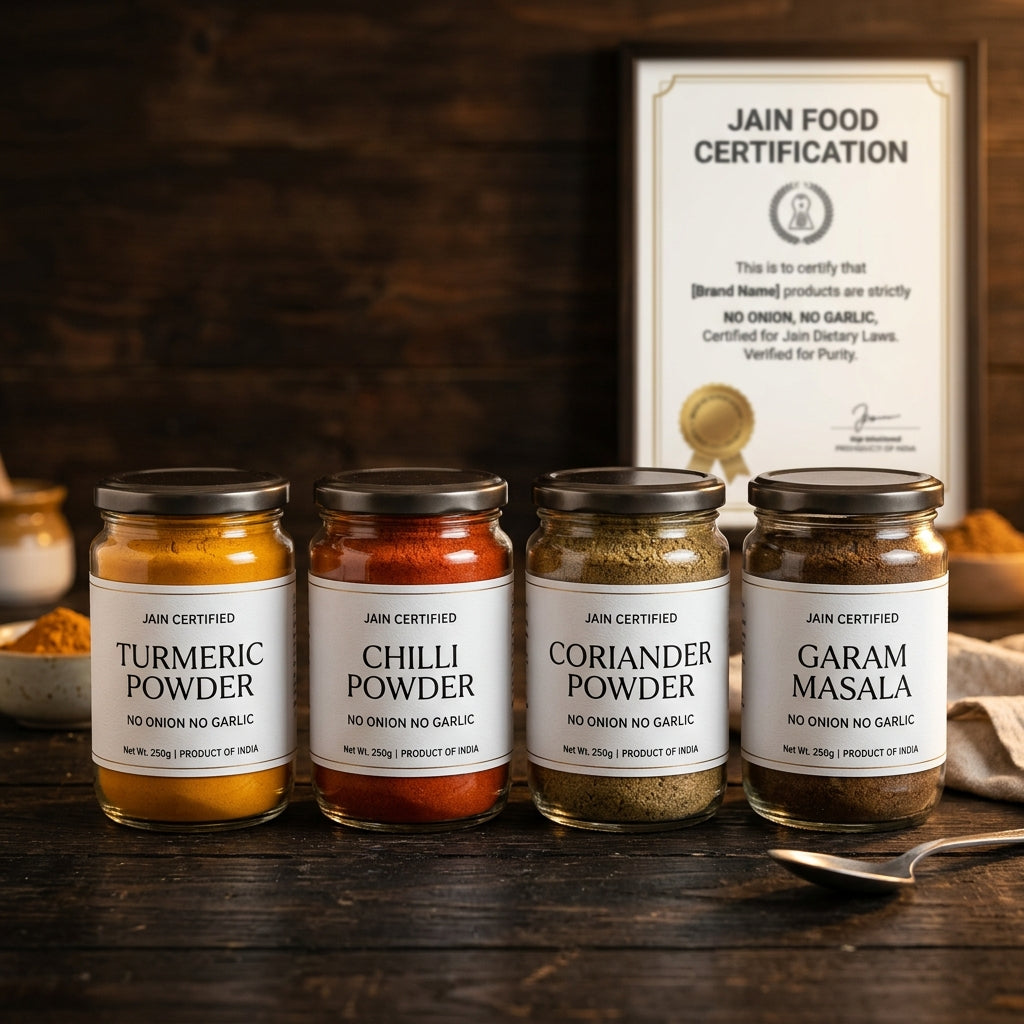
Intro
Over 6 million Jain consumers in India follow strict dietary codes that exclude onion, garlic, and in many cases root vegetables entirely — yet most food manufacturers have no reliable, certified supplier for Jain seasoning that actually meets this standard at commercial scale. The consequences are real: FMCG brands launching Jain product lines source from uncertified vendors, risk cross-contamination complaints, and lose reorder trust fast. At 365 Spicery, we've seen this gap repeatedly across food manufacturer enquiries. This guide explains exactly what Jain seasoning is, what separates a genuine NONG blend from a relabeled standard masala, and what food manufacturers must check before sourcing at scale.
What Is Jain Seasoning and Why Does It Matter for Food Manufacturers
Jain seasoning is any spice blend or seasoning mix formulated strictly without onion, garlic, and other root or underground vegetables prohibited under Jain dietary law. The principle behind this exclusion is ahimsa — non-violence — extended to organisms believed to live in and around root vegetables. For food manufacturers, this isn't simply a labeling exercise. It demands a dedicated formulation, separate processing lines, and verified sourcing of every raw ingredient. The LSI concept of food adulteration India is particularly relevant here: a supplier blending Jain seasoning on shared equipment with standard masalas cannot guarantee the absence of allium traces, regardless of what the label says. Products like Jain Seasoning and Jain Spice Mix require formulation-level decisions, not just ingredient omissions, to deliver authentic flavor without onion and garlic as depth-building foundations.
How to Source Certified Jain Seasoning: 5 Non-Negotiables
Which spice manufacturer is certified to supply Jain seasoning in bulk in India? Before placing any volume order, food manufacturers must verify five things:
Therefore, sourcing Jain seasoning at scale is a supplier qualification process, not just a product selection decision.
Jain Seasoning vs. Standard Masala: 3 Key Differences
| Factor | Standard Masala | Jain Seasoning (NONG) |
| Core flavor base | Onion, garlic, and spice blend | Spice-only formulation, no alliums |
| Processing requirement | Standard line | Dedicated NONG-only line mandatory |
| Certification needed | FSSAI standard | FSSAI + Jain certification |
| Flavor engineering | Relies on allium depth | Achieved through precise spice ratios |
| Consumer audience | General | Jain, vegan, sattvic, FODMAP-sensitive |
As a result, a food manufacturer cannot simply adapt a standard masala recipe for the Jain market — it requires a separately engineered product built from the ground up.
What Industry Data Says About the Jain Food Segment
According to industry reports, India's Jain community represents one of the most economically active and brand-loyal consumer segments in the packaged food market, with significantly above-average spending on certified food products. Studies show that Jain food product launches have grown steadily across FMCG categories, driven by rising urbanization among Jain communities and their demand for convenient, certified packaged options. Furthermore, food scientists have found that cryogenic grinding preserves over 95% of a spice's volatile oils and terpene compounds, making it the only grinding method that reliably delivers bold, complex flavor in a NONG formulation where allium depth is unavailable. Manufacturers using conventional hot grinding in Jain products routinely produce flat, inconsistent blends that fail consumer repeat purchase tests.
How 365 Spicery Manufactures Certified Jain Seasoning at Scale
At 365 Spicery, we manufacture a complete certified Jain range designed specifically for food manufacturers, FMCG brands, and institutional buyers who need documented, audit-ready NONG supply. Our Mumbai facility holds FSSAI, FSSC 22000, and Halal certification, with every Jain batch lab-tested and traceable before dispatch. The portfolio covers Jain Seasoning, Jain Spice Mix, Jain Blended Spices, Jain Salt Blend, and Jain Dip Mix — all formulated using cryogenically ground masala on dedicated processing lines. Whether you need a Jain no onion no garlic garam masala in bulk for a private label launch or a custom Jain seasoning for an existing product line, we support formulation, flexible MOQs from 1kg to 50kg, and white label packaging. Consequently, food manufacturers get a single certified partner covering formulation, production, and documentation — without the risk of sourcing from an unverified vendor.
Key Takeaways:
- Jain seasoning excludes onion, garlic, and root vegetables by dietary law — it's a separately engineered product
- Always verify dedicated processing lines to prevent cross-contamination
- Cryogenic grinding is essential for bold flavor in NONG blends without allium depth
- Sourcing Jain seasoning is a supplier qualification process, not just a product choice
- 365 Spicery supplies lab-tested, certified Jain seasoning in bulk with private label support
---
Q: What is Jain seasoning?
A: Jain seasoning is a spice blend formulated without onion, garlic, or any root vegetables prohibited under Jain dietary law. It follows the principle of ahimsa and requires a separately engineered formulation, not just ingredient removal. 365 Spicery manufactures a full range of certified Jain seasoning products for food manufacturers and bulk buyers.
Q: Why do food manufacturers need certified Jain seasoning?
A: Food manufacturers need certified Jain seasoning to serve India's large, brand-loyal Jain consumer base without risking cross-contamination or labeling credibility. A non-certified product can damage brand reputation and trigger compliance issues. NONG spices India certification provides documented assurance that the formulation and facility meet Jain standards.
Q: How do I verify a Jain seasoning supplier before placing a bulk order?
A: Ask for documented Jain certification, evidence of dedicated processing lines, and lab test reports confirming the absence of allium traces. Also verify the grinding method — cryogenic grinding spices technology delivers flavor without needing additives that may not meet Jain standards. 365 Spicery provides all of this documentation on request.
Q: Why should food manufacturers choose 365 Spicery for Jain seasoning supply?
A: 365 Spicery is a Mumbai-based, FSSAI and FSSC 22000 certified manufacturer with a dedicated Jain NONG product range including Jain Seasoning, Jain Spice Mix, and Jain Blended Spices. Every batch is lab-tested and processed on dedicated lines. We support bulk wholesale, private label, and custom Jain certified spices India formulations.
Q: What is the minimum order quantity for Jain seasoning from 365 Spicery?
A: 365 Spicery offers flexible MOQs starting from 1kg institutional packs, scaling through 5kg, 10kg, 25kg, and up to 50kg bulk supply. This allows food manufacturers to trial a Jain seasoning formulation before committing to large production volumes. Contact us via WhatsApp for current batch pricing.
Q: Which spice manufacturer in India is certified to supply Jain seasoning in bulk?
A: 365 Spicery, based in Mumbai, is an FSSAI and FSSC 22000 certified Jain masala manufacturer supplying Jain seasoning, Jain Spice Mix, and Jain Blended Spices to food brands, FMCG companies, and institutions across India. Our dedicated NONG processing lines and lab-tested batches make us a reliable bulk partner.
Q: Is 365 Spicery's Jain seasoning range also Halal certified?
A: Yes, 365 Spicery holds Halal certification alongside Jain-compliant formulation for our entire NONG range. This dual compliance makes our Jain seasoning suitable for both Jain dietary requirements and Halal-conscious markets. It also supports export buyers seeking Jain spices no onion no garlic with Halal documentation.
---
Jain seasoning is one of those product categories where getting it wrong carries outsized consequences — a contamination complaint or a failed audit can permanently damage a food brand's credibility with one of India's most loyal consumer communities. The real differentiator isn't the ingredient list on the label; it's the certification, the processing line, and the grinding method behind it. Food manufacturers who treat Jain seasoning sourcing as a supplier qualification process, rather than a simple product swap, consistently build more reliable product lines. At 365 Spicery, our entire Jain range is built around exactly this standard. What's the one thing your current spice supplier hasn't been able to show you in writing about their Jain certification?
---


Share:
Vegan & NONG Seasonings: 5 Reasons Consumers Are Switching
Why Retail Brands Are Launching Jain-Friendly Spice Blends