


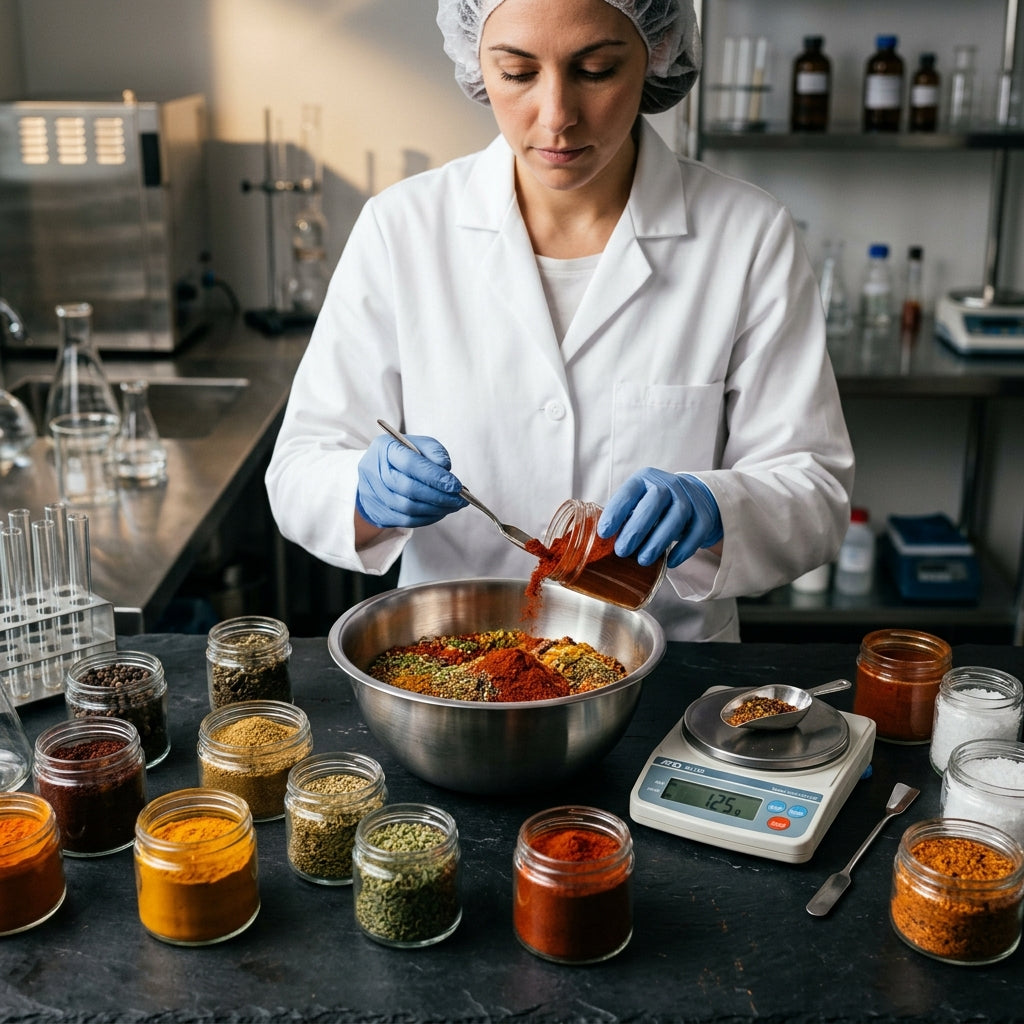
Why Custom Seasoning Blends Are a Competitive Edge
Two QSR chains can serve the exact same base dish, yet one tastes memorable and the other forgettable — the difference is almost always the seasoning. That's why understanding how seasoning manufacturers custom blends actually get developed matters so much to cloud kitchen owners and food brands chasing consistency. Flavor inconsistency across outlets is one of the most common complaints among multi-location food businesses. This guide walks through exactly how a custom blend goes from concept to finished seasoning. At 365 Spicery, we've formulated custom blends for QSR chains, cloud kitchens, and FMCG brands for over a decade.
5 Steps Behind Every Custom Seasoning Blend
Building a custom seasoning isn't guesswork; it follows a structured process that balances flavor, cost, and shelf stability. Batch-to-batch inconsistency is the single biggest risk in seasoning production, since even small variations in spice ratios change the final taste noticeably. Manufacturers relying on conventional grinding also struggle to hold flavor consistency, because heat-damaged volatile oils vary unpredictably between batches. A disciplined formulation process protects your brand's flavor identity at every outlet.
Here's how the process typically works:
Custom Formulation vs. Off-the-Shelf Seasoning
| Factor | Custom Formulation | Off-the-Shelf Seasoning |
| Flavor Uniqueness | Fully tailored to your brand | Generic, shared with competitors |
| Consistency Across Outlets | Locked-in recipe, lab-verified | Varies by batch and supplier |
| Ingredient Control | You choose ratios and ingredients | Fixed formula, no input |
| Best Suited For | QSR chains, cloud kitchens, FMCG brands | Small single-outlet operations |
What Research Shows About Flavor Consistency
According to industry reports, flavor inconsistency is one of the top reasons multi-outlet food brands lose repeat customers. Studies show that spices processed through conventional grinding can lose up to 40% of their volatile oil content, making consistent seasoning far harder to achieve. Food scientists have found that cryogenic grinding preserves over 95% of essential oils, giving custom blends a more stable and repeatable flavor base. For QSR and cloud kitchen brands, this translates directly into fewer customer complaints about taste variation between locations.
Why 365 Spicery Builds Custom Blends That Work
Creating a seasoning that tastes identical at every outlet requires more than a recipe; it requires a manufacturing partner with real process control. At 365 Spicery, we operate an FSSAI and FSSC 22000 certified facility in Mumbai, using cryogenic grinding to lock in flavor consistency batch after batch. Our seasoning portfolio includes Peri Peri, BBQ, Pizza, Burger, and Shawarma Seasoning, alongside fully custom spice formulation India blends built around your exact specifications. At 365 Spicery, we support QSR spice solutions with flexible MOQs and reliable repeat production, so your flavor never drifts as you scale. This makes us a practical partner for cloud kitchens and QSR brands searching for the best spice blend for QSR restaurant kitchen needs.
Key Takeaways:
- Custom formulation gives brands a flavor identity competitors can't copy
- Batch consistency depends heavily on grinding technology and process control
- Cryogenic grinding preserves 95%+ of volatile oils for stable flavor
- Lab testing between batches prevents flavor drift across outlets
- 365 Spicery builds custom seasonings for QSR, cloud kitchen, and FMCG brands
---
Q: How do seasoning manufacturers create custom blends?
A: Seasoning manufacturers custom blends start with defining a flavor profile, then testing ingredient ratios in small batches. 365 Spicery refines each formulation through lab testing before scaling to full commercial production for QSR and FMCG brands.
Q: Why is flavor consistency important for QSR and cloud kitchen brands?
A: Flavor consistency keeps customer experience identical across every outlet, which directly affects repeat business. Custom spice formulation India from a certified manufacturer like 365 Spicery reduces batch-to-batch variation significantly.
Q: How do I get a custom seasoning blend made for my restaurant brand?
A: Share your target flavor profile and dish type with a certified manufacturer, then test sample batches before scaling. 365 Spicery supports custom formulation from initial concept through full production for restaurant and QSR brands.
Q: Does 365 Spicery create custom seasonings for QSR and cloud kitchens?
A: Yes, 365 Spicery offers QSR spice solutions including custom seasonings, premixes, and marinades formulated to your exact specifications. Our cryogenic grinding process helps maintain consistent flavor across every production batch.
Q: What is the minimum order quantity for custom seasoning blends?
A: 365 Spicery offers flexible MOQs for custom seasoning blends, accommodating both small cloud kitchens and larger QSR chains. Exact quantities depend on the formulation, so reach out via WhatsApp for a tailored quote.
Q: What is the best spice blend for a QSR restaurant kitchen?
A: The best spice blend for QSR restaurant kitchen use depends on your menu, but Peri Peri, BBQ, and Shawarma Seasoning are popular choices. 365 Spicery can also custom-formulate a blend unique to your brand's flavor identity.
Q: Can 365 Spicery formulate Jain or Halal certified seasoning blends?
A: Yes, 365 Spicery formulates Jain No Onion No Garlic (NONG) seasonings and Halal certified custom blends on request. This allows restaurant brands targeting these markets to maintain consistent, certified flavor across their menu.
---
The single most important insight here is that consistent flavor across outlets isn't luck; it's the result of a controlled formulation process backed by proper grinding technology. Brands that skip lab testing or work with manufacturers using outdated methods often struggle with the exact flavor drift that damages customer trust. At 365 Spicery, we've built our custom seasoning process specifically to help QSR, cloud kitchen, and FMCG brands avoid that problem. What flavor profile is your brand trying to perfect right now?
---


Share:
Bulk Spices Buying Guide for Importers & Food Brands
How to Import Spices from India Successfully (2026 Guide)