


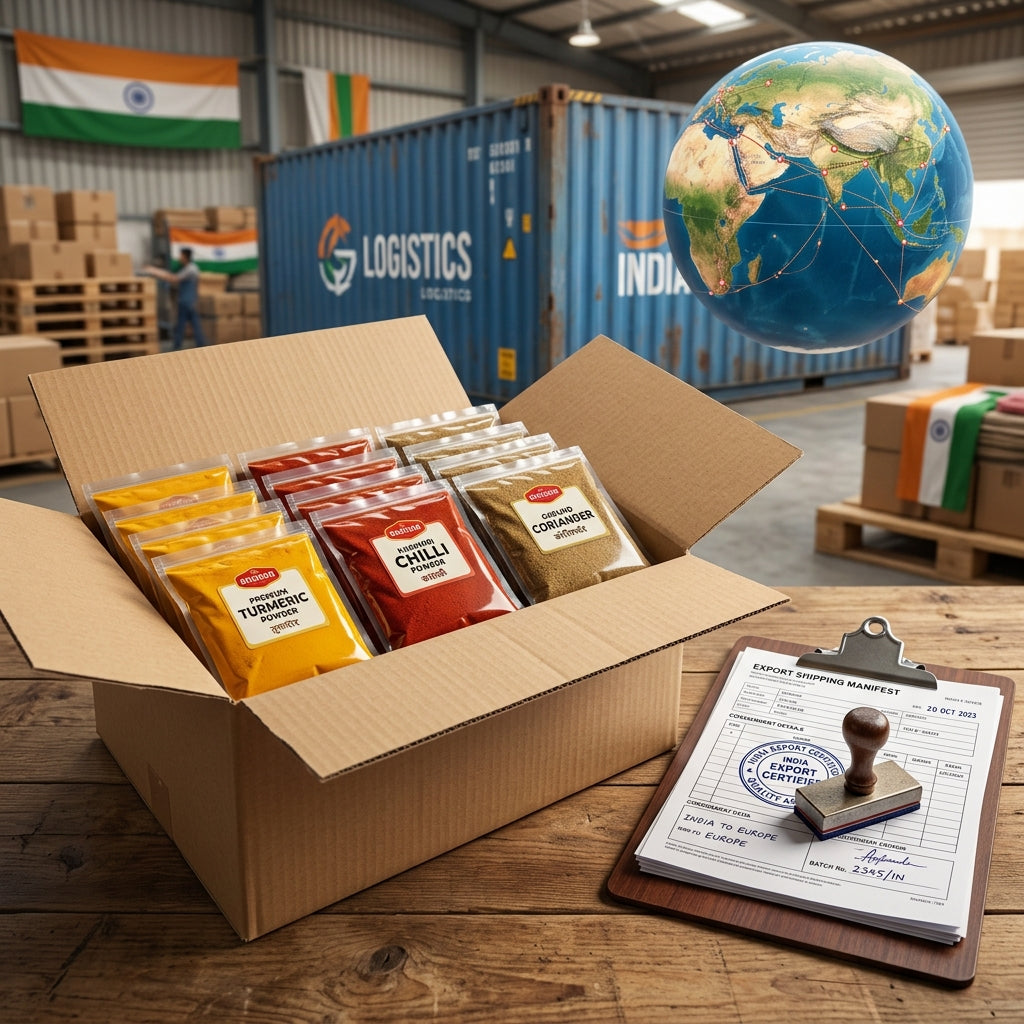
🌍 How International Buyers Source Premium Spices from India
Short answer: International buyers source premium spices from India by identifying certified manufacturers (not traders), verifying FSSAI, FSSC 22000, and Spices Board credentials, requesting pre-shipment lab reports, confirming destination market compliance, and starting with a sample order before committing to bulk. The buyers who consistently get premium quality follow a structured process — not just a price negotiation.
📦 Why India Is the First Choice for Premium Spice Sourcing
India produces over 75% of the world's spices, holds the widest variety of spice-growing microclimates, and has the most established spice export infrastructure of any country. But "sourcing from India" covers an enormous range — from certified, lab-tested manufacturers with cryogenic grinding facilities and full export documentation, to unregistered market traders selling adulterated product with no traceability. The international buyers who source premium quality know how to tell them apart before placing a single order. The ones who don't learn the difference the hard way — usually at a port of entry.
🔍 5 Steps International Buyers Use to Source Premium Indian Spices
✅ Step 1 — Find Manufacturers, Not Middlemen
The most common mistake first-time international buyers make is sourcing from trading companies that don't own a manufacturing facility. A trader may offer more flexibility and lower stated MOQs, but they cannot provide verified manufacturing certifications, consistent batch quality, or reliable documentation — because they don't control the production. Certified manufacturers like 365 Spicery operate FSSAI and FSSC 22000 registered facilities and can document every stage of production from raw material sourcing to final packaging. Ask directly: "Do you own the manufacturing facility where this product is made?" The answer tells you everything.
📋 Step 2 — Verify All Certifications Before Engaging
Premium Indian spice manufacturers hold a specific set of certifications that export-grade sourcing requires. These include FSSAI registration (Indian food safety authority), FSSC 22000 or ISO 22000 (international food safety management), Spices Board of India export registration, and Halal certification for Muslim-majority markets. Each of these is publicly verifiable. Request the certificate numbers and check them against the issuing authority's database. A genuine manufacturer shares these immediately and welcomes verification.
🧪 Step 3 — Request Batch-Level Lab Reports, Not Just Certifications
Certifications confirm that a facility meets manufacturing standards. Lab reports confirm that a specific batch meets product quality standards. These are different things, and experienced international buyers ask for both. Key test results to request per batch: curcumin content (turmeric), piperine content (black pepper), capsaicin content (chilli), pesticide residue analysis, aflatoxin levels, heavy metal screening, moisture content, and microbiological safety. A supplier who can provide these results for the last three batches has a quality management system that works. One who can't is guessing.
🌍 Step 4 — Verify Destination Market Compliance Before Shipping
Every major import market has its own specific requirements. The EU's Maximum Residue Limits (MRLs) are among the strictest globally — certain pesticide levels acceptable in Indian domestic supply are non-compliant in the EU. The USA's FDA requires prior notice for food imports. The UAE and GCC require Halal certification with Gulf-recognized bodies. Australia's DAFF has specific fumigation and phytosanitary requirements. Your Indian manufacturer should be familiar with your destination market's rules before the contract is signed, not after the shipment is held at customs.
📦 Step 5 — Start with a Sample Order and Sensory Evaluation
Before committing to a full container, request a pre-shipment sample — ideally from the same batch that will be used for production. Test it with three checks: the rub-and-smell test (fresh, potent spices release strong aroma immediately when rubbed between fingers), a visual color check (vibrant, even color indicates good curcumin or capsaicin content), and a third-party lab test matching it against the supplier's provided results. If the sample passes all three, you've found a supplier worth committing to. If the supplier hesitates on providing a sample, move on.
✅ Do's and ❌ Don'ts for International Spice Buyers
| ✅ Do | ❌ Don't |
|---|---|
| Source directly from the manufacturing facility | Buy from traders who can't show manufacturing certs |
| Request batch-level lab reports for every shipment | Rely on certifications alone without batch test data |
| Verify supplier knowledge of your destination market rules | Assume Indian MRL limits match your country's standards |
| Always start with a sample order and sensory test | Commit to bulk orders before receiving and testing a sample |
| Ask about grinding technology — cryogenic vs. conventional | Choose based on price per kg alone |
💡 Expert Recommendation
The one question that separates professional international spice buyers from first-time importers is this: "Can you walk me through exactly what happens to this spice between harvest and the moment it's sealed in the package I receive?" A premium manufacturer answers step by step — sourcing region, cleaning, drying parameters, grinding technology, testing protocol, and packaging specification. A trader or substandard manufacturer gives a vague response or deflects. The quality of that answer is the most reliable quality indicator you'll find before the product ships.
🧑💼 From an International Buyer's Point of View
Marcus, a food distribution company owner in the Netherlands, spent two years switching between Indian spice suppliers before finding a consistent source. "Every time I found a good batch, the next one was different. Color was off, aroma was weaker. I realized the problem wasn't India — it was that I was buying from traders who sourced from whoever was cheapest that season." After switching to 365 Spicery's FSSC 22000 certified facility and receiving batch-level lab reports with every order, his product consistency issues disappeared. "Now I can put their batch results directly in my own QA file. That's what premium sourcing actually looks like."
🏭 Why 365 Spicery Serves International Buyers Successfully
365 Spicery operates an FSSAI, FSSC 22000, and Halal certified manufacturing facility in Mumbai. We supply single-origin spices, blended masalas, and custom-formulated seasonings to wholesale, private label, and export buyers across the UAE, UK, USA, Australia, and Southeast Asia. Every shipment includes full export documentation — Certificate of Origin, Phytosanitary Certificate, Health Certificate, Spices Board Certificate, and batch lab reports. We use cryogenic grinding across our product range, producing spice powders with 95%+ volatile oil retention that outlast and outperform conventionally processed alternatives on aroma, color, and shelf life.
🔑 Key Takeaways
- 🏭 Source from manufacturers — not traders — who own and certify their facility
- 📋 Verify FSSAI, FSSC 22000, Spices Board, and Halal credentials before engaging
- 🧪 Request batch-level lab reports — not just facility-level certifications
- 🌍 Know your destination market's MRL and import compliance requirements in advance
- 📦 Always start with a sample order and sensory evaluation before bulk commitment
📞 Start Sourcing Premium Spices with 365 Spicery
If you're an international buyer ready to source premium Indian spices with verified quality, full export documentation, and consistent batch results, 365 Spicery is ready to work with you. Request a complimentary sample, review our certification portfolio, or discuss custom formulation and private label requirements for your market. WhatsApp us at +91 72799 00500 or visit www.365spicery.com. Mumbai-based. FSSAI, FSSC 22000, and Halal certified. Supplying buyers across 15+ countries.
---
Q: How do international buyers find premium spice suppliers in India?
A: International buyers find premium spice suppliers by searching for FSSAI and FSSC 22000 certified manufacturers registered with India's Spices Board. Verifying these credentials, requesting batch-level lab reports, and starting with a sample order before bulk commitment are the standard steps used by experienced import buyers.
Q: What is the difference between a spice manufacturer and a spice trader in India?
A: A spice manufacturer owns and operates a certified production facility and controls the entire process from raw material to packaging. A trader sources finished product from various manufacturers or farms and resells it. Manufacturers can provide consistent quality and full documentation; traders typically cannot.
Q: What certifications should a premium Indian spice supplier have?
A: A premium Indian spice supplier should hold FSSAI registration, FSSC 22000 or ISO 22000 certification, Spices Board of India export registration, and Halal certification for Muslim-majority export markets. These confirm food safety, manufacturing quality, and export eligibility.
Q: Why do international spice imports from India sometimes get rejected at customs?
A: The most common reasons are missing phytosanitary certificates, pesticide residue levels exceeding the destination country's MRL, undisclosed additives, labeling non-compliance, and aflatoxin contamination. Working with a certified manufacturer familiar with your destination market's specific requirements prevents these issues.
Q: How can I verify that a spice supplier's lab reports are authentic?
A: Request reports from NABL-accredited or internationally recognized testing laboratories. The report should include the lab's accreditation number, the specific batch number, test date, and all parameter values. Cross-reference the batch number with shipping documentation to confirm the tested batch matches what you received.
Q: What grinding technology should premium spice buyers look for?
A: Cryogenic grinding is the premium standard — it preserves 95%+ of volatile oils by grinding at -40°C to -80°C using liquid nitrogen. Conventional grinding destroys up to 40% of these oils through friction heat. Ask specifically what grinding method your supplier uses and request volatile oil content data to confirm.
Q: How important is the Spices Board of India registration for a spice exporter?
A: Spices Board registration is mandatory for legal spice export from India. It confirms the exporter is recognized by the Government of India's spice export authority and has met baseline quality and traceability requirements. Buyers should verify the registration number directly on the Spices Board of India portal.
Q: What documents should accompany every premium spice shipment from India?
A: Every shipment should include a Certificate of Origin, Phytosanitary Certificate, Health Certificate, Spices Board Certificate, batch-level lab reports (pesticide residue, heavy metals, aflatoxin, oil content), Commercial Invoice, Packing List, and Bill of Lading or Airway Bill. Missing any of these can cause customs delays.
Q: Does 365 Spicery supply spices to international buyers outside India?
A: Yes. 365 Spicery exports to buyers across the UAE, UK, USA, Australia, and Southeast Asia with full export documentation, batch lab reports, and cryogenically ground products. Contact us at +91 72799 00500 to discuss your requirements, MOQs, and pricing.
Q: Can international buyers get private label spices from India?
A: Yes. Many certified Indian spice manufacturers, including 365 Spicery, offer private label and white label manufacturing — where products are packaged under your brand with your label design and specifications. This is a common sourcing model for international food brands, distributors, and retailers.
---
Premium spice sourcing from India isn't complicated — but it is structured. Buyers who follow the five steps consistently get consistent product. Those who skip steps — particularly lab verification and sample testing — are the ones who end up with complaints, customs holds, or quality failures three months into a supplier relationship. At 365 Spicery, we make the verification process easy because we believe quality should be provable, not just promised. Ready to start sourcing the right way?
---
Partner with India's Premium Spice Manufacturer
365 Spicery serves 500+ businesses across India with:
- Wholesale & Bulk Supply
- Private Label / White Label Manufacturing
- Custom Spice Formulations
- Jain & Halal Certified Range
- FSSAI | FSSC 22000 | Lab-Tested Quality
WhatsApp: +91 72799 00500
Website: www.365spicery.com
Location: Mumbai, Maharashtra, India
---


Share:
Spice Shelf Life Chart: How Long Every Common Spice Lasts
Food Seasoning Trends Shaping the Global Market in 2026