


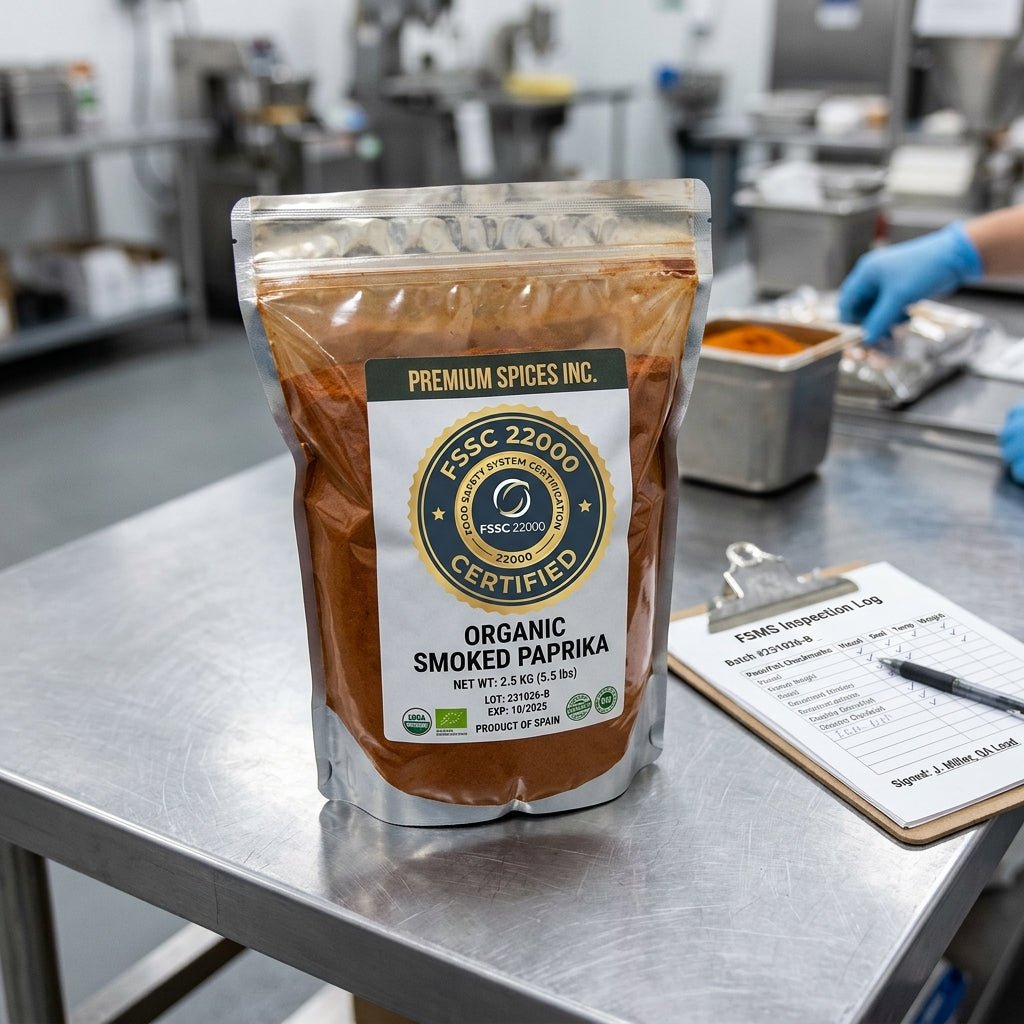
Introduction
Most bulk spice buyers can recite "FSSAI certified" without hesitation, but ask them what FSSC 22000 actually covers, and the answer usually gets vague. This gap in understanding creates real risk for food manufacturers, since these two certifications verify very different things, and relying on the wrong one can leave a supply chain exposed. This article breaks down what FSSC 22000 certified spice manufacturer status genuinely means, how it differs from FSSAI, and what procurement teams should actually check before signing a bulk supply contract. At 365 Spicery, our facility holds both certifications, so this explanation comes from direct compliance experience, not a generic overview.
What FSSC 22000 Certification Actually Covers
FSSC 22000 (Food Safety System Certification 22000) is an internationally recognized food safety management standard built on ISO 22000, combined with technical specifications for the specific food sector involved. Notably, this is a process certification, not a product certification. It verifies that a manufacturer's entire food safety management system, covering hazard analysis, traceability, hygiene control, and supplier verification, meets a consistent, auditable standard. Therefore, FSSC 22000 answers a different question than FSSAI registration does. FSSAI confirms legal compliance to operate as a food business in India, while FSSC 22000 confirms that the manufacturing process itself is systematically controlled against food safety risks. This matters because regulatory and compliance risk is one of the top concerns for FMCG buyers, particularly when spices are used as an ingredient in a larger packaged food product that carries its own certification obligations downstream.
3 Reasons FSSC 22000 Matters More Than FSSAI Alone
Understanding the practical difference helps buyers evaluate suppliers correctly:
How to Verify a Supplier's FSSC 22000 Certification
Buyers should not accept a certification claim at face value. Follow these steps:
FSSC 22000 Certified vs. Uncertified Spice Supply
| Factor | FSSC 22000 Certified Supplier | Uncertified Supplier |
| Food Safety Management | Documented, audited system covering the full process | Informal, varies by internal practice |
| Traceability | Full batch-to-source traceability required | Often limited or undocumented |
| Audit Frequency | Periodic surveillance audits mandatory | No external verification |
| International Recognition | Widely accepted for export and FMCG contracts | May not meet requirements for larger buyers |
| Buyer Risk Level | Lower, backed by a recognized compliance system | Higher, relies on trust rather than verified process |
As the table shows, the real value of FSSC 22000 is the ongoing, documented system behind the certificate, not the certificate itself. A supplier that cannot explain their traceability process likely does not have one worth relying on.
What the Data Says About Certification and Supply Chain Risk
According to industry reports, food safety recalls and compliance failures remain a significant cost risk for FMCG and food manufacturing companies sourcing raw ingredients like spices in bulk. Food scientists have found that suppliers with structured food safety management systems, such as those required by FSSC 22000, show measurably lower rates of contamination and adulteration incidents compared to informally managed operations. Studies show that buyers who verify certification scope and audit history, rather than relying on certificate claims alone, report significantly fewer supply chain disruptions. This is why leading food manufacturers increasingly treat FSSC 22000 verification as a mandatory procurement step, not an optional quality preference, when selecting a bulk spice supplier.
How 365 Spicery Meets FSSC 22000 Standards for Bulk Buyers
At 365 Spicery, our Mumbai facility holds FSSC 22000 certification alongside FSSAI registration and Halal certification, giving bulk buyers a fully documented food safety management system across our entire spice and masala portfolio. Every batch is lab-tested, so FMCG buyers, hotel procurement teams, and private label founders can source with confidence that traceability and hygiene controls are actively maintained, not just claimed. Our relevant portfolio for compliance-sensitive buyers spans Whole Spices, Single Spice Powders, and Blended Spice Mixes, all manufactured using Cryogenic Grinding Technology within the same certified facility. For food manufacturers exploring FSSC 22000 certified spice manufacturer India partnerships, we also support custom formulation and large-volume institutional supply, backed by the same audited system across every order. This is what lets a bulk buyer build their own downstream compliance on a foundation that has already been independently verified.
Key Takeaways:
- FSSC 22000 certifies a manufacturer's food safety management system, while FSSAI confirms legal compliance to operate.
- FSSC 22000 requires full supply chain traceability, addressing adulteration risk at the sourcing stage, not just final testing.
- Always verify the certification scope, audit history, and certifying body, rather than accepting a logo or claim at face value.
- Buyers sourcing for export or multinational FMCG contracts often specifically require FSSC 22000, not just FSSAI.
- 365 Spicery holds FSSC 22000, FSSAI, and Halal certification across its entire Mumbai manufacturing facility.
---
#
s
Q: What does FSSC 22000 certification mean for spice buyers?
A: FSSC 22000 certifies that a manufacturer's entire food safety management system, including traceability, hygiene, and hazard control, meets an internationally recognized, audited standard. It goes beyond basic legal compliance to verify the actual process is systematically controlled.
Q: How is FSSC 22000 different from FSSAI certification?
A: FSSAI confirms legal compliance to operate as a food business in India, while FSSC 22000 verifies that the manufacturing process itself follows a documented, audited food safety management system. Many serious buyers require both certifications together.
Q: How do I verify a spice supplier's FSSC 22000 certification?
A: Request the actual certificate with certification body, scope, and expiry date, and confirm it covers the specific facility and product category you are sourcing. Asking about recent audit history also helps confirm the certification is actively maintained.
Q: Is 365 Spicery an FSSC 22000 certified spice manufacturer?
A: Yes, 365 Spicery's Mumbai facility holds FSSC 22000 certification alongside FSSAI registration and Halal certification, covering our full spice, masala, and seasoning portfolio with documented traceability and lab testing.
Q: What is the minimum order quantity for bulk spice supply from an FSSC 22000 certified manufacturer like 365 Spicery?
A: 365 Spicery offers flexible institutional packaging from 5kg up to 50kg depending on the product, suited to FMCG and large-volume buyers. Procurement teams can contact the team on WhatsApp to discuss specific volume requirements.
Q: Which is the best FSSC 22000 certified spice manufacturer in India?
A: A reliable manufacturer should hold active FSSC 22000, FSSAI, and ideally Halal certification, with documented batch traceability and cryogenic grinding for quality consistency. 365 Spicery meets these standards from its certified Mumbai facility.
Q: Does FSSC 22000 certification also cover Halal compliance?
A: No, FSSC 22000 and Halal certification are separate standards covering different requirements. 365 Spicery holds both independently, alongside FSSAI, giving buyers documentation across food safety, legal, and religious dietary compliance requirements.
---
#
The most important insight here is that FSSC 22000 is not just another logo on a supplier's website, it represents an ongoing, audited commitment to food safety management that FSSAI alone does not verify. Buyers who take the time to check certification scope, audit history, and traceability documentation protect their own supply chain far more effectively than those who accept a certificate claim at face value. As compliance expectations rise across FMCG, export, and institutional food service, the manufacturers who maintain genuine, verifiable FSSC 22000 systems will become the default choice for serious bulk buyers. Does your current spice supplier's certification hold up if you actually asked to see the audit history?
---
#


Share:
Why Hotels Are Switching to Cryogenic Ground Spices
No Onion No Garlic Vegetable Broth Powder: 2026 Guide