


Introduction
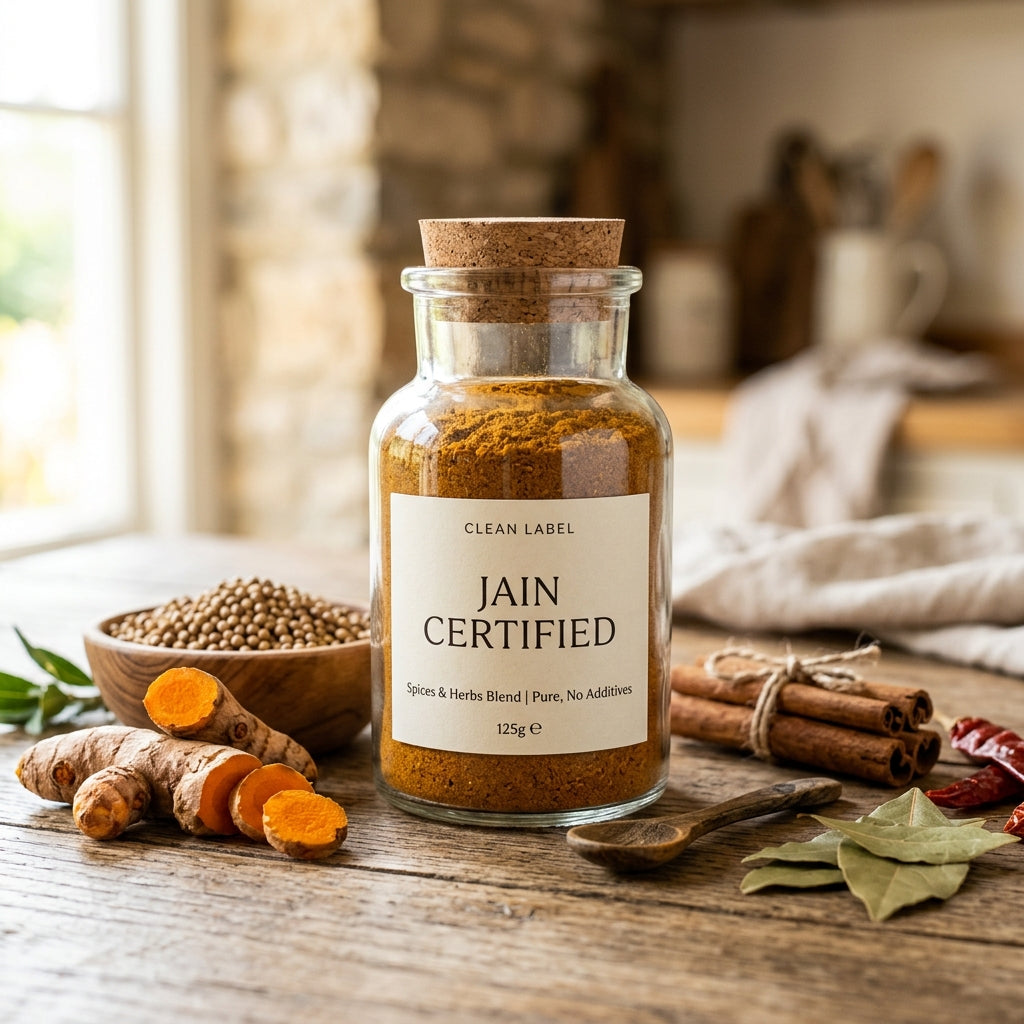
Two food trends that started from completely different motivations are now converging into one buyer expectation. Clean label, driven by additive-conscious consumers, and Jain-compliant sourcing, rooted in religious dietary law, are increasingly demanded by the same person: someone who wants a short ingredient list, no onion or garlic, and full transparency on how the product was made. For food brands, this creates a rare opportunity to serve two audiences with one well-built product. This article explains why clean label and Jain requirements overlap so naturally, how brands can formulate for both simultaneously, and where the manufacturing details actually matter. At 365 Spicery, we build products that satisfy both standards daily, so this comes from direct production experience.
Why Clean Label and Jain Certification Overlap So Well
At first glance, clean label and Jain certification look like separate checklists, but they share the same underlying discipline: nothing hidden, nothing unnecessary. A clean label product avoids artificial color, MSG, and unnecessary preservatives, while a Jain product avoids onion, garlic, and root vegetables. Notably, both standards demand the same thing from a manufacturer — precise sourcing and a process that does not need shortcuts to taste good. Therefore, when a brand builds a genuinely Jain-compliant product using cryogenic grinding spices, it is very often clean label by default, since neither onion-garlic flavor bases nor heat-degradation-driven additives are present in the formulation. This matters because spice adulteration and mislabeled "natural" claims remain common in India, so a brand that can prove both standards at once earns disproportionate trust.
3 Reasons This Combination Wins With Modern Buyers
Understanding the overlap helps explain why brands are moving in this direction:
Additionally, "natural spices no preservatives" and "Jain certified spices India" increasingly appear together in the same buyer search sessions, signaling that this is now one combined purchase decision, not two separate ones.
How to Build a Clean Label Jain Product
Brands aiming for both standards should follow this sequence:
Cryogenic Ground vs. Conventional Ground for Clean Label Claims
| Factor | Cryogenic Grinding | Conventional Grinding |
| Grinding Temperature | -40°C to -80°C | 60°C to 90°C (friction heat) |
| Volatile Oil Retention | 95%+ preserved | Up to 40% lost to heat |
| Need for Flavor Additives | Low, since natural aroma is intact | Higher, sometimes needs enhancers to compensate |
| Clean Label Compatibility | High — short, honest ingredient list | Lower — may require compensatory additives |
| Jain Formulation Flavor Strength | Strong, since remaining spices carry full flavor load | Weaker, harder to hit "authentic" taste without onion/garlic |
As the table shows, the grinding method is where clean label and Jain requirements meet in practice. A brand cannot claim both convincingly if the manufacturing process itself relies on heat-degraded spices patched up with additives.
What the Data Says About Clean Label Plus Jain Demand
According to industry reports, India's clean label food segment has been growing as urban consumers increasingly reject additive-heavy packaged products. Food scientists have found that volatile oil retention above 90% correlates strongly with both perceived freshness and reduced need for flavor-masking additives, tying the clean label and Jain formulation challenge together directly. Studies show that products carrying dual certification claims (such as Jain plus FSSAI or Halal) see stronger repeat purchase behavior than single-claim products, since buyers interpret multiple certifications as a broader trust signal. This is why manufacturers building genuinely clean label Jain products, rather than treating them as separate SKUs, are gaining a measurable edge with both religious and health-conscious buyers.
How 365 Spicery Supports Clean Label Jain Brands
At 365 Spicery, we manufacture our entire Jain Range (NONG) using Cryogenic Grinding Technology inside an FSSAI, FSSC 22000, and Halal certified facility in Mumbai, giving every product a naturally short, clean ingredient list. Every batch is lab-tested, so brands positioning themselves on both clean label and Jain compliance can back up their claims with real documentation. Our relevant portfolio includes Jain Garam Masala, Jain Chole Masala, Jain Biryani Masala, Jain Sambar Powder, and Jain Seasoning, all formulated without onion, garlic, artificial color, or unnecessary additives. For founders exploring custom spice formulation for food company India, we offer private label packaging and flexible MOQ, so a new brand can launch a genuinely dual-compliant product without managing two separate manufacturing relationships. This is what allows a brand to make both claims honestly, rather than treating clean label as a marketing layer over a standard formulation.
Key Takeaways:
- Clean label and Jain certification share the same underlying discipline: precise sourcing and no unnecessary additives.
- Products built to be genuinely Jain-compliant are very often clean label by default, when made with cryogenic-ground spices.
- Building for both standards from the start costs less than reformulating a standard product later.
- Cryogenic grinding reduces the need for flavor-masking additives, keeping both compliance claims honest.
- 365 Spicery manufactures a full Jain Range (NONG) in an FSSAI, FSSC 22000, and Halal certified Mumbai facility, supporting brands that want both claims verified.
---
#
s
Q: What does clean label and Jain mean for a food product?
A: It means a product has a short, honest ingredient list free of artificial additives, and also excludes onion, garlic, and root vegetables per Jain dietary rules. Together, these two standards signal the same underlying manufacturing discipline to buyers.
Q: Why do clean label and Jain certification overlap so naturally?
A: Both standards avoid shortcuts, whether that means artificial preservatives or onion-garlic flavor bases. A product built with cryogenic grinding spices often satisfies both requirements without any extra reformulation needed.
Q: How can I formulate a product that is both clean label and Jain compliant?
A: Start by designing around a short, recognizable ingredient list, then choose a manufacturer with FSSAI, FSSC 22000, and Jain certification under one roof. Insisting on cryogenic-ground inputs helps avoid the need for flavor-masking additives later.
Q: Does 365 Spicery manufacture clean label Jain products?
A: Yes, 365 Spicery's Jain Range (NONG) is cryogenically ground and manufactured in an FSSAI, FSSC 22000, and Halal certified facility in Mumbai, giving every product a naturally short, additive-free ingredient list. Every batch is lab-tested.
Q: What is the minimum order quantity for a clean label Jain private label product with 365 Spicery?
A: 365 Spicery offers flexible MOQ with packaging from 1kg retail-ready packs up to 50kg institutional packs, depending on the product. Brands can contact the team on WhatsApp to plan a launch order for their specific formulation.
Q: Which manufacturer offers both clean label and Jain certified spices in India?
A: A reliable manufacturer should combine FSSAI, FSSC 22000, Halal, and Jain certification with cryogenic grinding for genuine clean label quality. 365 Spicery supports brands with this exact combination from its certified Mumbai facility.
Q: Is 365 Spicery's clean label Jain range also Halal certified?
A: Yes, 365 Spicery's facility holds Halal certification alongside FSSAI, FSSC 22000, and its dedicated Jain (NONG) product range. This lets brands make multiple certified claims on a single product without sourcing from separate manufacturers.
---
#
The most important insight here is that clean label and Jain compliance are not two separate boxes to check, they are two expressions of the same manufacturing discipline. A brand that builds its formulation around a short ingredient list and genuine onion-garlic exclusion, backed by cryogenic grinding and real certification, earns both claims honestly and at the same time. As buyers increasingly expect transparency and dietary compliance together, brands that treat these as one combined standard, rather than an afterthought layered on later, will build stronger, more durable trust. Is your brand currently formulating for one of these standards, or both at once?
---
#


Share:
How to Launch a No Onion No Garlic Product Line (2026)
Top Export Destinations for No Onion No Garlic Spices