


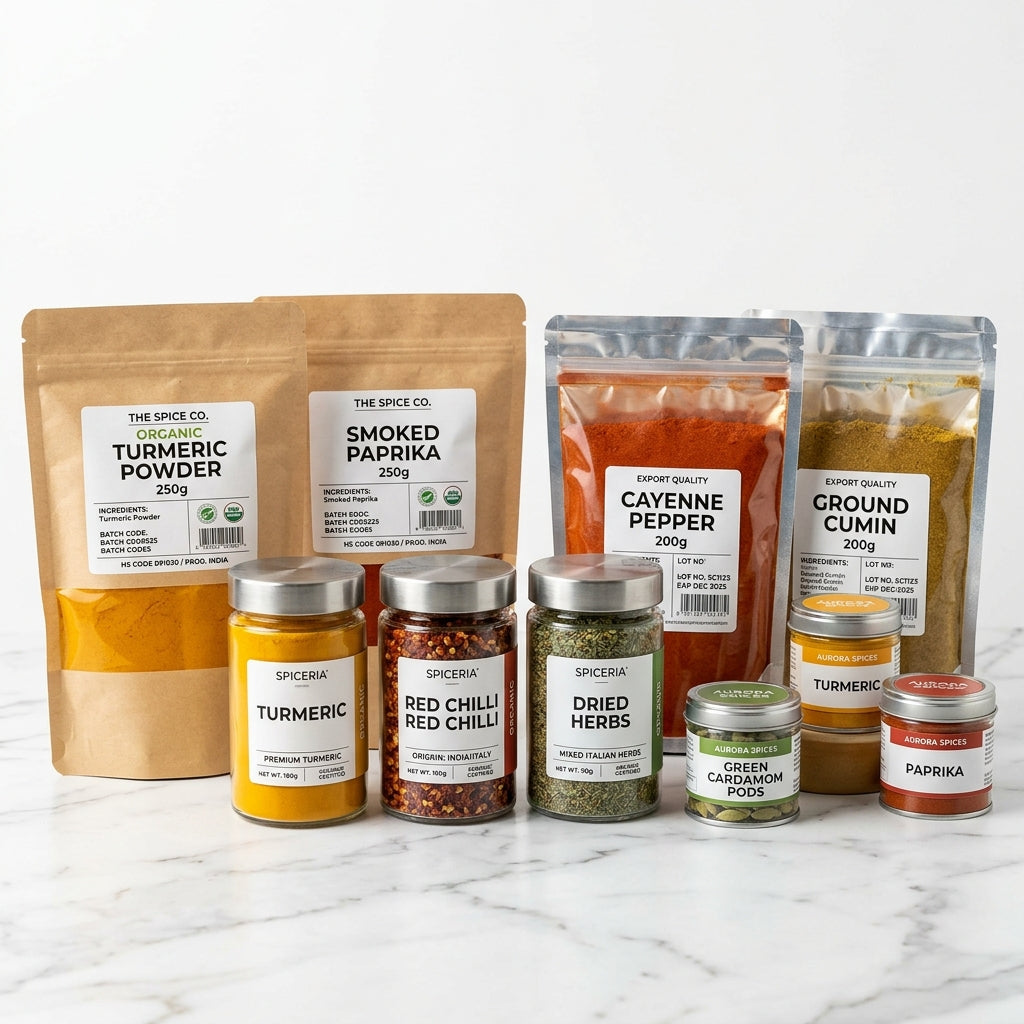
📦 Best Spice Packaging for Export & Retail: Complete Guide
Short answer: The best spice packaging depends on the destination market and application. For export, triple-layer laminated foil pouches (with moisture barrier, oxygen barrier, and puncture resistance) are the industry standard — they protect volatile oils, prevent moisture ingress, and meet international shipping requirements. For retail, glass jars and kraft stand-up pouches perform best because consumers associate them with premium quality and transparency. For food service and bulk supply, multi-layer kraft paper bags with inner poly liners at 5–25 kg are most practical. Every format must carry correct FSSAI, country-specific import compliance, and batch traceability labeling to clear customs without delays.
🎯 Why Spice Packaging Is a Business-Critical Decision
Spice packaging is not merely a container — it is the primary defense system protecting a product worth significantly more than the packaging itself. The volatile oils responsible for a spice's aroma, the carotenoids responsible for its color, and the moisture-sensitive compounds responsible for its texture are all compromised by inadequate packaging within weeks or even days of production. A turmeric powder with high curcumin content and vibrant color that arrives in an EU market looking pale and flat — because packaging failed to block oxygen and moisture during the 4–6 week ocean freight journey — is a product failure that no quality manufacturing can compensate for after the fact. For food businesses sourcing or manufacturing spices, packaging specification is as important as the product specification itself.
📋 Spice Packaging Types: When to Use Each
🏆 1. Triple-Layer Laminated Foil Pouches (Export Standard)
The gold standard for bulk export and long-shelf-life retail. Constructed from PET / aluminium foil / PE layers, this packaging blocks oxygen (O₂), moisture (water vapor), and light — the three primary enemies of spice quality. With a correctly sealed foil pouch, high-volatile-oil spices like cardamom, Garam Masala, and black pepper can maintain quality for 18–24 months. Available with zip-lock closure for resealable retail formats, or heat-sealed for one-time use bulk export. Mandatory for EU and UK export to comply with migration limits and food contact material regulations. 365 Spicery uses triple-layer laminated foil as the default export packaging for all shipments above 1 kg.
🫙 2. Glass Jars (Premium Retail)
The highest perceived value retail format — glass communicates quality, purity, and transparency to the end consumer. Completely inert (no chemical migration), indefinitely resealable, and visually appealing. The key limitation is weight (shipping cost) and fragility in transit. Best suited for premium consumer retail products priced above ₹150–₹200 per unit, where higher packaging cost is justified by brand positioning. For export in glass jars, foam inserts or corrugated dividers in outer cartons are essential to prevent breakage. Increasingly popular for D2C spice brands and specialty grocery chains globally.
♻️ 3. Kraft Stand-Up Pouches with Zipper (Clean Label Retail)
The fastest-growing retail packaging format in the premium spice category globally. Kraft paper exterior communicates natural, artisanal, and clean label values that consumers in health-focused and premium grocery segments actively seek. The inner liner (typically PE or foil) provides the actual barrier protection. With a zip-lock closure, the consumer can reseal after each use — a critical shelf-life advantage. The format also accepts excellent print quality for branding. For private label and D2C spice brands, kraft pouches are often the first-choice packaging for market differentiation at a manageable cost.
🥫 4. Metal / Tin Containers (Specialty and Gift Retail)
Tin packaging delivers the highest premium feel in a retail spice product — it's durable, gift-worthy, and completely opaque (protecting light-sensitive spices). Used by specialty spice brands and gifting ranges. The per-unit cost is higher than foil or kraft, making it suitable for products priced at ₹300+ or for branded gifting sets. Heat-sealed inner membrane provides initial freshness protection before the tin lid is opened.
📦 5. Multi-Layer Kraft Paper Bags with Poly Liner (Bulk / Food Service)
The industry standard for bulk spice supply in 1 kg, 5 kg, 10 kg, and 25 kg sizes. Outer kraft paper provides structural integrity and printability; inner poly liner provides the moisture barrier. The most cost-effective packaging for B2B food service, industrial manufacturing customers, and bulk export shipments. Not suitable for retail — the format does not communicate consumer-facing quality signals but is functionally excellent for its intended applications.
🌍 Export Compliance: What Your Packaging Must Include
| Market | Mandatory Label Requirements |
|---|---|
| EU / UK | Ingredient list, allergen declaration, net weight, country of origin, manufacturer address, best-before date, lot number, food contact material compliance |
| USA (FDA) | Nutrition facts panel, ingredient list, allergen statement, FDA facility registration number, net weight in US and metric units |
| GCC (UAE, Saudi) | Arabic language labeling, Halal certification mark, ingredient list, manufacturing and expiry date, importer details |
| India (FSSAI) | FSSAI license number, ingredient list, best-before date, manufacturing date, batch number, net weight, green/red dot (veg/non-veg) |
| Australia / NZ | Country of origin statement, allergen list, FSANZ compliance, importer details, best-before date |
✅ Do's and ❌ Don'ts — Spice Packaging for Export & Retail
| ✅ Do | ❌ Don't |
|---|---|
| Specify oxygen and moisture barrier requirements when sourcing packaging | Use single-layer poly bags for export — they offer no oxygen or UV protection |
| Include batch numbers and manufacture dates on every pack | Use vague "best before" dating without a batch code — customs will reject it |
| Verify food contact material compliance for destination market | Assume Indian-market packaging meets EU or FDA requirements without checking |
| Use nitrogen flushing inside sealed pouches for volatile oil preservation | Overfill pouches — headspace is needed for sealing integrity and nitrogen flush |
| Match packaging format to channel — premium retail needs glass or kraft, bulk B2B needs multi-layer kraft bags | Use the same packaging for retail and bulk B2B — they serve completely different functions |
💡 Expert Recommendation
The most expensive packaging mistake in the spice export business is using Indian-market compliant packaging for EU or US shipments without verifying food contact material (FCM) regulations. EU Regulation 10/2011 sets strict migration limits for plastic packaging in contact with food — and many Indian inner-liner materials used in standard kraft pouches are not tested against these limits. A shipment that clears customs in week one but is rejected after a routine market surveillance test in week eight creates a recall scenario that is far more expensive than the cost of correct packaging at the source. Always request FCM compliance documentation from your packaging supplier before the first export shipment. At 365 Spicery, our export packaging is selected specifically for FCM compliance in EU and UK markets.
🧑💼 From an Export Buyer's Point of View
Tanya, owner of an Indian specialty food import company in the Netherlands, had two consecutive shipments of turmeric powder rejected by her retail chain buyer — not for product quality, but for labeling compliance failures: missing lot numbers and non-compliant allergen formatting under EU Regulation 1169/2011. "I had been working with a Mumbai supplier for two years with no issues in smaller specialty stores. The moment I tried to list in a mainstream supermarket, the compliance requirements were completely different. 365 Spicery was the first supplier who handed me a complete packaging compliance checklist before we even discussed price." Export packaging compliance is not a checkbox at the end of a deal — it's a prerequisite for retail channel access in serious markets.
🔑 Key Takeaways
- 📦 Export = triple-layer laminated foil pouches (O₂ + moisture + UV barrier mandatory)
- 🫙 Premium retail = glass jars or kraft stand-up pouches (perceived quality + resealable)
- 📦 Bulk B2B = multi-layer kraft with poly liner (cost-effective, functional, scalable)
- 🌍 Every export market has distinct mandatory labeling requirements — verify before production
- ⚠️ Food contact material (FCM) compliance is a legal requirement in EU and UK — request documentation
📞 Export-Ready Spice Packaging from 365 Spicery
Every spice product shipped by 365 Spicery comes in export-compliant packaging — triple-layer laminated foil for bulk and private label, kraft stand-up pouches for premium retail, glass jars for specialty channels — with full FSSAI, FSSC 22000, and destination-market labeling compliance built in. Our team handles packaging format selection, label compliance review, and custom branding for private label clients across 15+ countries. If your current packaging is creating export delays or retail compliance issues, we'd like to help you solve them. WhatsApp us at +91 72799 00500 or visit www.365spicery.com to discuss packaging options for your next shipment. Halal and Jain certified. Full export documentation provided.
---
Q: What is the best packaging for exporting spices from India?
A: Triple-layer laminated foil pouches (PET / aluminium foil / PE construction) are the industry standard for spice export from India. They block oxygen, moisture, and UV light — the three primary causes of spice quality degradation during long-haul shipping. They also meet food contact material requirements for EU, UK, and US markets.
Q: What packaging is best for retail spice products?
A: For premium retail, glass jars and kraft stand-up pouches with zip-lock closures perform best. Glass communicates quality and purity; kraft pouches communicate natural and clean label values. Both outperform generic plastic containers in consumer perception studies for specialty food products.
Q: What labeling is required for exporting spices to the EU?
A: EU spice exports require: ingredient list, allergen declaration per EU Regulation 1169/2011, net weight, country of origin, manufacturer and importer address, best-before date, lot number, and food contact material compliance certification (EU Regulation 10/2011). Arabic language is additionally required for GCC markets.
Q: What is food contact material (FCM) compliance in spice packaging?
A: FCM compliance means the packaging material in direct contact with the spice has been tested to confirm it does not migrate harmful substances into the food product above legal limits. EU Regulation 10/2011 sets these limits for plastic materials. Packaging sold in India may not be FCM-tested for EU standards — always request documentation.
Q: How long do spices last in laminated foil pouches?
A: High-quality spices in triple-layer laminated foil pouches with nitrogen flush can maintain peak quality for 18–24 months. Spices with particularly high volatile oil content (cardamom, Garam Masala) benefit most from foil packaging. In inadequate packaging (single-layer poly bags), the same spice may lose significant aroma quality within 3–6 months.
Q: What is the best packaging size for bulk spice export?
A: For bulk export, 5 kg, 10 kg, and 25 kg multi-layer kraft bags with poly inner liners are the most common formats. For premium wholesale or private label export, 500g–1 kg laminated foil pouches are preferred. The right size depends on your buyer's usage volume, storage capacity, and shelf life requirements per opening.
Q: Can I use the same packaging for India retail and export?
A: Not without modification. Indian retail packaging must comply with FSSAI labeling requirements (including the FSSAI license number and green/red dot). Export packaging must additionally meet the destination country's food safety labeling requirements — which differ significantly between EU, US, GCC, and Australian markets.
Q: What is nitrogen flushing in spice packaging?
A: Nitrogen flushing replaces oxygen inside a sealed spice pouch with inert nitrogen gas before final sealing. Since oxygen is a primary cause of volatile oil oxidation and color degradation in spices, removing it significantly extends the product's aroma and color shelf life. This is standard practice in high-quality spice manufacturing and should be requested when sourcing certified spice suppliers.
Q: Is kraft packaging good for spice shelf life?
A: Kraft paper alone provides no barrier protection — it's the inner liner (PE film or foil laminate) that determines actual shelf life. A kraft pouch with a robust foil inner liner performs comparably to a pure foil pouch. Always verify the barrier specification of the inner liner, not just the outer aesthetic, when evaluating kraft packaging for spice use.
Q: Does 365 Spicery offer private label spice packaging with export compliance?
A: Yes. 365 Spicery provides fully compliant private label packaging for retail and export markets in glass jars, kraft stand-up pouches, and laminated foil formats. Services include custom label design, compliance review for destination market requirements, and full FSSAI/FSSC 22000 certified documentation. Contact us at +91 72799 00500 to discuss your requirements.
---
Spice packaging is the final — and often most overlooked — link in the quality chain between a perfectly produced spice and a customer who opens the packet 8 weeks and 10,000 km later expecting the full aroma and color of a freshly ground product. The packaging decisions you make at the source determine whether that expectation is met or disappointed. At 365 Spicery, we treat packaging as seriously as formulation — because a product that arrives correctly is the only product that earns a repeat order. What packaging challenge is currently limiting your export or retail performance?
---
Partner with India's Premium Spice Manufacturer
365 Spicery serves 500+ businesses across India with:
- Wholesale & Bulk Supply
- Private Label / White Label Manufacturing
- Custom Spice Formulations
- Jain & Halal Certified Range
- FSSAI | FSSC 22000 | Lab-Tested Quality
WhatsApp: +91 72799 00500
Website: www.365spicery.com
Location: Mumbai, Maharashtra, India
---


Share:
BBQ Seasoning vs BBQ Rub: What's the Real Difference?
How to Start a Spice Export Business in 2026: Complete Guide