


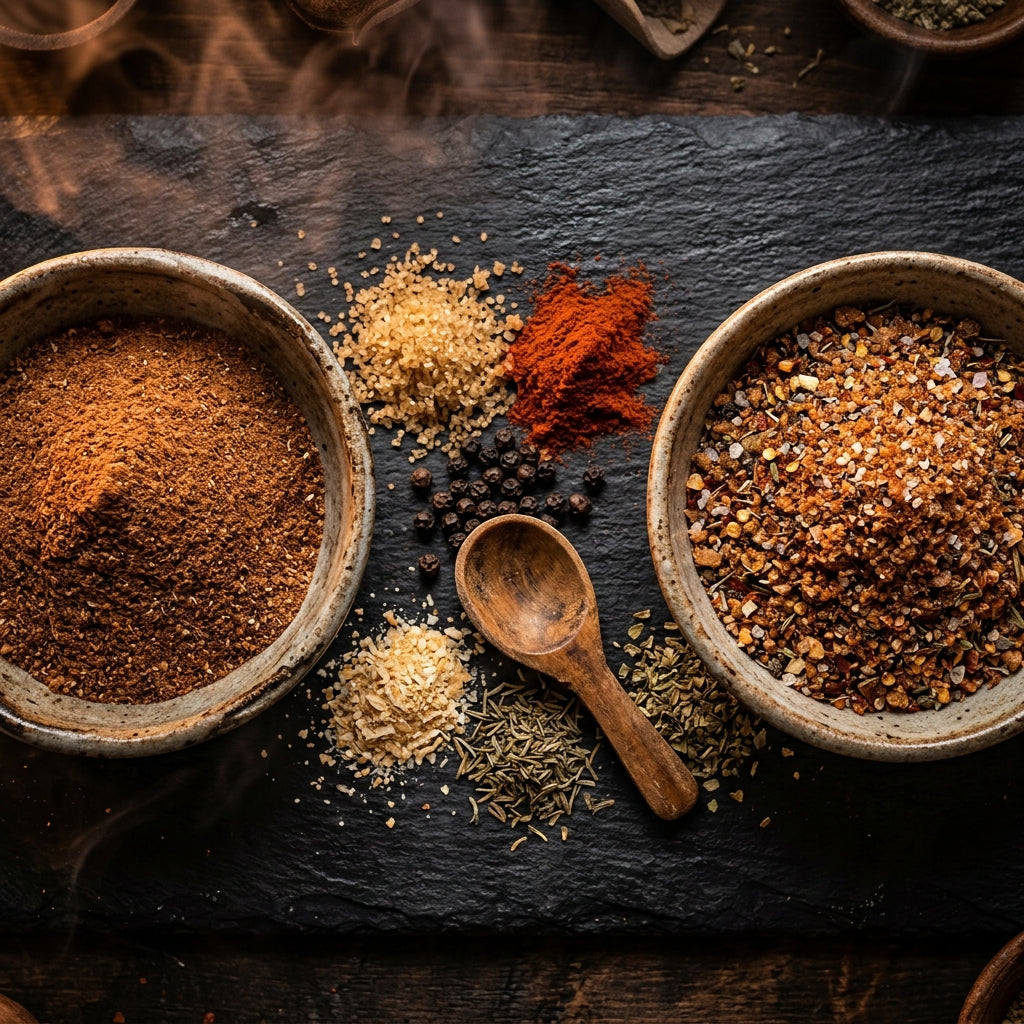
🔥 BBQ Seasoning vs BBQ Rub: What's the Real Difference?
Short answer: BBQ seasoning is a finely ground, all-purpose spice blend used before, during, or after cooking for flavor. A BBQ rub is a coarser, often sugar-heavy mixture applied to raw protein before slow cooking or smoking to form a caramelized crust called a "bark." Both share overlapping ingredients, but they differ in texture, particle size, sugar content, application method, and the cooking technique they're designed for. Using the wrong one for the wrong method produces noticeably different results.
🍖 Why the Distinction Matters for Food Businesses and Serious Cooks
In India's rapidly growing BBQ food segment — QSR chains, cloud kitchens, premium grilling brands, and outdoor food concepts — the BBQ category is often treated as a single flavor identity. But the distinction between seasoning and rub determines texture outcome, not just flavor. A BBQ rub applied to a chicken wing before air-frying at 200°C for 20 minutes creates a completely different surface result than the same blend used as a finishing sprinkle. Understanding which product to develop, stock, or source for a specific menu application is a manufacturing and formulation decision with direct impact on product quality and customer experience.
📊 BBQ Seasoning vs BBQ Rub — Head-to-Head Comparison
| Factor | BBQ Seasoning | BBQ Rub |
|---|---|---|
| Texture | Fine powder, even grind | Coarse, mixed particle sizes |
| Sugar Content | Low to none | High (brown sugar is key ingredient) |
| Salt Content | Moderate, blended in | High, coarse sea or kosher salt |
| Application Timing | Before, during, or after cooking | Before cooking only — needs time to penetrate |
| Cooking Method | Grilling, roasting, air-frying, finishing | Slow smoking, low-and-slow BBQ, oven roasting |
| Key Result | Flavor enhancement | Caramelized crust / bark formation |
| Best Proteins | Chicken, fish, vegetables, fries | Ribs, brisket, pork shoulder, lamb |
| Moisture Draw | Minimal | Draws surface moisture (osmosis), forms pellicle |
🧾 What Goes Into Each Blend
🫙 BBQ Seasoning Core Ingredients
- 🌶️ Smoked Paprika — The defining flavor; provides deep color and subtle smokiness
- 🧄 Garlic Powder — Savory backbone and umami
- 🧅 Onion Powder — Background sweetness
- 🌿 Dried Oregano / Thyme — Herbal complexity
- 🌶️ Cayenne or Chilli Powder — Heat calibration
- ⬛ Black Pepper — Sharp bite
- 🧂 Fine Salt — Even distribution across the blend
- 🍬 Brown Sugar (30–40% of blend) — Caramelization and bark formation at high heat
- 🧂 Coarse Sea Salt or Kosher Salt — Draws moisture and creates pellicle
- 🌶️ Smoked Paprika — Color and smoke character
- 🧄 Granulated Garlic — Coarser cut than powder for texture in the crust
- ⬛ Cracked Black Pepper — Visual and textural presence in the crust
- 🌶️ Cayenne — Heat and color depth
- 🌿 Dried Mustard / Cumin — Complexity and earthy warmth
- 🔥 BBQ seasoning = fine powder, low sugar, versatile application timing
- 🍖 BBQ rub = coarse texture, high brown sugar, applied pre-cook only for bark formation
- ⚗️ Bark requires sugar + osmosis + low-and-slow heat — seasoning powder cannot replicate this
- 🇮🇳 In Indian QSR and snack markets, BBQ seasoning (fine, low-sugar) is the more widely applicable format
- 🏭 Specify your primary application before sourcing — one blend cannot optimize all three uses
🍖 BBQ Rub Core Ingredients
⚗️ The Science of Bark vs Flavor Coat
When a BBQ rub is applied to raw protein and given 30 minutes to 12 hours to rest, the salt draws moisture to the surface through osmosis. The drawn moisture dissolves the sugar and spices, creating a concentrated paste. During slow cooking at 110–135°C, the Maillard reaction and caramelization convert this sugar-spice paste into a hard, flavorful crust called a "bark." The bark is not just a flavored coating — it's a structural layer that seals in the meat's juices and adds a textural contrast to every bite. BBQ seasoning, applied to a surface already in contact with direct heat, simply seasons the outer layer without undergoing the same chemical transformation. Both are valid — but they are different products serving different purposes.
🇮🇳 BBQ Blends in the Indian Market Context
The Indian BBQ seasoning market is primarily driven by three applications: QSR chicken formats (wings, tenders, burgers), snack coatings (BBQ-flavored chips and namkeen), and home grilling and tandoor use. For QSR and snack applications, BBQ seasoning (fine powder, lower sugar, stable at high heat) is the correct product. For premium restaurant or catering formats involving slow-cooked meats, a true BBQ rub with coarse texture and significant brown sugar is appropriate. At 365 Spicery, we develop both formats for food brands — with heat levels, smoke character, and sugar content calibrated to the specific application and target market.
✅ Do's and ❌ Don'ts — BBQ Seasoning and Rub
| ✅ Do | ❌ Don't |
|---|---|
| Apply BBQ rub 30 min to overnight before cooking for bark formation | Use a high-sugar rub in a very high-heat application — sugar burns above 175°C |
| Use BBQ seasoning as a finishing sprinkle on cooked proteins | Apply rub on already-cooked protein — the bark process requires raw surface |
| Press the rub firmly into the protein surface — don't just dust it on | Use fine-powder seasoning expecting a crust — texture is a key factor in bark |
| Specify which format you need when sourcing from a manufacturer | Substitute one for the other in a recipe without adjusting cooking temperature and time |
| Request cryogenically ground smoked paprika for deeper color and aroma | Store high-sugar rubs in humid conditions — brown sugar clumps aggressively |
💡 Expert Recommendation
The most common BBQ product development mistake in the Indian food industry is formulating a single "BBQ masala" that is supposed to work across snack coatings, grilling, and slow cooking simultaneously. These are three different applications with different texture, sugar, and heat requirements. A snack coating needs a very fine powder with minimal sugar (sugar burns in a deep fryer). A grilling rub needs moderate sugar and coarse texture for crust development. A slow-cook rub needs high brown sugar and coarse salt for bark formation. If your current BBQ blend is being used for all three, at least two of those applications are underperforming. Specify the primary application before formulating — or ask your manufacturer to develop application-specific versions.
🧑🍳 From a Restaurant Owner's Point of View
Sameer, who runs a premium American-style BBQ restaurant in Delhi, started making his own dry rub after struggling with commercial "BBQ masalas" that didn't form a proper bark on his brisket. "Every BBQ masala I tried was clearly made for grilling or snack use — fine powder, low sugar. I was applying it to brisket and getting zero crust. When I switched to 365 Spicery's coarse-cut dry rub with high brown sugar content, I got the bark I was looking for in the first batch." The difference wasn't skill or equipment — it was using the right product for the right method. A grilling seasoning on a smoker produces frustrating results. A proper rub on a smoker produces competition-level bark.
🔑 Key Takeaways
📞 Develop Your BBQ Blend with 365 Spicery
Whether you need a fine BBQ seasoning for snack coatings and QSR applications, a coarse dry rub for your restaurant's slow-cook menu, or a custom private label BBQ blend for retail, 365 Spicery develops application-specific BBQ formulations from its FSSAI and FSSC 22000 certified facility in Mumbai. We calibrate heat levels, smoke character, sugar content, and particle size to your exact cooking method and target market. WhatsApp us at +91 72799 00500 or visit www.365spicery.com to request a sample or discuss custom formulation. Halal certified. Low MOQs for development samples. Export-ready.
---
Q: What is the difference between BBQ seasoning and BBQ rub?
A: BBQ seasoning is a finely ground spice blend used for all-purpose flavoring before, during, or after cooking. A BBQ rub is a coarser mixture with high sugar content applied to raw protein before slow cooking or smoking to form a caramelized crust called bark. They differ in texture, sugar content, application timing, and intended cooking method.
Q: Can I use BBQ seasoning instead of BBQ rub?
A: For grilling and finishing, yes — BBQ seasoning works well. For low-and-slow smoking or oven roasting where bark formation is desired, BBQ seasoning will not produce the same result because fine powder with low sugar cannot form the caramelized crust that a coarse, sugar-heavy rub creates at slow cooking temperatures.
Q: Why does a BBQ rub need brown sugar?
A: Brown sugar is the key ingredient that creates bark — the flavorful caramelized crust on slow-cooked BBQ meats. During cooking at 110–135°C, the Maillard reaction and caramelization convert the sugar in the rub into a hard, flavorful crust that seals in juices and adds textural contrast. Without sufficient sugar, no bark forms.
Q: How long should I leave a BBQ rub on meat before cooking?
A: Minimum 30 minutes for thin cuts; 4–12 hours (refrigerated) for thick cuts like brisket, ribs, or pork shoulder. The resting time allows salt to draw moisture to the surface through osmosis, dissolving the sugar and spices into a paste that forms bark during cooking.
Q: Can you put BBQ rub on chicken?
A: Yes, but with caution. The high sugar content in a traditional BBQ rub can burn at high grilling temperatures. For chicken grilled at 200°C+, use a BBQ seasoning or a modified low-sugar rub. For oven-roasted or smoked chicken at 150–165°C, a traditional rub works well and creates a good bark.
Q: What is a BBQ dry rub made of?
A: A classic BBQ dry rub contains brown sugar (30–40%), coarse sea salt, smoked paprika, granulated garlic, cracked black pepper, cayenne, dried mustard, and cumin. The coarse texture and high sugar content differentiate it from finer BBQ seasonings used for all-purpose flavoring.
Q: Does BBQ seasoning contain sugar?
A: Most BBQ seasonings contain minimal to no sugar, which is what makes them suitable for high-heat applications like deep frying, grilling, and snack coating where sugar would burn. BBQ rubs typically contain 30–40% brown sugar specifically for low-and-slow cooking applications.
Q: Is BBQ seasoning the same as smoked paprika?
A: No. Smoked paprika is a single ingredient — ground, smoked red peppers. BBQ seasoning is a multi-ingredient blend where smoked paprika is the dominant flavor component, supported by garlic powder, onion powder, chilli, herbs, black pepper, and salt.
Q: What is the best BBQ seasoning for Indian cooking?
A: For Indian food formats — tandoor chicken, grilled paneer, BBQ-flavored snacks — a BBQ seasoning with smoked paprika, garlic, cumin, and mild chilli works well without overpowering Indian base flavors. The smoke character from smoked paprika bridges Indian and international BBQ aesthetics effectively.
Q: Does 365 Spicery supply custom BBQ seasoning and rub blends?
A: Yes. 365 Spicery develops custom BBQ seasoning and dry rub formulations for QSR chains, cloud kitchens, snack brands, and private label products at its FSSAI and FSSC 22000 certified facility in Mumbai. Application-specific calibration (heat level, sugar content, particle size) is available for all formulations.
---
BBQ seasoning and BBQ rub look similar, share many of the same ingredients, and are often confused — but they are built for different cooking methods and produce different results. Getting the distinction right is the difference between a BBQ product that delivers its intended texture and one that consistently underperforms in kitchen testing. At 365 Spicery, we build both formats with the precision that commercial food production requires — because a product's flavor begins with the right formulation, not just the right recipe. Which BBQ format does your application actually need?
---
Partner with India's Premium Spice Manufacturer
365 Spicery serves 500+ businesses across India with:
- Wholesale & Bulk Supply
- Private Label / White Label Manufacturing
- Custom Spice Formulations
- Jain & Halal Certified Range
- FSSAI | FSSC 22000 | Lab-Tested Quality
WhatsApp: +91 72799 00500
Website: www.365spicery.com
Location: Mumbai, Maharashtra, India
---


Share:
Peri Peri Seasoning: Ingredients, Uses & Recipe Ideas
Best Spice Packaging for Export & Retail: Complete Guide